ToolMage
Sign in

Best 2 Calculator AI tools for Science

Popular Calculator AI tools in Science include MathGPTPro and MathGPT, helping you work more efficiently.

MathGPT
Free

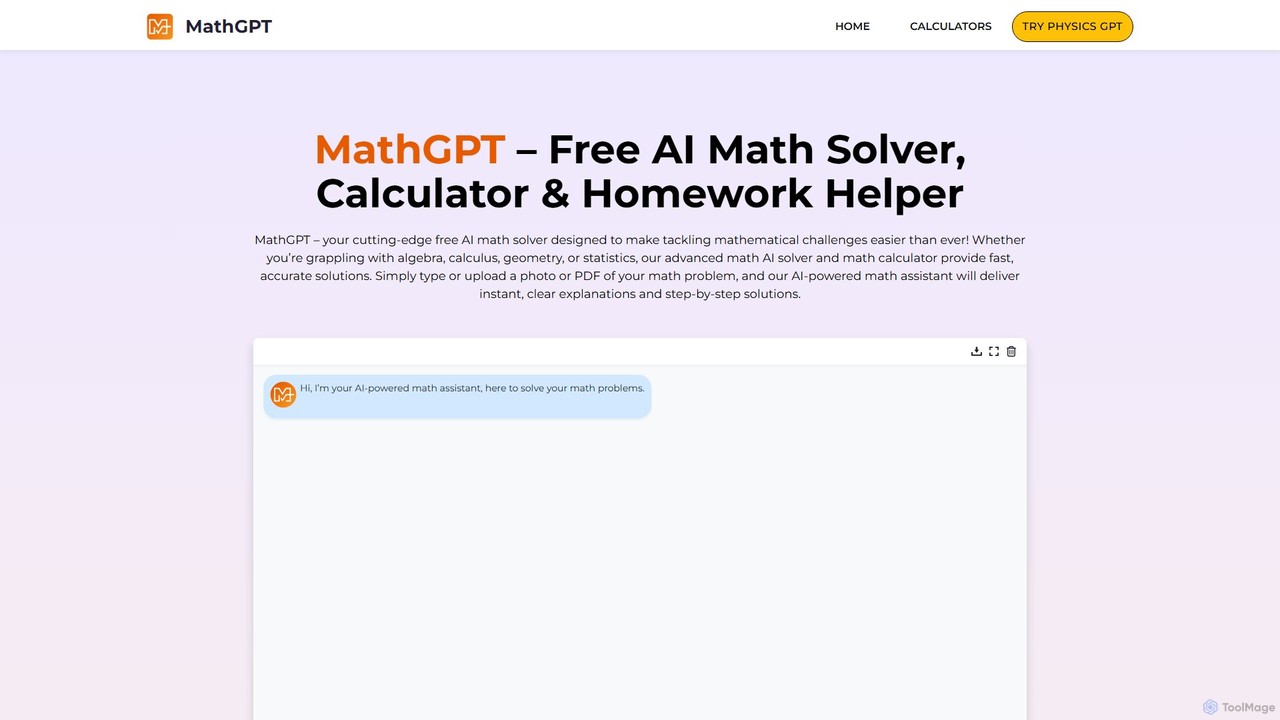
MathGPT

MathGPT is a free, AI-powered math solver and calculator designed to help students and educators. It provides instant, step-by-step solutions for a wide range of math problems, from basic arithmetic to advanced calculus. Users can input problems by typing, uploading a photo of handwritten or printed equations, or submitting a PDF document, making it a versatile homework helper and learning tool.

Homework Helper
Visits 4.3KFavorites 97Likes 104
MathGPTPro
Freemium

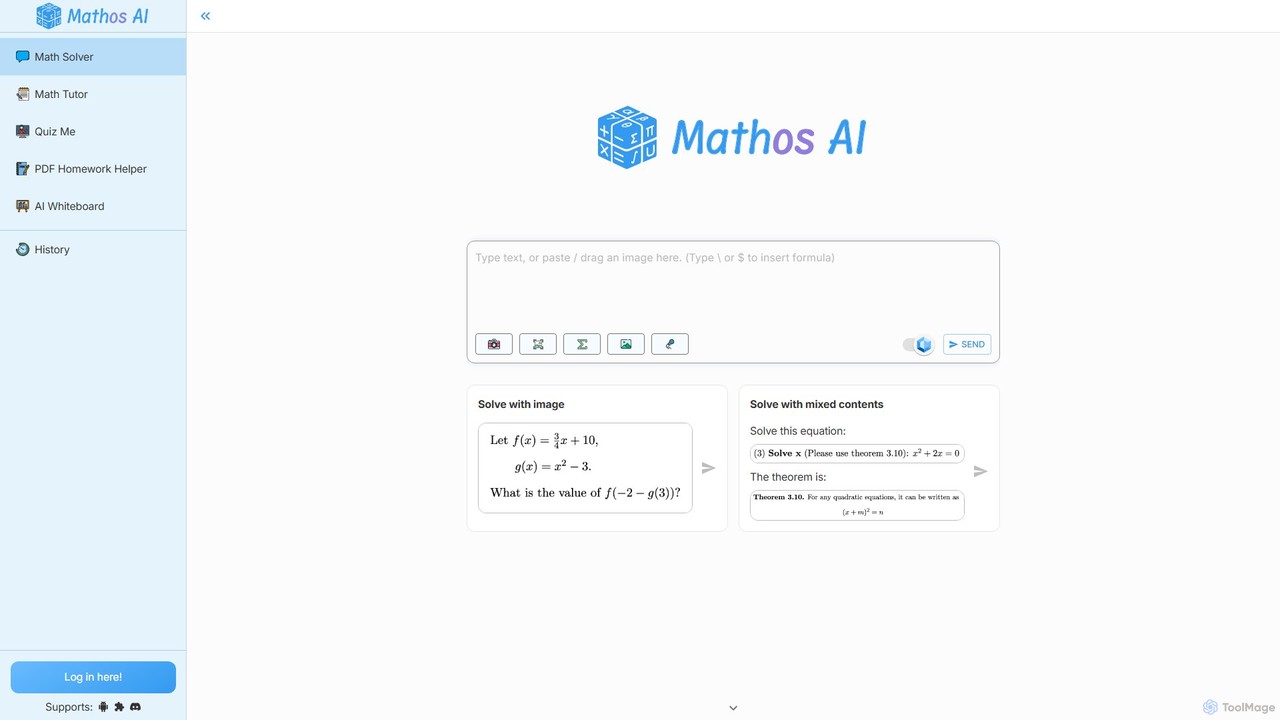
MathGPTPro

MathGPTPro (also known as Mathos) is an advanced AI-powered math solver and personal tutor designed to help students master mathematics. It provides highly accurate, step-by-step solutions for a wide range of problems, from basic algebra to advanced calculus. With features like PDF homework help, a graphing calculator, and multiple input methods (text, image, voice), it offers a comprehensive and interactive learning experience for students at all levels.

Math
Visits 711.7KFavorites 113Likes 117

About Calculator

AI Calculators are advanced computational tools that use artificial intelligence to interpret and solve complex queries expressed in natural language. They go beyond basic arithmetic, leveraging machine learning and natural language processing (NLP) to understand word problems, perform multi-step calculations, and even analyze data. This allows users to get answers to complex questions without needing to formulate precise mathematical equations. Their key value lies in making sophisticated computation accessible and conversational.

Core Features

  • Natural Language Input: Understands and processes problems written in plain English, not just mathematical syntax.
  • Multi-Step Problem Solving: Breaks down complex word problems into a logical sequence of calculations to find the solution.
  • Data Integration: Connects to spreadsheets, databases, or live data feeds to perform calculations on real-time information.
  • Symbolic Mathematics: Solves algebraic equations, derivatives, and integrals, providing symbolic answers rather than just numerical ones.
  • Contextual Understanding: Remembers previous parts of a conversation to answer follow-up questions without needing all the information again.

Applicable Scenarios

AI Calculators are widely used in fields requiring complex problem-solving. Financial analysts use them for market forecasting and investment modeling. Engineers and scientists rely on them for complex physics simulations and data analysis. Students and educators also find them valuable for learning and teaching mathematics and science by exploring problems step-by-step.

Selection Criteria

When choosing an AI Calculator, consider the specific domain it's designed for (e.g., finance, engineering, general math). Evaluate the accuracy and reliability of its results, especially for critical applications. Assess its ability to integrate with your existing data sources and tools. Finally, consider the user interface and whether it provides clear, step-by-step explanations for its calculations to ensure transparency.

Featured tool rankings

Calculator use cases

1

Financial Forecasting for Business Planning

A small business owner needs to project next quarter's revenue. Instead of complex spreadsheet formulas, they type into an AI Calculator: "Forecast Q4 revenue based on our sales data from the last three quarters, applying a 10% seasonal increase and factoring in a new $5,000 monthly marketing spend." The tool connects to their sales data, performs the trend analysis and adjustments, and provides a projected revenue figure along with a confidence interval, saving hours of manual work in a spreadsheet.

2

Solving Complex Engineering Problems

An engineering student is working on a fluid dynamics problem that involves solving a differential equation. They can state the problem in natural language, including the initial conditions and constants. For example: "Solve the differential equation dy/dx = -2y with the initial condition y(0) = 5." The AI Calculator not only provides the numerical solution but also shows the step-by-step symbolic derivation, helping the student understand the process, which is something a standard calculator cannot do.

3

Quick Data Analysis for Researchers

A social scientist has collected survey data in a spreadsheet and wants to find a quick correlation. They can upload the file to an AI Calculator and ask, "What is the Pearson correlation coefficient between 'hours of study' and 'exam score' in the attached data?" The tool processes the spreadsheet, identifies the relevant columns, performs the statistical calculation, and returns the coefficient along with an interpretation of the strength of the correlation, streamlining a task that would typically require statistical software.

4

Personal Finance and Investment Planning

A user wants to plan for retirement. They can ask an AI Calculator a complex, multi-part question like: "If I invest $500 monthly into an account with an average 7% annual return, and my current balance is $25,000, how many years will it take to reach $1 million? Adjust for an average 2.5% annual inflation." The AI tool can parse this request, apply compound interest and inflation formulas correctly, and provide a clear timeline, making complex financial planning more accessible to the average person.

5

Converting Complex Scientific Units

A chemist needs to prepare a solution and must convert units from molar concentration to mass per volume, which involves molecular weights and multiple steps. They can ask an AI Calculator: "How many grams of sodium chloride (molar mass 58.44 g/mol) are needed to make 250 mL of a 0.5 M solution?" The AI understands the context of molarity, volume, and molar mass, performs the sequential calculation (moles = Molarity * Volume, mass = moles * molar mass), and provides the final answer in grams, preventing potential manual calculation errors.

6

Real Estate Investment Comparison

An investor is comparing two rental properties. They can provide the key metrics for both to an AI Calculator in a single query: "Compare two properties. Property A: price $300k, monthly rent $2,200, annual taxes $3,600. Property B: price $350k, monthly rent $2,600, annual taxes $4,200. Which has a better capitalization rate and gross rent multiplier?" The tool will calculate and present a side-by-side comparison of these key investment metrics, allowing for a quick and informed decision without manual calculations.

Calculator FAQ

What is an AI Calculator?

An AI Calculator is an advanced computational tool that uses natural language processing (NLP) to understand and solve problems written in plain language. Unlike traditional calculators that require structured mathematical input, AI calculators can interpret word problems, perform multi-step calculations, and even connect to data sources to provide answers. They essentially act as a conversational partner for complex mathematical, scientific, or financial problem-solving.

How is an AI Calculator different from a standard scientific calculator?

The primary difference lies in the input method and problem-solving capability. A scientific calculator requires users to input precise mathematical expressions using a specific syntax. An AI Calculator, powered by NLP, accepts natural language queries. You can ask it a question like "What's the future value of a $100 monthly investment over 10 years at 5% interest?" instead of inputting a formula. AI calculators can also break down complex word problems, which standard calculators cannot do.

Who can benefit from using an AI Calculator?

A wide range of users can benefit from AI Calculators. Here are a few examples:

  • Students: For help with homework, understanding complex math and science concepts, and checking their work step-by-step.
  • Financial Professionals: For quick investment modeling, loan calculations, and forecasting without building complex spreadsheets.
  • Engineers and Scientists: For solving complex equations, converting units, and performing quick data analysis on the fly.
  • Business Owners: For making data-driven decisions by asking questions about sales projections, pricing models, and budgets.
What are the key features to look for in an AI Calculator?

When choosing an AI Calculator, consider the following features:

  • Natural Language Understanding: How well does it interpret complex, conversational questions?
  • Domain Specialization: Is it a general-purpose calculator, or is it specialized for finance, engineering, or another field? Choose one that fits your primary needs.
  • Data Integration: Can it connect to external data sources like spreadsheets (e.g., Excel, Google Sheets) or databases?
  • Step-by-Step Solutions: Does it show its work? A good AI calculator should provide a transparent breakdown of how it arrived at an answer, which is crucial for verification and learning.
  • Context Awareness: Can it handle follow-up questions without requiring you to restate all the initial information?
Are AI Calculators accurate?

Generally, AI calculators built on robust mathematical engines and large language models are highly accurate for standard calculations. However, accuracy can depend on the complexity of the query and the quality of the tool's training data. For highly specialized or critical calculations (e.g., engineering stress analysis, medical dosages), it is always recommended to verify the results. Many advanced AI calculators provide step-by-step breakdowns to allow users to check the logic and ensure the final answer is reliable.