ToolMage
Sign in

Best 1 Geology AI tools for Science

Popular Geology AI tools in Science include Mineflow, helping you work more efficiently.

Mineflow
Freemium

Mineflow

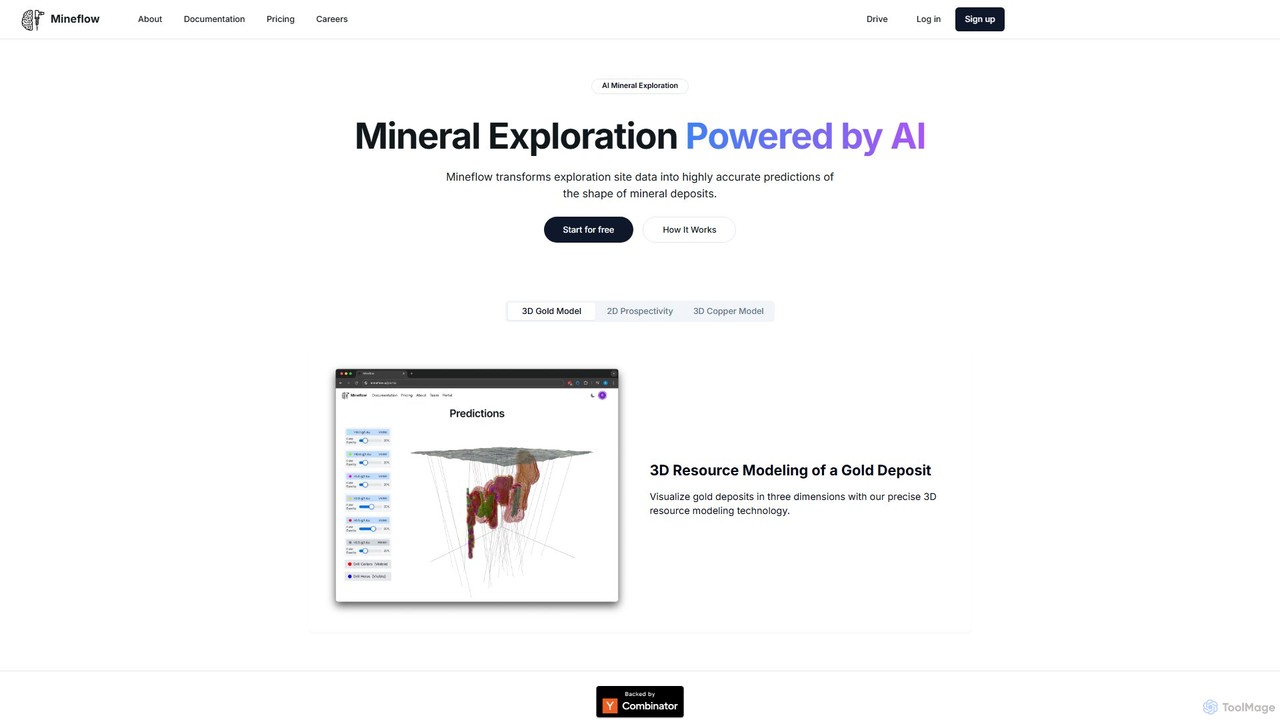
Mineflow is an AI-powered platform for mineral exploration. It transforms complex geological data from various formats into highly accurate 3D models and predictions of mineral deposit shapes and locations, streamlining workflows for geologists and mining companies.

Predictive Modeling
Visits 7.1KFavorites 127Likes 146

About Geology

Geology AI tools are advanced software solutions that leverage artificial intelligence, machine learning, and data analytics to process, interpret, and model complex geological data. These tools enhance the efficiency and accuracy of geological research, exploration, and resource management by uncovering hidden patterns and making predictive analyses. As a specialized segment within Science AI tools, they transform raw geophysical, geochemical, and remote sensing data into actionable insights.

Core Features

  • Seismic Interpretation: Automates the analysis of seismic data to identify subsurface structures, faults, and stratigraphy.
  • Mineral Prospectivity Mapping: Predicts potential locations of mineral deposits by integrating various geological datasets.
  • Well Log Analysis: Interprets well log data to characterize reservoirs, identify lithologies, and estimate petrophysical properties.
  • Geological Hazard Prediction: Models and forecasts risks associated with landslides, earthquakes, and volcanic activity.
  • Remote Sensing Data Processing: Classifies and interprets satellite and aerial imagery for geological mapping and environmental monitoring.

Applicable Scenarios

These tools are indispensable for professionals in the oil and gas industry, mining, environmental geology, and academic research. They are used for optimizing exploration strategies, assessing natural resource potential, and mitigating geological risks. For instance, an oil exploration company might use AI to rapidly process vast seismic datasets to pinpoint drilling targets, while a mining firm could employ AI for more efficient identification of new ore bodies.

How to Choose

Selecting the right Geology AI tool involves considering several factors. Evaluate the tool's compatibility with your existing data formats (e.g., seismic, well logs, GIS), the accuracy and robustness of its underlying AI models, and its integration capabilities with other geological software. Also, assess the level of domain-specific algorithms offered and the user interface's intuitiveness for geoscientists.

Geology use cases

1

Seismic Data Interpretation for Hydrocarbon Exploration

Oil and gas geophysicists utilize AI tools to rapidly interpret vast volumes of seismic data, identifying complex subsurface structures like salt domes, faults, and stratigraphic traps. By automating pattern recognition and anomaly detection, these tools significantly reduce the time required for manual interpretation, leading to more precise drilling target identification and optimized exploration strategies, ultimately increasing success rates and reducing operational costs.

2

Mineral Prospectivity Mapping for Mining Operations

Mining geologists employ AI algorithms to integrate and analyze diverse datasets, including geochemical assays, geophysical surveys, and geological maps, to generate high-resolution prospectivity maps. This allows for the prediction of new mineral deposit locations with greater accuracy, guiding targeted exploration efforts and minimizing the need for extensive, costly fieldwork. The AI identifies subtle correlations that human analysts might miss, accelerating discovery.

3

Geological Hazard Assessment for Urban Planning

Urban planners and civil engineers leverage AI tools to assess and predict geological hazards such as landslides, subsidence, and seismic risks in specific regions. By analyzing historical data, topographic features, soil properties, and climate patterns, AI models generate risk maps that inform land-use planning, infrastructure development, and emergency preparedness. This proactive approach helps in designing safer communities and resilient infrastructure.

4

Automated Well Log Analysis for Reservoir Characterization

Petroleum engineers and geologists use AI to automate the interpretation of well log data from multiple boreholes. The AI can quickly identify lithologies, fluid types, and petrophysical properties (porosity, permeability) across an entire field, even in complex or unconventional reservoirs. This automation provides a consistent and comprehensive understanding of reservoir characteristics, crucial for optimizing production and managing reserves more effectively.

5

Remote Sensing for Regional Geological Mapping

Environmental geologists and researchers apply AI to process and interpret satellite and aerial imagery for large-scale geological mapping. AI algorithms can classify different rock types, identify structural features, and detect changes in land cover related to geological processes or environmental impacts. This enables efficient and cost-effective mapping of remote or inaccessible areas, supporting environmental monitoring, resource assessment, and hazard mitigation.

6

Groundwater Flow and Contaminant Transport Modeling

Hydrologists and environmental scientists use AI-powered tools to build and refine models of groundwater flow and predict the movement of contaminants. By integrating hydrogeological data, climate information, and land-use patterns, AI can simulate complex subsurface interactions. This capability is vital for managing water resources, designing effective remediation strategies for contaminated sites, and ensuring sustainable groundwater supply for communities.

Geology FAQ

What are AI tools for Geology?

AI tools for Geology are specialized software applications that use artificial intelligence, including machine learning and deep learning, to analyze and interpret geological data. They are designed to automate complex tasks, identify patterns, and make predictions from diverse datasets like seismic surveys, well logs, satellite imagery, and geochemical analyses. These tools significantly enhance the speed and accuracy of geological investigations.

How do AI tools enhance geological research and exploration?

AI tools enhance geological research and exploration by providing capabilities beyond traditional methods. They can process massive datasets much faster, uncover subtle correlations and anomalies that human eyes might miss, and generate predictive models for resource location or hazard assessment. This leads to more efficient exploration, reduced costs, improved decision-making, and a deeper understanding of Earth's subsurface processes.

What specific tasks can AI tools perform in geology?

AI tools in geology can perform a wide range of specific tasks. These include automated interpretation of seismic data, mineral prospectivity mapping, classification of rock types from imagery, prediction of geological hazards (like landslides), analysis of well log data for reservoir characterization, and modeling of groundwater flow. They can also assist in generating geological maps and identifying environmental impacts.

How to choose the right AI tool for geological applications?

Choosing the right AI tool for geological applications requires evaluating several factors. Consider its compatibility with your specific data types (e.g., 2D/3D seismic, well logs, GIS files), the accuracy and transparency of its AI models, and its integration capabilities with existing geological software workflows. Also, assess the tool's scalability, user-friendliness, and the availability of domain-specific algorithms tailored to your geological challenges.

What's the difference between traditional geological methods and AI-powered approaches?

Traditional geological methods often rely on manual interpretation, empirical models, and expert knowledge, which can be time-consuming and subjective. AI-powered approaches, while still requiring expert input, leverage computational power to analyze vast datasets objectively, identify complex non-linear relationships, and automate repetitive tasks. This results in faster processing, enhanced accuracy, and the ability to uncover insights from data volumes that are unmanageable by traditional means, complementing and augmenting human expertise.