Information Best in category 1 results Resource AI Tool

Popular AI tools in the Resource field of Information include The Primary Caregiver, etc., helping you quickly improve efficiency.

The Primary Caregiver

The Primary Caregiver

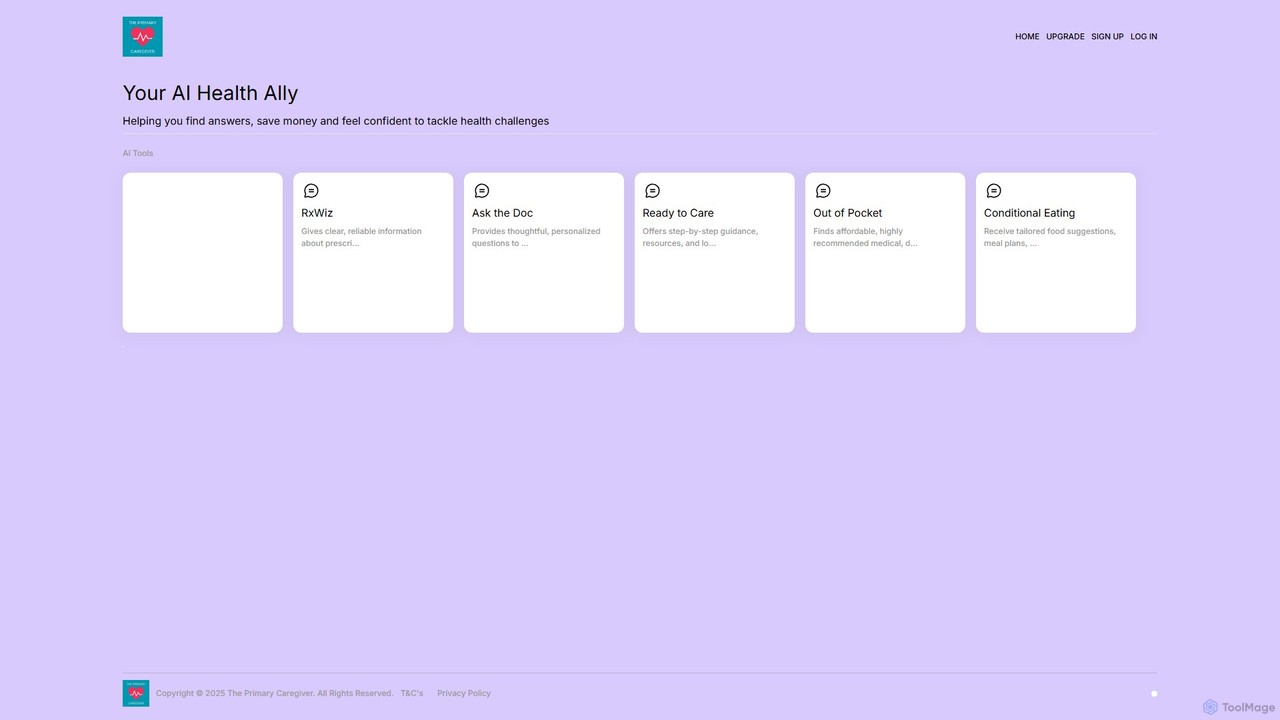
An AI-powered platform designed to assist primary caregivers by simplifying task management, providing reliable health information, and offering …

2.7K

About Resource

AI Resource tools are platforms that provide curated datasets, pre-trained models, APIs, and specialized knowledge bases for AI projects. They function as foundational building blocks, supplying the essential components needed for developing, training, and enhancing AI applications. These tools accelerate research and development by offering ready-to-use assets, eliminating the need to gather data or build models from scratch. Their primary value lies in providing high-quality, structured information that powers more complex AI systems.

Core Features

  • Curated Datasets: Provides access to high-quality, labeled datasets for training and validating machine learning models.
  • Model & API Access: Offers a library or marketplace of pre-trained AI models and APIs for easy integration into applications.
  • Knowledge Bases: Delivers structured information and knowledge graphs that AI systems can query for accurate responses.
  • Prompt Libraries: Features collections of optimized and tested prompts for achieving specific outcomes with generative AI.

Applicable Scenarios

These tools are primarily used by AI developers, data scientists, researchers, and MLOps engineers. For instance, a developer might use a resource tool to access a computer vision API to add image recognition to an app. A data scientist could source a specialized financial dataset to train a predictive model for market trends.

Selection Criteria

When choosing an AI Resource tool, consider the quality and relevance of its assets to your project. Evaluate the licensing terms and usage rights to ensure compliance, especially for commercial use. Assess the ease of integration through APIs and SDKs, and review the quality of documentation and developer support available.

ResourceUse Cases

1

Training a Custom AI Model with Specialized Datasets

A data scientist at a healthcare startup needs to build a model for detecting early signs of a specific disease from medical scans. Instead of spending months collecting and manually annotating images, they use an AI Resource tool. They access a high-quality, pre-labeled dataset of thousands of relevant scans. This allows them to focus directly on model development, training, and validation, significantly reducing the project timeline from a year to just a few months and improving the model's accuracy with verified data.

2

Integrating Third-Party AI APIs to Enhance Applications

A mobile app developer wants to add a real-time language translation feature to their social networking app. Building a translation model from scratch is complex and resource-intensive. By using an AI Resource marketplace, the developer finds a powerful, well-documented translation API. They can integrate this API with just a few lines of code, instantly providing users with high-quality translation capabilities. This approach saves significant development time and costs, allowing the team to focus on core app features.

3

Accelerating Content Creation with Prompt Libraries

A marketing team uses generative AI to create ad copy and social media visuals. However, they struggle to get consistent, high-quality results. By subscribing to an AI Resource tool that offers a prompt library, they gain access to thousands of expert-crafted, field-tested prompts for various marketing scenarios. This allows them to generate more effective and on-brand content quickly. They can now produce a week's worth of social media content in a few hours, a task that previously took several days of trial and error.

4

Powering a Chatbot with a Structured Knowledge Base

A company wants to build an internal chatbot to help employees find information about HR policies and company procedures. To ensure the chatbot provides accurate and consistent answers, they use an AI Resource tool to access a structured knowledge base. They connect their chatbot's language model to this verified information source. When an employee asks a question, the chatbot queries the knowledge base to retrieve the correct information instead of guessing. This results in a highly reliable and trusted internal support tool.

5

Sourcing Unique AI-Generated Stock Media

A digital artist and content creator needs unique visual and audio assets for their projects that stand out from generic stock libraries. They turn to an AI Resource platform specializing in generative media. Here, they can browse or generate millions of one-of-a-kind images, music tracks, and sound effects. This allows them to find the perfect, royalty-free asset that precisely matches their creative vision, something impossible with traditional stock photo sites. The result is more original and engaging content for their audience.

6

Academic Research and Rapid Prototyping

A university research team is exploring new methods in natural language processing. To test their hypotheses, they need access to various pre-trained language models. An AI Resource platform provides them with a repository of state-of-the-art models. They can quickly download and experiment with different architectures without the immense computational cost of training them from scratch. This access accelerates their research cycle, allowing them to publish findings faster and contribute to the academic community more efficiently.

ResourceFrequently Asked Questions