Information Best in category 1 results Search Engine AI Tool

Popular AI tools in the Search Engine field of Information include VoteGPT, etc., helping you quickly improve efficiency.

Free
VoteGPT

VoteGPT

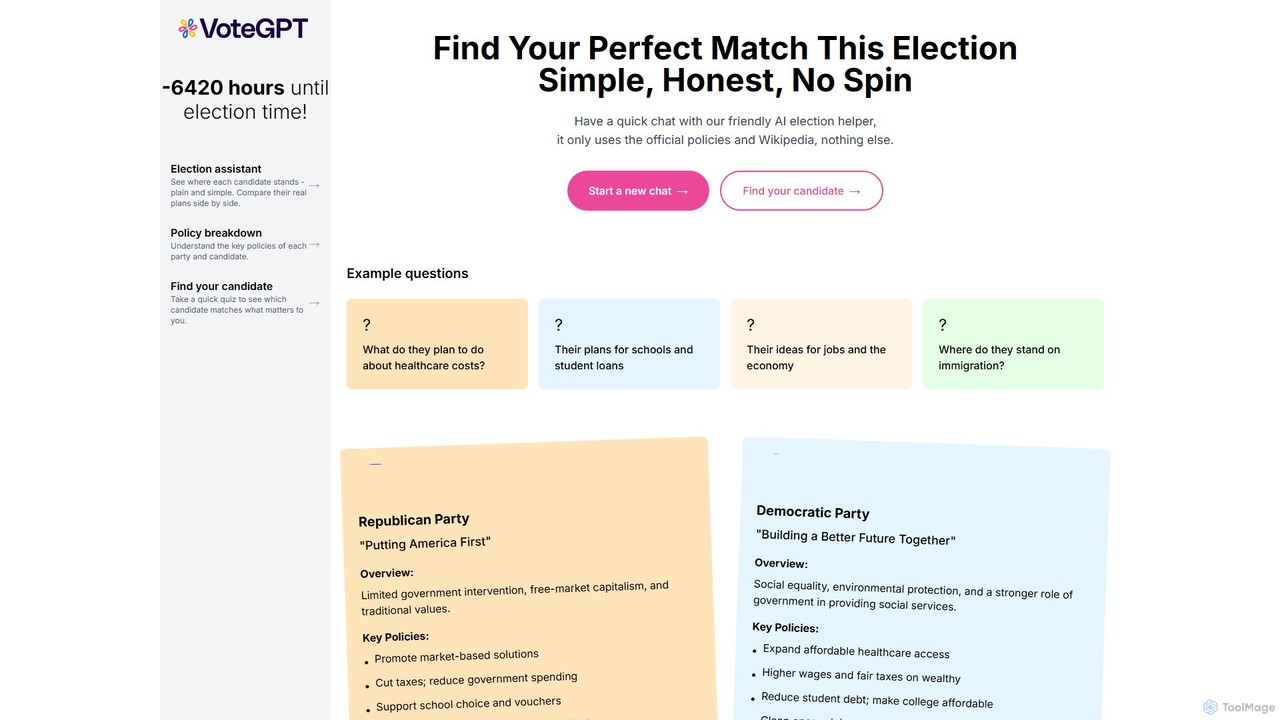
VoteGPT is an AI-powered election assistant designed to help voters make informed decisions. Through a simple chat interface, …

2.6K

About Search Engine

AI Search Engines are a new generation of information retrieval tools that provide direct, synthesized answers to user queries. Unlike traditional search engines that return a list of links, these tools use Large Language Models (LLMs) and Natural Language Processing (NLU) to understand complex questions, gather information from multiple sources, and generate a single, coherent response. This approach significantly accelerates research and learning by delivering consolidated knowledge with cited sources. They excel at answering complex, multi-faceted questions that would typically require visiting numerous websites.

Core Features

  • Answer Synthesis: Combines information from various web pages into a concise, easy-to-understand summary.
  • Natural Language Understanding (NLU): Interprets conversational and complex queries, understanding user intent beyond simple keywords.
  • Source Citation: Provides links to the original sources of information, allowing for verification and further reading.
  • Conversational Follow-up: Enables users to ask follow-up questions to refine, expand, or clarify the initial answer.
  • Multi-modal Input: Some advanced engines can process queries in formats beyond text, such as images or voice.

Use Cases

AI Search Engines are particularly valuable for students, researchers, developers, and content creators who need to quickly synthesize information. They are used for academic literature reviews, market research, complex problem-solving in programming, and fast fact-checking for articles. Their ability to provide direct answers makes them ideal for learning new topics or getting a quick overview of an unfamiliar subject.

How to Choose

When selecting an AI Search Engine, consider the accuracy and reliability of its answers by checking the quality of its source citations. Evaluate its speed and the relevance of the generated responses. Assess the user interface for ease of use, especially its conversational capabilities. Also, consider if you need a general-purpose engine or one specialized for a specific domain like scientific research or coding.

Search EngineUse Cases

1

Accelerating Academic Literature Reviews

A graduate student working on a thesis needs to understand the current state of research on a niche topic. Instead of manually searching databases and reading dozens of papers, they use an AI Search Engine. They ask, 'Summarize the key findings on quantum computing's impact on cryptography since 2020.' The engine synthesizes information from recent academic journals and pre-prints, providing a concise summary with direct links to the source papers. This allows the student to quickly identify key authors, trends, and foundational studies, saving days of preliminary research.

2

Debugging Complex Code for Developers

A software developer encounters a cryptic error message in a new programming framework. Traditional searching yields fragmented forum posts and outdated documentation. Using an AI Search Engine, they paste the entire error message and ask, 'Why am I getting this error in a Python Flask application with SQLAlchemy, and how do I fix it?' The AI analyzes the context, synthesizes solutions from Stack Overflow, official documentation, and GitHub issues, and provides a direct explanation of the problem along with a corrected code snippet. This turns a multi-hour debugging session into a quick fix.

3

Conducting Rapid Market Research

A marketing manager needs to create a presentation on emerging trends in the sustainable packaging industry. They use an AI Search Engine to ask, 'What are the top 3 trends in sustainable packaging for 2024, with statistics and key players?' The engine scans market reports, industry news, and corporate press releases to generate a bulleted list of trends, such as bioplastics and smart packaging. It includes recent statistics on market growth and names leading companies in each segment, providing cited links for verification. This allows the manager to build a data-driven presentation in a fraction of the time.

4

Planning a Detailed Travel Itinerary

A family is planning a 7-day trip to Italy and feels overwhelmed by the options. They use an AI Search Engine with a conversational query: 'Create a 7-day itinerary for a family with two teenagers visiting Rome and Florence for the first time, focusing on history but also including fun activities.' The AI generates a day-by-day plan, suggesting historical sites like the Colosseum, museums like the Uffizi Gallery, and teen-friendly activities like a pizza-making class. It also provides logistical advice on train travel between cities and suggests restaurants, all synthesized from travel blogs, guidebooks, and review sites.

5

Learning a New Complex Skill

An aspiring musician wants to learn music theory but finds textbooks dense and confusing. They use an AI Search Engine to ask questions like, 'Explain the circle of fifths in simple terms for a guitarist' or 'What are some common chord progressions in pop music?' The engine provides clear, synthesized explanations with diagrams and practical examples relevant to their instrument. They can ask follow-up questions like 'How does that apply to the key of G major?' to deepen their understanding. This creates a personalized, interactive learning experience that is more effective than passive reading.

6

Drafting and Fact-Checking Content

A content creator is writing a blog post about the health benefits of the Mediterranean diet. They use an AI Search Engine to quickly gather information. They ask, 'What are the scientifically proven benefits of the Mediterranean diet, with links to studies?' The engine provides a summarized list of benefits like improved heart health and reduced risk of certain diseases, each supported by citations to medical journals. The creator can then use this synthesized, pre-verified information to draft their article confidently and efficiently, ensuring the content is accurate and well-sourced from the start.

Search EngineFrequently Asked Questions