ToolMage
Sign in

Best 1 Platform for Information

Popular Platform in Information include cAImpare, helping you work more efficiently.

cAImpare

cAImpare

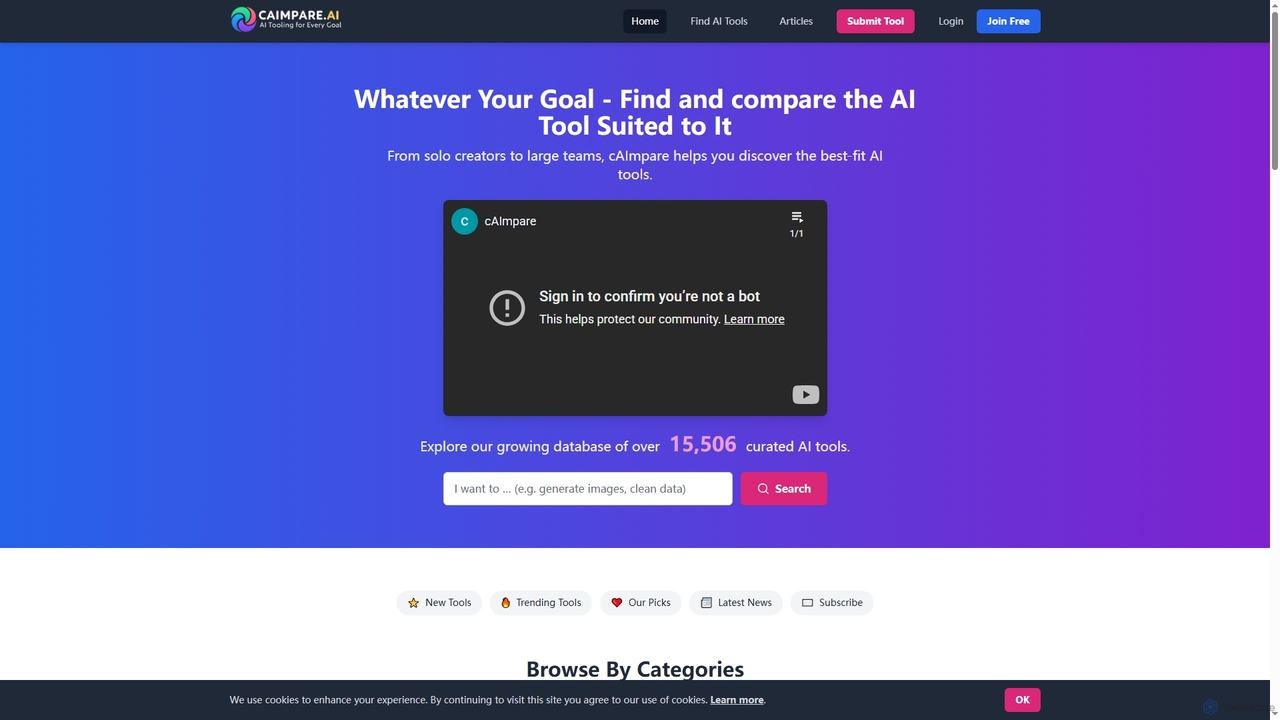
cAImpare is a leading AI tool discovery and comparison platform, offering a vast, curated database of over 20,000 AI tools. It helps individuals and teams efficiently find, evaluate, and select the best-fit AI solutions for any goal, from creative tasks to complex business operations, emphasizing real-world performance and practical applications.

Directory
Visits 3.5KFavorites 113Likes 112

About Platform

AI Platforms are comprehensive, integrated environments designed to facilitate the entire lifecycle of artificial intelligence development, from data preparation to model deployment and management. Within the broader 'Information' category, these platforms serve as the foundational infrastructure, enabling users to process, analyze, and generate information through advanced AI models. They provide a robust ecosystem of tools, APIs, and computational resources, empowering developers and enterprises to build, scale, and operationalize intelligent applications efficiently.

Core Features

  • End-to-End Development: Offers tools for data ingestion, model training, evaluation, and deployment within a single environment.
  • Scalable Infrastructure: Provides access to powerful computing resources (GPUs, TPUs) for handling large datasets and complex models.
  • MLOps Capabilities: Supports model versioning, monitoring, retraining, and lifecycle management for production AI systems.
  • API & SDK Access: Enables seamless integration of AI functionalities into existing applications and workflows.
  • Pre-trained Models & Services: Often includes a library of ready-to-use AI models or services for common tasks like NLP or computer vision.

Applicable Scenarios

AI Platforms are indispensable for organizations and individuals looking to build, deploy, and manage custom AI solutions at scale. They are widely adopted in enterprise settings for digital transformation, by startups for rapid AI product development, and by research institutions for advanced machine learning experiments.

How to Choose

Selecting an AI Platform requires evaluating several factors: the range of supported AI/ML frameworks, scalability options for data and compute, ease of integration with existing systems, MLOps features for production readiness, and the pricing model. Consider also the availability of pre-built services and the platform's community support.

Featured tool rankings

Platform use cases

1

Develop Custom Machine Learning Models

Data scientists leverage AI platforms to build, train, and validate bespoke machine learning models tailored to unique business challenges. By utilizing the platform's integrated tools for data preprocessing, algorithm selection, and hyperparameter tuning, they can rapidly iterate on model designs, achieving optimal performance for tasks like fraud detection or personalized recommendations, significantly reducing development cycles.

2

Automate Business Processes with AI

Enterprises integrate AI models deployed on platforms into their core business processes, such as intelligent document processing, customer service automation, or predictive maintenance. For instance, a manufacturing company can deploy a predictive maintenance model to analyze sensor data from machinery, anticipating failures before they occur and reducing costly downtime by up to 30%.

3

Manage AI Model Lifecycle (MLOps)

MLOps engineers and IT teams utilize AI platforms to manage the entire lifecycle of hundreds of AI models in production. This includes version control for models and data, continuous integration/continuous deployment (CI/CD) for AI, performance monitoring, and automated retraining. This ensures models remain accurate, secure, and compliant with regulatory standards, minimizing operational risks and maximizing model effectiveness.

4

Accelerate AI-Powered Product Development

Startups and product teams leverage AI platforms to rapidly prototype, develop, and launch new AI-powered products and features. By providing pre-built components, scalable infrastructure, and easy API access, these platforms allow teams to focus on innovation rather than infrastructure management. This significantly reduces time-to-market for AI-driven applications like intelligent chatbots, recommendation engines, or content generation tools.

5

Enable Advanced Data Analysis and Insights

Researchers and data analysts utilize AI platforms to process and analyze massive datasets, extracting complex insights that would be impossible with traditional methods. The platforms provide powerful computational resources and advanced analytical tools, allowing users to run sophisticated AI algorithms for pattern recognition, anomaly detection, and predictive modeling across various domains, from scientific research to financial forecasting.

6

Facilitate Collaborative AI Development

Teams of developers, data scientists, and domain experts use AI platforms to collaborate seamlessly on complex AI projects. Features like shared workspaces, version control for code and models, and integrated communication tools enable efficient teamwork. This fosters innovation and ensures consistency across different stages of AI development, from initial experimentation to large-scale deployment, improving project delivery speed and quality.

Platform FAQ

What are AI Platforms?

AI Platforms are integrated software environments that provide a comprehensive suite of tools and services for building, deploying, and managing artificial intelligence and machine learning models. They typically feature capabilities for data preparation, model training, MLOps, and API integration. These platforms empower developers and organizations to operationalize AI solutions efficiently, transforming raw data into actionable insights and intelligent applications across various industries.

How do AI Platforms differ from individual AI tools?

AI Platforms offer an integrated, end-to-end environment for the entire AI lifecycle, providing a cohesive suite of tools for data management, model development, deployment, and MLOps. In contrast, individual AI tools typically focus on a single, specific task, such as a standalone image recognition API or a text generation library. While individual tools offer specialized functionality, platforms provide the comprehensive infrastructure and orchestration needed for scalable, production-grade AI solutions, simplifying complex workflows and reducing integration overhead.

What are the key components of a typical AI Platform?

A typical AI Platform comprises several key components. These include data management tools for ingestion, storage, and preprocessing; development environments for model building and training (often supporting various frameworks like TensorFlow or PyTorch); compute resources for scalable processing; MLOps capabilities for deployment, monitoring, and governance; and APIs/SDKs for integrating AI functionalities into applications. Some platforms also offer pre-trained models or AI services for common tasks, accelerating development.

Who benefits most from using AI Platforms?

AI Platforms primarily benefit data scientists, machine learning engineers, and enterprise development teams. Data scientists gain robust environments for model experimentation and training, while ML engineers leverage MLOps features for efficient deployment and management. Enterprises benefit from accelerated digital transformation, enabling them to integrate AI into various business functions, from customer service to supply chain optimization, leading to improved efficiency, innovation, and competitive advantage.

How to choose the right AI Platform for my project?

Choosing the right AI Platform involves assessing several critical factors. First, consider the range of AI/ML frameworks and libraries supported, ensuring compatibility with your existing tech stack. Evaluate the platform's scalability for both data storage and computational power, crucial for handling growing workloads. Look for robust MLOps features, including model versioning, monitoring, and automated retraining. Integration capabilities with other enterprise systems, security features, and the pricing model are also vital. Finally, assess the ease of use and the availability of community or vendor support.