It Best in category 1 results Compliance Management AI Tool

Popular AI tools in the Compliance Management field of It include Swif.ai, etc., helping you quickly improve efficiency.

Swif.ai

Swif.ai

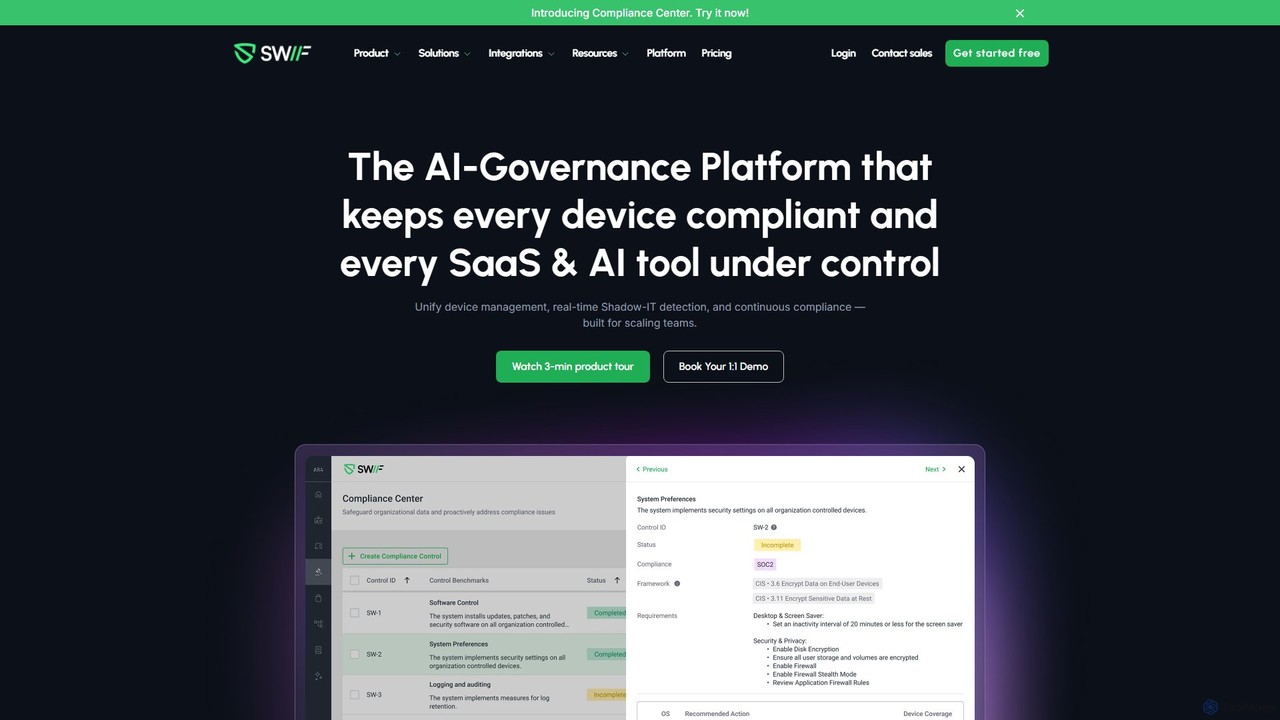
Swif.ai is an AI-powered governance platform that unifies device management (MDM), continuous compliance, and Shadow IT detection. It's …

34.4K

About Compliance Management

Compliance Management tools are a specialized category of software that uses artificial intelligence to automate adherence to legal, regulatory, and internal policy requirements. These platforms leverage machine learning and natural language processing to continuously monitor data, systems, and user activities for potential violations. They help organizations proactively identify risks, streamline audits, and maintain an up-to-date understanding of complex, evolving regulations like GDPR or HIPAA. This automated approach significantly reduces manual effort and minimizes the risk of costly non-compliance penalties.

Core Features

  • Regulatory Intelligence: Automatically tracks and interprets changes in global laws and standards.
  • Automated Monitoring: Continuously scans systems, data, and communications for policy deviations.
  • Predictive Risk Analysis: Identifies potential compliance risks before they escalate into incidents.
  • Automated Reporting: Generates customizable reports for internal audits and regulatory bodies.
  • Policy Lifecycle Management: Manages the creation, distribution, and enforcement of internal policies.

Applicable Scenarios

These tools are critical in highly regulated industries such as finance (for SOX, FINRA), healthcare (for HIPAA), and technology (for GDPR, CCPA). Compliance officers, IT security teams, and legal departments use them to manage data privacy, monitor financial transactions, secure patient information, and ensure adherence to cloud security standards like SOC 2.

Selection Criteria

When selecting a tool, consider its specific regulatory coverage—does it support the standards you need? Evaluate its integration capabilities with your existing IT infrastructure, such as cloud services and HR systems. Also, assess the sophistication of its AI models for risk detection and the flexibility of its reporting and dashboarding features.

Compliance ManagementUse Cases

1

Automating GDPR & CCPA Data Privacy Audits

A Data Protection Officer (DPO) at a multinational e-commerce company is responsible for ensuring continuous compliance with GDPR and CCPA. Instead of performing manual spot-checks, the DPO uses an AI Compliance Management tool to automate the process. The tool connects to the company's databases, cloud storage, and SaaS applications, using natural language processing to identify and classify Personally Identifiable Information (PII). It continuously scans for non-compliant data handling, such as unencrypted PII or unauthorized data transfers, and generates real-time alerts. This allows the DPO to remediate issues instantly and produce comprehensive audit reports in minutes, saving hundreds of hours of manual work.

2

Monitoring Financial Communications for Compliance

A compliance officer at a large investment bank needs to monitor thousands of daily communications (emails, chat messages) to prevent insider trading and ensure adherence to FINRA regulations. Manually reviewing this volume is impossible. The firm implements an AI Compliance tool that uses Natural Language Understanding (NLU) to analyze all communications in real-time. The AI is trained to detect suspicious language, patterns of communication between specific individuals, and discussion of non-public information. When a potential violation is flagged, it is automatically routed to the compliance officer with a risk score and context, allowing for immediate investigation and intervention, drastically reducing regulatory risk.

3

Ensuring HIPAA Compliance in Healthcare IT

A hospital's IT administrator is tasked with protecting Electronic Health Records (EHR) and ensuring HIPAA compliance. A major risk is unauthorized access to patient data by staff. They deploy an AI Compliance Management platform that integrates with their EHR system. The AI establishes a baseline of normal access patterns for each role (e.g., doctors, nurses, billing staff). It then monitors all access logs in real-time, using anomaly detection to flag suspicious activities, such as a nurse accessing records of a patient not under their care or an employee accessing an unusually high number of records. This proactive monitoring helps prevent data breaches before they occur and provides a clear audit trail for HIPAA reporting.

4

Automating Cloud Security Compliance (SOC 2)

A DevOps team at a SaaS company must maintain SOC 2 compliance to assure clients of their security posture. This requires continuous monitoring of their cloud infrastructure (AWS, Azure, GCP). They use an AI Compliance tool that automates this process. The tool continuously scans cloud configurations, IAM policies, network settings, and data storage buckets against hundreds of SOC 2 controls. It uses AI to identify misconfigurations that could lead to vulnerabilities, such as public S3 buckets or overly permissive firewall rules. Instead of periodic manual audits, the team receives real-time alerts and automated remediation suggestions, ensuring they are always audit-ready and significantly reducing the time and effort required for SOC 2 certification.

5

Managing Internal Policy Adherence Across a Large Enterprise

An HR department in a global corporation with 50,000 employees struggles to ensure everyone completes mandatory annual training (e.g., code of conduct, anti-harassment). They use an AI Compliance platform to manage the entire policy lifecycle. The platform automates the distribution of new policies and training materials, tracks employee acknowledgment and completion rates in real-time, and sends intelligent, personalized reminders to those who are overdue. The AI can also analyze acknowledgment data to identify departments or regions with low compliance rates, allowing HR to target their intervention efforts more effectively. This automates a massive administrative burden and provides a defensible record of compliance efforts.

6

Streamlining Third-Party Risk and Compliance

A manufacturing company works with hundreds of global suppliers and must ensure they comply with ethical sourcing, anti-bribery, and environmental regulations. Manually vetting and monitoring each supplier is a monumental task. The company's procurement team uses an AI Compliance tool to automate third-party risk management. The tool continuously monitors public data sources, news, and legal databases for any negative information related to their suppliers. It also automates the distribution and collection of compliance questionnaires and certifications. The AI provides a dynamic risk score for each supplier, allowing the team to focus their due diligence on high-risk partners and maintain a compliant and ethical supply chain.

Compliance ManagementFrequently Asked Questions