ToolMage
Sign in

Best 1 Translation AI tools for Language Learning

Popular Translation AI tools in Language Learning include Question AI, helping you work more efficiently.

Question AI
Freemium

Question AI

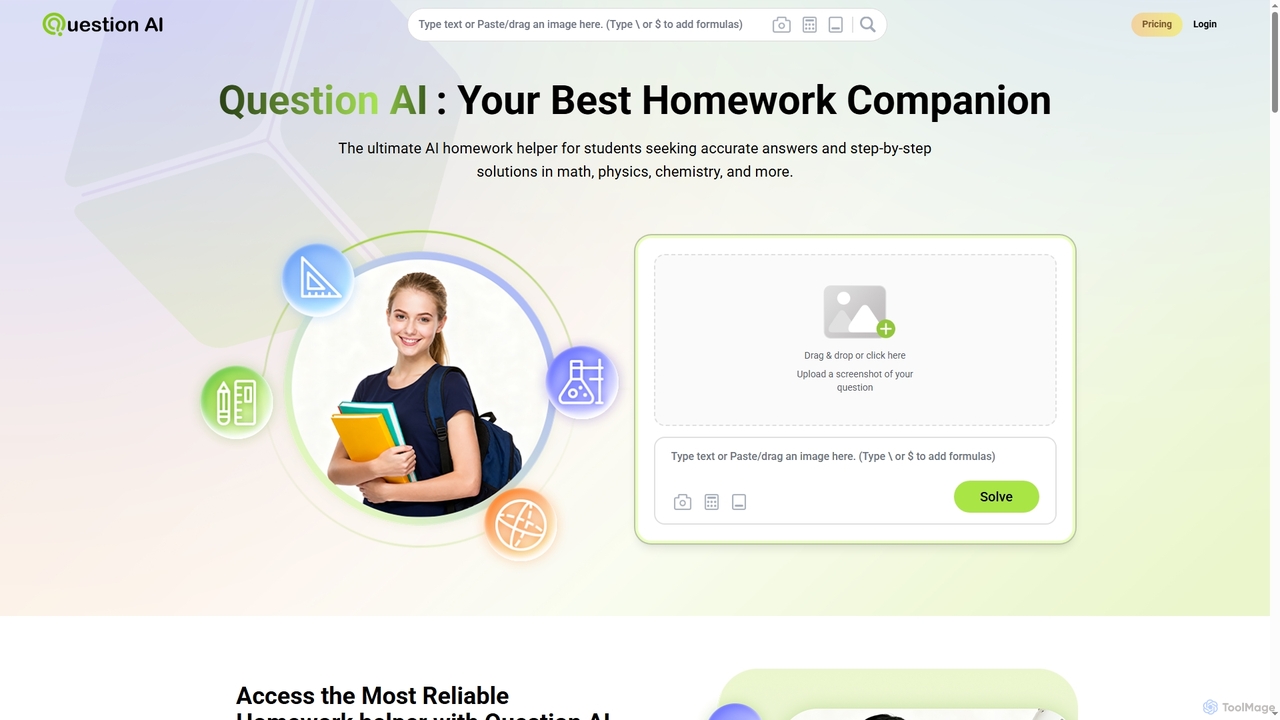
Question AI is an advanced AI homework helper designed for students to get accurate, step-by-step solutions across a wide range of subjects. It covers math, physics, chemistry, literature, history, and programming, offering flexible input options and multilingual support. With reported accuracy up to 98%, it aims to simplify academic challenges and enhance understanding for learners worldwide.

Homework Assistance
Visits 7.1KFavorites 188Likes 167

About Translation

AI Translation tools are applications that use neural machine translation (NMT) and other advanced models to automatically convert text or speech from a source language to a target language. They analyze context, grammar, and idiomatic expressions to produce more natural and accurate translations than traditional methods. These tools are widely used for instant communication, content localization, and accessing information across linguistic barriers. Their key advantage lies in their speed, scalability, and ability to continuously improve through machine learning.

Core Features

  • Neural Machine Translation (NMT): Utilizes deep learning models to understand sentence context for fluent and highly accurate translations.
  • Real-time Speech Translation: Instantly translates spoken words during conversations, meetings, or presentations.
  • Document Translation: Preserves the original formatting of files like PDFs, Word documents, and presentations while translating the text.
  • Glossary & Tone Customization: Allows users to define specific terminology and select a desired tone (e.g., formal, informal) for brand consistency.
  • API Integration: Enables developers to embed translation capabilities directly into websites, applications, and business workflows.

Use Cases

These tools are essential in international business, global marketing, multilingual customer support, and academic research. For instance, an e-commerce company can use them to localize product descriptions for different markets, while a support team can communicate with international customers in their native language in real-time.

How to Choose

When selecting an AI translation tool, first consider the required language pairs and their translation quality. Evaluate its integration capabilities with your existing software (e.g., CRM, CMS). Also, assess the security protocols for handling sensitive data and the pricing model, which could be based on character count, per user, or a flat subscription.

Translation use cases

1

Localizing Marketing Content for Global Campaigns

A marketing team for a software company needs to launch a new product in Japan, Germany, and Brazil. They use an AI translation tool with glossary features to ensure brand terms are translated consistently. They upload their English website copy, ad creatives, and press releases, and the tool generates localized versions in minutes while preserving the layout. This process accelerates their go-to-market timeline by over 90% compared to traditional manual translation workflows.

2

Localizing Marketing Content for Global Campaigns

A marketing manager preparing to launch a product in several new international markets uses an AI translation tool to adapt website copy, social media posts, and advertising materials. By creating a custom glossary, they ensure that the brand name, slogans, and key product features are translated consistently and accurately across all content. This process allows them to rapidly generate localized materials for each target region, significantly reducing the time-to-market and avoiding the high costs associated with hiring translation agencies for every language, while maintaining brand integrity on a global scale.

3

Facilitating Real-time Multilingual Customer Support

A customer support team for a global e-commerce platform integrates an AI translation API into their helpdesk software. When a customer submits a support ticket in Spanish, the system automatically translates it into English for the agent. The agent can then write their response in English, and the tool instantly translates it back into Spanish for the customer. This enables a small, centralized support team to provide seamless, real-time assistance to customers worldwide, improving first-response times and customer satisfaction without the need to hire native speakers for dozens of languages.

4

Providing Real-time Multilingual Customer Support

A customer support agent for an online travel agency receives a query in Korean via live chat. The agent, who only speaks English, uses an integrated AI translation tool. The tool instantly translates the customer's message into English and the agent's reply back into natural-sounding Korean. This allows a small support team to handle global inquiries 24/7 without hiring multilingual staff, improving first-response time and overall customer satisfaction.

5

Translating Legal and Technical Documents at Scale

A legal firm needs to review a large volume of contracts written in French for a due diligence process. Using an AI translation tool specialized in legal terminology, paralegals can quickly get a high-quality draft translation of hundreds of pages. This allows them to identify key clauses and potential issues rapidly. While a human lawyer performs the final review for critical accuracy, the AI handles the initial bulk work, reducing project costs and turnaround time significantly.

6

Translating Legal and Technical Documents with Precision

A paralegal at a law firm needs to review a contract written in German. Instead of waiting days for a human translator, they use an AI document translation tool. They upload the PDF, and within minutes, receive a fully translated version in English that preserves the original formatting, including tables and headers. While this initial translation is used for preliminary review and to quickly grasp the key clauses, it significantly speeds up the workflow. The tool's ability to handle specific legal terminology ensures a high-quality first draft, which can then be passed to a legal expert for final validation.

7

Enhancing International Team Collaboration

A project manager leads a distributed team with members in Japan, Brazil, and Germany. They use a translation tool integrated into their chat platform (like Slack or Microsoft Teams). When a team member from Japan posts an update in Japanese, the tool automatically displays a translation in English, Portuguese, and German for the other members. This eliminates communication delays and misunderstandings caused by language differences. It fosters a more inclusive and efficient environment where all team members can contribute and understand discussions in real-time, regardless of their native language.

8

Facilitating International Team Collaboration

A distributed engineering team with members in the US, India, and Ukraine uses a collaboration platform with a built-in AI translation plugin. When a Ukrainian developer posts a technical update in their native language, the plugin automatically translates it into English for other team members. This removes communication barriers in daily stand-ups and project channels, ensuring everyone stays aligned regardless of their primary language and fostering a more inclusive work environment.

9

Accelerating Academic Research and Literature Review

A university researcher is studying a niche topic where key papers have been published in Korean and French. Using an AI translation tool, they can quickly translate the abstracts and conclusions of dozens of papers to identify the most relevant ones for their study. For critical papers, they use the document translation feature to get a full English version. This allows them to access a global pool of knowledge that would otherwise be inaccessible, broadening the scope of their literature review and helping them stay current with international research trends without needing to be fluent in multiple languages.

10

Accelerating Academic Research and Literature Review

A university researcher is studying climate change models published in German and Chinese scientific journals. They use an AI document translation tool to convert entire PDF research papers into English. The tool accurately translates complex scientific terms and data tables, allowing the researcher to access and synthesize a much broader range of global research than would be possible otherwise. This process enriches their literature review and helps identify novel cross-regional findings.

11

Enabling Instant Voice Translation for International Travel

A tourist traveling in Vietnam uses a mobile AI translation app on their smartphone. When asking for directions or ordering food, they speak into their phone in English. The app instantly plays back the translation in Vietnamese through the phone's speaker. The local person can then reply in Vietnamese, and the app translates it back to English for the tourist. This facilitates smooth, real-time conversations, overcoming language barriers for essential daily interactions and making travel more accessible.

12

On-the-Go Communication for International Travel

An international traveler uses a mobile translation app on their smartphone to navigate a foreign country. When trying to buy a train ticket, they use the speech-to-speech feature to ask the clerk for a ticket to their destination. The app translates their English into the local language for the clerk and then translates the clerk's response back into English. They also use the camera translation feature to instantly translate menus at restaurants and signs on the street. This empowers the traveler to communicate effectively for essential tasks, making their trip smoother and more enjoyable without prior language knowledge.

Translation FAQ

What are AI Translation tools?

AI Translation tools are software applications that use artificial intelligence, primarily neural machine translation (NMT), to automatically convert text or speech between languages. Unlike older rule-based systems, they analyze the full context of a sentence to produce more accurate, fluent, and natural-sounding translations. They are designed for tasks ranging from instant communication to professional document localization.

What are AI Translation tools?

AI Translation tools are applications that use artificial intelligence, specifically a technology called Neural Machine Translation (NMT), to automatically translate content. Unlike older rule-based systems, NMT models analyze the entire context of a sentence to produce translations that are more accurate, fluent, and natural-sounding. They can handle various types of content, including text, speech, and entire documents, making them powerful aids for overcoming language barriers in many different scenarios.

How to choose the right AI Translation tool?

To select the best tool for your needs, consider these key factors:

  • Accuracy and Domain: Check if the tool performs well for your specific industry (e.g., legal, medical, creative). Some tools offer specialized models.
  • Language Support: Ensure it covers all the language pairs you require, including less common ones if needed.
  • Features: Determine if you need document translation with format preservation, real-time conversation modes, API access, or glossary management.
  • Security and Privacy: For sensitive information, choose a tool with strong data encryption and clear privacy policies.
  • Cost and Scalability: Compare pricing models (free, subscription, pay-per-use) and ensure the tool can handle your expected volume of translation.
How do I choose the right AI Translation tool?

To choose the right tool, first assess your primary need: is it for real-time conversation, document translation, or website localization? Then, consider these factors:

  • Language Support: Ensure it offers high-quality translation for your required language pairs.
  • Accuracy & Context: Look for tools using advanced NMT models and check reviews on their accuracy for your specific domain (e.g., legal, medical).
  • Features: Determine if you need document format preservation, API access for integration, or glossary customization for brand consistency.
  • Security: For confidential information, choose a tool with strong data encryption and clear privacy policies.
What's the difference between AI Translation and traditional machine translation?

The main difference lies in the underlying technology. Traditional machine translation (like Statistical Machine Translation, SMT) often translated phrases or words in isolation, leading to grammatically awkward and contextually poor results. AI Translation, powered by Neural Machine Translation (NMT), processes entire sentences as a single unit. This allows it to learn grammar, syntax, and context, resulting in significantly more accurate and human-like translations.

What is the difference between AI translation and human translation?

The primary difference lies in speed, cost, and nuance. AI translation is extremely fast and cost-effective, making it ideal for translating large volumes of text quickly and for understanding the general meaning of a document (gisting). Human translation, performed by professional linguists, is superior for tasks that require creativity, cultural adaptation (localization), and absolute precision, such as marketing copy, legal contracts, or literary works. A common professional workflow involves using AI for a first-pass translation, which is then reviewed and refined by a human editor (a process called post-editing).

Can AI Translation replace human translators?

AI translation is a powerful tool for speed and scale, ideal for getting the gist of a text, handling large volumes of content, or facilitating real-time communication. However, for high-stakes content requiring nuance, cultural adaptation, and creativity (like marketing slogans, legal contracts, or literature), human translators remain essential. The most effective workflow often involves using AI for a first draft, followed by human post-editing (a process known as MTPE).

Can AI Translation tools handle different file formats?

Yes, many advanced AI Translation tools are specifically designed to handle a wide variety of file formats while preserving the original layout. Common supported formats include Microsoft Word (.docx), PowerPoint (.pptx), Excel (.xlsx), PDF, HTML, and subtitle files (.srt). This capability is crucial for businesses and professionals who need to translate reports, presentations, websites, or technical manuals without the time-consuming task of manually reformatting the translated content. However, the quality of format preservation can vary between tools, especially with complex PDF layouts.

How do AI Translation tools relate to Language Learning?

While their primary function is translation, not teaching, these tools are valuable aids in language learning. Learners can use them to quickly look up unknown words or phrases in context, check their own writing for accuracy, or listen to the pronunciation of translated text. They act as a practical support tool for comprehension and expression, complementing structured learning platforms by providing instant, real-world language assistance rather than formal lessons.

How do AI Translation tools relate to Language Learning?

While primarily designed for translation, these tools can serve as useful aids in language learning. Learners can use them to quickly look up unknown words or phrases in context, which is often more effective than a simple dictionary. They can also be used for practice by translating a sentence and comparing their version to the AI's output to identify errors or alternative phrasings. However, it's important to use them as a supplement, not a replacement for core learning methods. Over-reliance can hinder the development of genuine comprehension and production skills, which are the goals of language learning.