ToolMage
Sign in

Best 2 Adventure AI tools for Lifestyle

Popular Adventure AI tools in Lifestyle include Exploresoul and Local Buddy, helping you work more efficiently.

Exploresoul
Free

Exploresoul

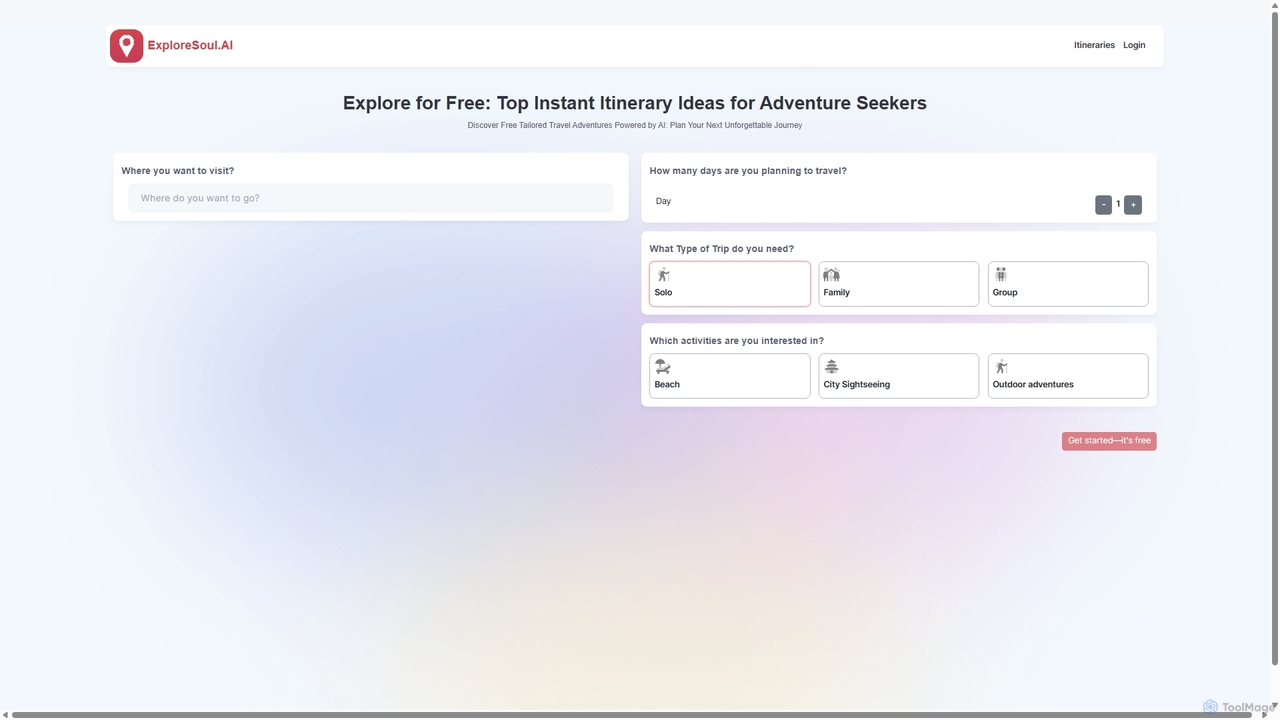
Exploresoul is an AI-powered travel planner that instantly creates personalized, detailed itineraries for free. Simply input your destination, travel dates, trip type, and interests, and let the AI craft a unique adventure for you. Ideal for solo travelers, families, and groups seeking tailored travel experiences.

Adventure
Visits 5.8KFavorites 142Likes 119
Local Buddy
Free

Local Buddy

Local Buddy is an AI-powered travel planner app that creates personalized itineraries filled with local favorites, hidden gems, and unique experiences. Tailor your trip by destination, duration, season, and party size for a truly authentic and stress-free adventure.

Adventure
Visits 5.7KFavorites 120Likes 108

About Adventure

AI Adventure tools are a class of applications that use artificial intelligence to generate interactive stories, personalized journeys, and unique exploratory experiences. These tools often leverage generative models and procedural content generation to create dynamic narratives, characters, and environments that respond to user input. Their primary value lies in offering highly replayable and personalized adventures, whether in a virtual world or for real-world travel planning. This approach transforms passive consumption into active participation, making each user's experience distinct.

Core Features

  • Dynamic Narrative Generation: Creates branching storylines and plot points in real-time based on user choices.
  • Procedural World Building: Automatically generates unique maps, environments, and quests for exploration.
  • AI-Powered Characters (NPCs): Populates worlds with non-player characters that have dynamic behaviors and dialogues.
  • Personalized Itinerary Planning: Crafts custom travel plans and activity suggestions based on user preferences, budget, and time.

Use Cases

These tools are ideal for game developers, writers, educators, and travelers. For instance, a writer can quickly prototype an interactive novel, a game master can generate on-the-fly content for a tabletop RPG session, and a traveler can receive a unique itinerary for a spontaneous trip. They are also used in education to create immersive historical or scientific simulations.

How to Choose

When selecting an AI Adventure tool, consider the type of experience you want: text-based, 2D/3D visual, or real-world planning. Evaluate the level of customization and control offered over the generated content. Also, check for platform compatibility (web, desktop, mobile) and the strength of the community for sharing creations and support.

Adventure use cases

1

Create a Personalized Text-Based RPG

A hobbyist game developer or writer wants to create an interactive fantasy story without coding. They use an AI Adventure tool to define a basic premise, such as 'a detective in a magical city.' The AI then generates a world, complex characters with their own motivations, and a branching narrative. The creator can guide the AI to refine plot points or introduce new elements, resulting in a unique, playable text adventure that can be shared with others. This process reduces development time from months to days.

2

Plan a Spontaneous Weekend Getaway

A traveler wants to plan a last-minute road trip but is overwhelmed by options. They use an AI Adventure tool focused on travel. They input their starting location, a budget of $300, interests in 'hiking' and 'local breweries,' and a timeframe of two days. The AI analyzes real-time data on weather, traffic, and opening hours to generate a complete, optimized itinerary. It suggests a scenic route, books a budget-friendly hotel, and schedules visits to a national park and three top-rated breweries, including estimated travel times and costs, all within minutes.

3

Generate On-the-Fly Content for Tabletop RPGs

A Game Master (GM) is running a Dungeons & Dragons session. The players decide to visit a tavern the GM hadn't prepared. Instead of pausing the game, the GM uses an AI Adventure tool. They input 'rowdy port tavern, secret smuggler's den in the back.' The AI instantly generates a description of the tavern, a name and personality for the bartender, a list of interesting patrons, and a rumor that leads to a new quest. This allows the GM to react dynamically to player choices, creating a more immersive and seamless world.

4

Design an Interactive Educational Simulation

A history teacher wants to create an engaging lesson about ancient Rome. Using an AI Adventure tool, they design a simulation where students play as a Roman citizen. The teacher sets key historical events as fixed points in the narrative. The AI then fills in the gaps, generating dynamic scenarios and dialogues based on the student's choices, such as deciding whether to support Caesar or Pompey. Students receive immediate, context-aware feedback on their decisions, making history feel more personal and impactful than a textbook.

5

Generate a Unique World for a Novel

A fantasy author is experiencing writer's block while building a new world. They turn to an AI Adventure tool for inspiration. By providing prompts like 'a desert civilization powered by captured starlight' and 'a culture that communicates through scent,' the AI generates detailed descriptions of the world's geography, history, social structures, and magical systems. It can even create a basic map and character concepts. This doesn't write the book for the author, but it provides a rich, consistent foundation of lore, saving weeks of brainstorming and research.

6

Collaborative Storytelling with an AI Game Master

A group of friends wants to play an RPG but no one wants to be the Game Master (GM). They use an AI Adventure tool as a virtual GM. The players create their characters and the AI sets the scene. As the players describe their actions, the AI interprets them and narrates the consequences, controls the non-player characters, and generates new challenges. If the players go off-script, the AI adapts the story in real-time, ensuring the adventure always feels responsive and tailored to their unique path, offering a collaborative experience without the heavy preparation burden on one person.

Adventure FAQ

What are AI Adventure tools?

AI Adventure tools are applications that use artificial intelligence, particularly generative AI, to create dynamic and personalized experiences. Unlike traditional games or planners with fixed content, these tools generate unique stories, game worlds, or travel itineraries in real-time based on user input. Their core purpose is to provide interactive, unpredictable, and highly replayable adventures, ranging from text-based RPGs to custom vacation plans.

How do I choose the right AI Adventure tool?

To choose the right tool, first identify your primary goal. Are you creating a text-based story, a visual game, or planning a real-world trip? Consider these factors:

  • Output Type: Does it generate text, images, maps, or structured itineraries?
  • Customization Level: How much control do you have over the AI's output? Can you edit, guide, or reject its suggestions?
  • Ease of Use: Is the interface intuitive for your skill level, or does it require technical knowledge?
  • Platform: Is it a web-based tool, a downloadable application, or integrated into another platform?
What's the difference between AI Adventure games and traditional video games?

The primary difference is predictability and adaptability. Traditional video games have pre-written scripts, fixed maps, and predictable character behaviors. Every player experiences largely the same core story. AI Adventure games use procedural generation and large language models to create content on the fly. This means the story can adapt to unexpected player actions, worlds can be unique for every playthrough, and non-player characters can have unscripted, dynamic conversations, leading to a much more personalized and replayable experience.

Can these tools plan real-world travel?

Yes, a specific subset of AI Adventure tools is designed for real-world travel planning. Instead of generating fictional worlds, they access and analyze vast amounts of real-world data, including maps, hotel availability, flight prices, restaurant reviews, and weather forecasts. By understanding your preferences (e.g., budget, interests, travel style), they can construct a personalized and optimized travel itinerary, handling complex logistics that would take a human hours to research and coordinate.

Who are AI Adventure tools for?

These tools serve a diverse audience. They are for:

  • Gamers: Seeking unique, endlessly replayable experiences that adapt to their playstyle.
  • Writers & Creators: Looking for inspiration, world-building assistance, or a platform to create interactive fiction without coding.
  • Game Masters: Needing a tool to generate dynamic content and react to player choices in tabletop RPGs.
  • Travelers: Wanting personalized, optimized itineraries for trips without the hassle of manual planning.
  • Educators: Aiming to create immersive and interactive learning simulations for students.