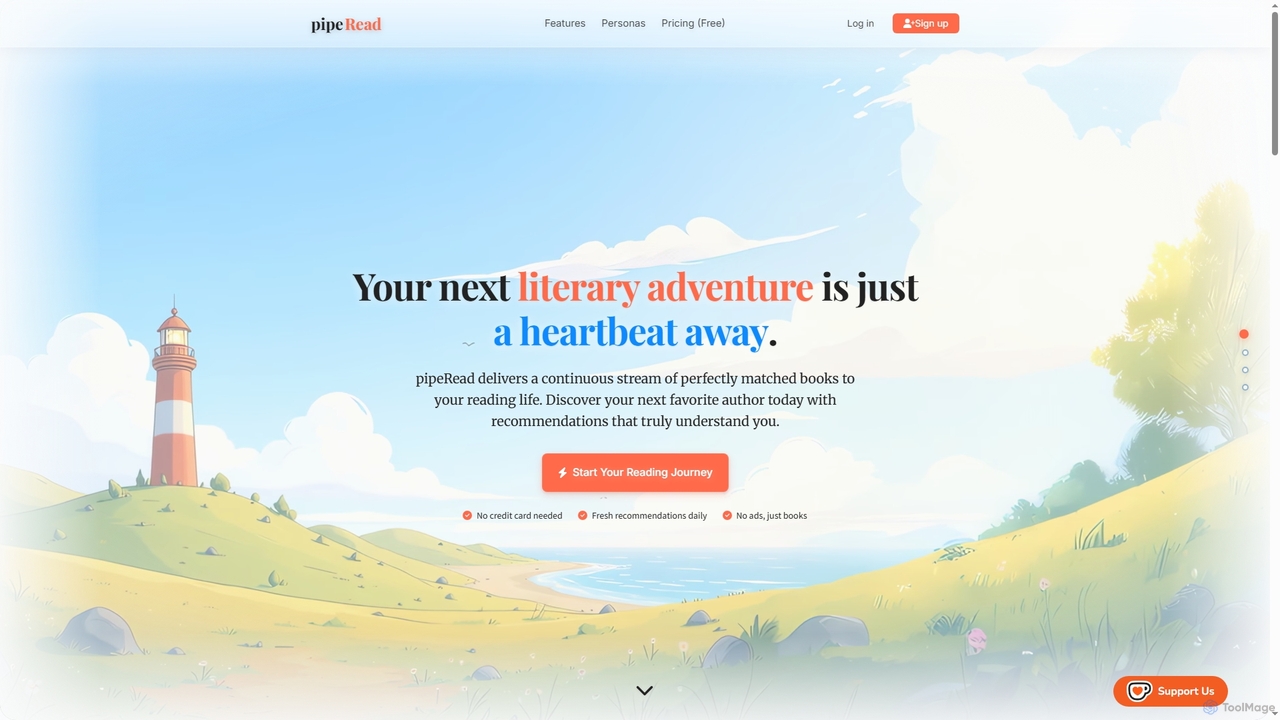
Piperead
Piperead is a free, AI-powered book discovery platform that delivers personalized recommendations. Users swipe through suggestions, and the …
Piperead is a free, AI-powered book discovery platform that delivers personalized recommendations. Users swipe through suggestions, and the AI learns their tastes in real-time. It uses curated 'Personas' to match books to your mood and reading goals, creating a continuous, ad-free stream of literary adventures.
About Books
AI Books tools are a specialized class of applications that use generative AI to create, summarize, or interact with book-length content. These tools leverage large language models trained on vast literary datasets to understand narrative structure, character development, and thematic elements. They empower authors, students, and readers to generate original stories, distill key insights from dense texts, or create interactive reading experiences. This technology serves as a creative partner, accelerating the journey from initial idea to finished manuscript or summary.
Core Features
- Narrative Generation: Creates complete stories, plot outlines, character backstories, and dialogue based on user prompts.
- Book Summarization: Condenses long-form books into concise summaries, key takeaways, or chapter-by-chapter breakdowns.
- Interactive Story Creation: Generates branching narratives and choice-based fiction for games or educational content.
- Illustrated Story-Making: Combines AI-generated text with AI-generated images to produce illustrated books, especially for children.
- Style Emulation: Analyzes the writing style of a given author or text and generates new content in a similar voice.
Use Cases
These tools are valuable for fiction and non-fiction writers seeking to overcome writer's block or accelerate drafting. Students and researchers use them to quickly grasp the core arguments of academic texts. Educators and parents can create personalized and engaging stories for learning and entertainment. Marketers also use them to develop narrative-driven content for campaigns.
How to Choose
When selecting an AI Books tool, first identify your primary need: content creation (writing) or consumption (summarizing). Evaluate the tool's specialization in specific genres (e.g., fantasy, sci-fi, non-fiction). Assess the quality and coherence of the generated output, the level of customization available for plots and characters, and whether it offers integration with AI image generators for illustrated books.

BooksUse Cases
Create a Personalized Children's Book
A parent wants to give their child a unique birthday gift. Using an AI Books tool, they input their child's name, favorite activities, and a moral for the story. The AI generates a complete narrative featuring the child as the hero. By connecting to an AI image generator, it also creates custom illustrations for each page, matching the story's events. The parent can then review, make minor edits, and export the final book as a printable PDF, resulting in a deeply personal and professionally-looking storybook created in under an hour.
Generate a Novel Outline and First Draft
An aspiring novelist has a great concept for a fantasy epic but struggles with structuring the plot. They use an AI Books tool to brainstorm. By providing a one-paragraph summary, the AI generates several potential plot outlines, complete with rising action, climax, and resolution. The author selects the most compelling outline and instructs the AI to flesh out the first three chapters. This process overcomes writer's block and provides a solid foundation of over 10,000 words, allowing the author to focus on refining characters and adding their unique voice.
Quickly Summarize Non-Fiction for Research
A university student is writing a thesis and needs to review a dozen dense academic books. Instead of spending weeks reading each one cover-to-cover, they use an AI book summarizer. For each book, the tool generates a high-level summary, a list of key arguments, and chapter-by-chapter breakdowns. This allows the student to quickly identify which books are most relevant to their research, pinpoint specific chapters for in-depth reading, and extract key quotes and concepts efficiently. The process reduces research time by over 70%, enabling a more comprehensive literature review.
Develop Interactive Educational Content
An educator wants to create a more engaging history lesson about ancient Rome. Using an AI interactive story tool, they set up a scenario where the student plays the role of a Roman senator. The educator defines key historical decision points. The AI then generates branching narratives and realistic consequences for each choice the student makes, such as voting on a law or supporting a military campaign. This transforms a passive reading assignment into an active, immersive learning experience where students understand the complexities of historical events by participating in them.
Brainstorm World-Building for a Sci-Fi Series
A screenwriter is developing a new science fiction book series set in a distant galaxy. To ensure the world feels rich and consistent, they use an AI Books tool for world-building. They input core concepts like 'a desert planet with twin suns' and 'a society based on psychic energy'. The AI then generates detailed descriptions of the planet's ecosystem, the societal structure of its inhabitants, potential technologies, and cultural traditions. This provides a wealth of creative material, helping the writer establish a coherent and imaginative setting for their story to unfold.
Analyze Literary Themes in Classic Novels
A literature enthusiast wants to explore recurring themes across Shakespeare's plays. They upload the full texts of several plays into an AI analysis tool. The tool processes the language to identify and track themes like 'ambition', 'betrayal', and 'fate' across the different works. It generates visualizations showing how frequently these themes appear and in which character dialogues. This provides a data-driven perspective on literary analysis, uncovering subtle patterns and connections that might be missed during a traditional reading, deepening their appreciation of the author's work.