ToolMage
Sign in

Best 1 Spiritual Guidance AI tools for Lifestyle

Popular Spiritual Guidance AI tools in Lifestyle include AskPriest, helping you work more efficiently.

AskPriest
Freemium

AskPriest

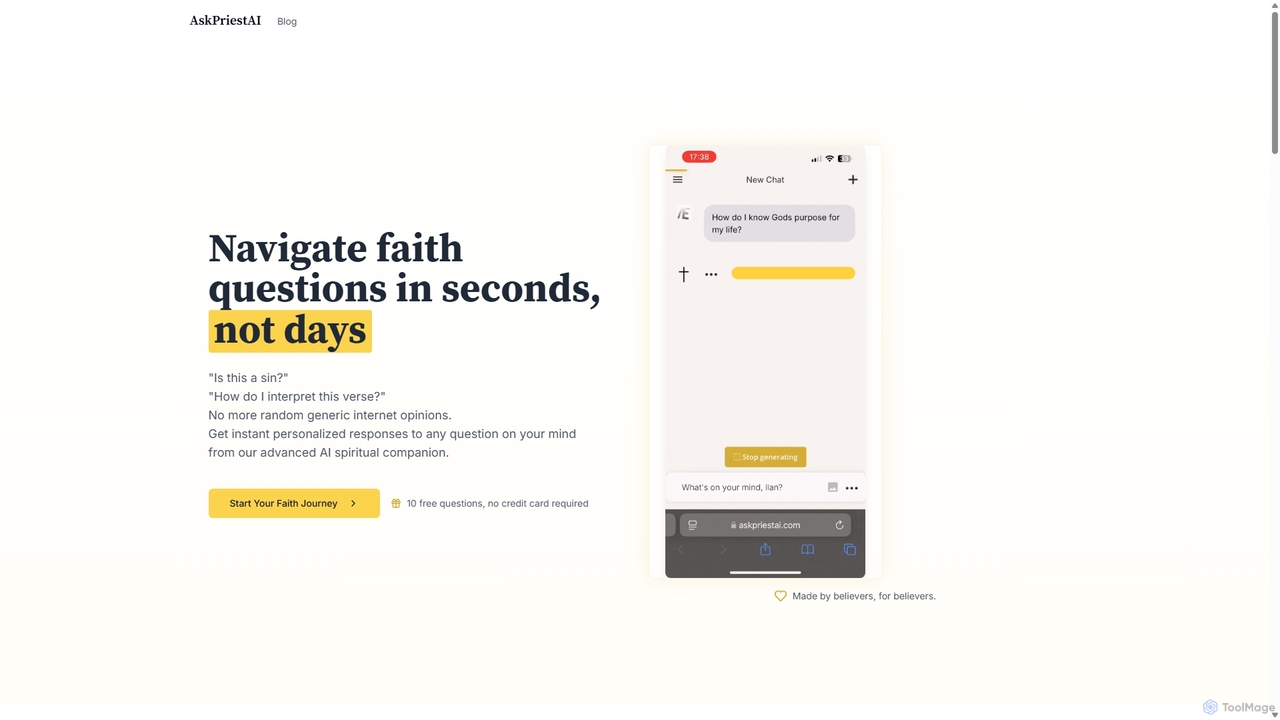
AskPriest is an AI-powered spiritual companion designed to provide instant, personalized, and Bible-based answers to questions about Christianity. Acting as a virtual Christian guide, it offers a safe, judgment-free space for users to explore scripture, faith, and life guidance 24/7. Rooted exclusively in Christian teachings, it helps believers deepen their understanding, find comfort, and navigate their spiritual journey with confidence, eliminating the need to sift through generic internet opinions.

Religious Studies
Visits 6.6KFavorites 115Likes 132

About Spiritual Guidance

Spiritual Guidance AI tools are applications designed to offer insights and reflections using artificial intelligence. These tools often leverage large language models and pattern recognition to interpret data based on established esoteric systems like astrology, tarot, or numerology. They provide users with accessible, personalized avenues for self-exploration, introspection, and understanding different perspectives on life's questions. This technology serves as a modern supplement for personal reflection within the broader lifestyle category.

Core Features

  • Personalized Readings: Generates interpretations for tarot, astrology, numerology, or I Ching based on user input.
  • Dream Analysis: Utilizes AI to identify symbols and themes in dream descriptions, offering potential meanings.
  • Conversational AI for Reflection: Provides a chatbot interface for users to explore their thoughts and feelings in a guided, reflective manner.
  • Guided Meditation Generation: Creates custom meditation scripts or audio based on user-specified goals, moods, or timeframes.
  • Astrological Charting: Automatically calculates and interprets natal charts, transits, and synastry reports.

Use Cases

These tools are primarily used by individuals interested in personal growth, self-discovery, and mindfulness. They are suitable for those exploring spiritual concepts for the first time, as well as enthusiasts of astrology or tarot seeking a convenient digital tool for daily reflection. They function as private, on-demand resources for introspection, helping users organize their thoughts or view a situation from a new angle.

How to Choose

When selecting a Spiritual Guidance AI tool, consider the specific system it uses (e.g., Tarot, Astrology, I Ching) and whether it aligns with your interests. Evaluate the depth and quality of its interpretations—does it provide nuanced insights or generic statements? Assess its data privacy policy, especially if you are inputting sensitive personal information like birth details. Finally, consider the user interface; a calming and intuitive design is often more conducive to reflection.

Spiritual Guidance use cases

1

Daily Tarot Reading for Self-Reflection

An individual seeking daily guidance or a moment of introspection uses an AI tool to draw a 'card of the day'. The application presents a tarot card image and provides a detailed interpretation generated by the AI. This interpretation covers the card's general meaning, its potential relevance to love, career, and personal growth. The user can reflect on this message throughout their day, using it as a prompt for journaling or mindfulness, helping to foster a consistent practice of self-awareness without needing physical cards or deep knowledge of tarot.

2

Interpreting a Confusing Dream

A user who had a vivid but confusing dream inputs the details into an AI dream interpreter. They describe the setting, characters, actions, and emotions experienced in the dream. The AI analyzes the text for common archetypes, symbols, and narrative structures based on psychological theories and cultural dream dictionaries. It then generates a report suggesting possible interpretations, connecting dream elements to potential real-life stressors, desires, or unresolved feelings. This provides the user with a structured perspective to begin their own analysis and understand their subconscious mind better.

3

Generating a Personalized Meditation Script

A user feeling stressed before a work presentation wants a short, calming meditation. They open a spiritual guidance AI and input their goal ('reduce anxiety'), current emotion ('stressed'), and desired duration ('10 minutes'). The AI generates a unique, text-based or audio-based guided meditation script. The script might include specific visualizations related to confidence and calm, breathing exercises, and affirmations tailored to their situation. This provides a highly customized mindfulness experience that is more relevant and potentially more effective than a generic, pre-recorded meditation.

4

Exploring a Natal Astrology Chart

An astrology enthusiast wants to understand their birth chart in more detail. They input their exact birth date, time, and location into an AI astrology tool. The application instantly generates a visual chart and a comprehensive report. The AI interprets the positions of the sun, moon, and planets, explaining the significance of each placement in their respective houses and signs. It also analyzes major aspects (angles between planets) and provides insights into personality traits, potential strengths, and challenges. This allows for deep, personalized astrological exploration without needing to consult a professional astrologer for a foundational reading.

5

Seeking Guidance on a Life Decision

Facing a career crossroads, a user turns to an AI I Ching or oracle tool for a different perspective. They focus on their question, such as 'What should I consider when choosing my new career path?', and perform a digital 'coin toss'. The AI generates a hexagram and provides its classical interpretation from ancient texts, along with a modern, AI-enhanced explanation relating it to themes of change, growth, or caution. This symbolic guidance doesn't provide a direct answer but offers a metaphorical framework, encouraging the user to reflect on their situation from a new, less conventional angle.

6

Reflective Journaling with an AI Companion

A user wants to start a journaling practice for mental clarity but struggles with where to begin. They use an AI journaling companion trained on principles of cognitive behavioral therapy and mindfulness. The user writes a free-form entry about their day. The AI then responds not with advice, but with gentle, open-ended questions like 'What did you learn from that experience?' or 'How did that make you feel in your body?'. This interaction transforms simple journaling into a guided, reflective dialogue, helping the user delve deeper into their own thoughts and emotions in a supportive, non-judgmental space.

Spiritual Guidance FAQ

What are AI Spiritual Guidance tools?

AI Spiritual Guidance tools are software applications that use artificial intelligence to provide personalized insights based on spiritual or esoteric systems like tarot, astrology, and numerology. They are not sentient or conscious; instead, they use algorithms to interpret user data against a vast database of traditional meanings. Their primary purpose is to serve as a modern tool for self-reflection, offering new perspectives and prompts for introspection.

How do I choose the right AI Spiritual Guidance tool?

Choosing the right tool depends on your personal interests and goals. Consider the following factors:

  • System Alignment: Are you more drawn to the symbolism of Tarot, the structure of Astrology, or the reflective nature of the I Ching? Choose a tool that specializes in a system that resonates with you.
  • Depth of Content: Look for tools that provide detailed, nuanced interpretations rather than brief, generic ones.
  • Data Privacy: Read the privacy policy. Be comfortable with how the tool handles your personal data, such as birth information or journal entries.
  • User Experience: The interface should be intuitive and create a calm, focused environment for reflection.
Can AI tools replace a human spiritual advisor or therapist?

No. It is crucial to understand that AI tools are not a substitute for human spiritual advisors, therapists, or counselors. They lack genuine consciousness, empathy, and the lived experience that a human professional provides. These AI tools should be viewed as supplementary resources for personal exploration and entertainment. For serious mental health concerns or deep spiritual crises, always seek guidance from a qualified human professional.

How accurate are AI-generated tarot or astrology readings?

The 'accuracy' of AI readings should be viewed in terms of their value for reflection, not prediction. The AI doesn't 'know' the future. It generates interpretations by applying complex algorithms to vast datasets of symbolic meanings. A high-quality AI tool can provide interpretations that are consistent with traditional esoteric knowledge and feel insightful. Their true value lies in their ability to present a situation from a new perspective, sparking personal insight and self-discovery, rather than foretelling a fixed outcome.

What is the difference between Spiritual Guidance AI and general wellness apps?

The primary difference lies in their focus and methodology. General wellness apps, part of the broader Lifestyle category, typically concentrate on measurable aspects of mental and physical health, such as tracking meditation minutes, sleep cycles, or mood scores. Spiritual Guidance AI tools, a niche within Lifestyle, focus specifically on providing insights through established esoteric or symbolic systems like astrology, tarot, or dream analysis. While both aim to improve well-being, wellness apps are often data-driven and goal-oriented, whereas spiritual guidance apps are interpretive and focused on promoting reflection.