Accurment
Accurment is an AI-powered web app that leverages behavioral science to transform marketing guesswork into strategic growth. Designed …
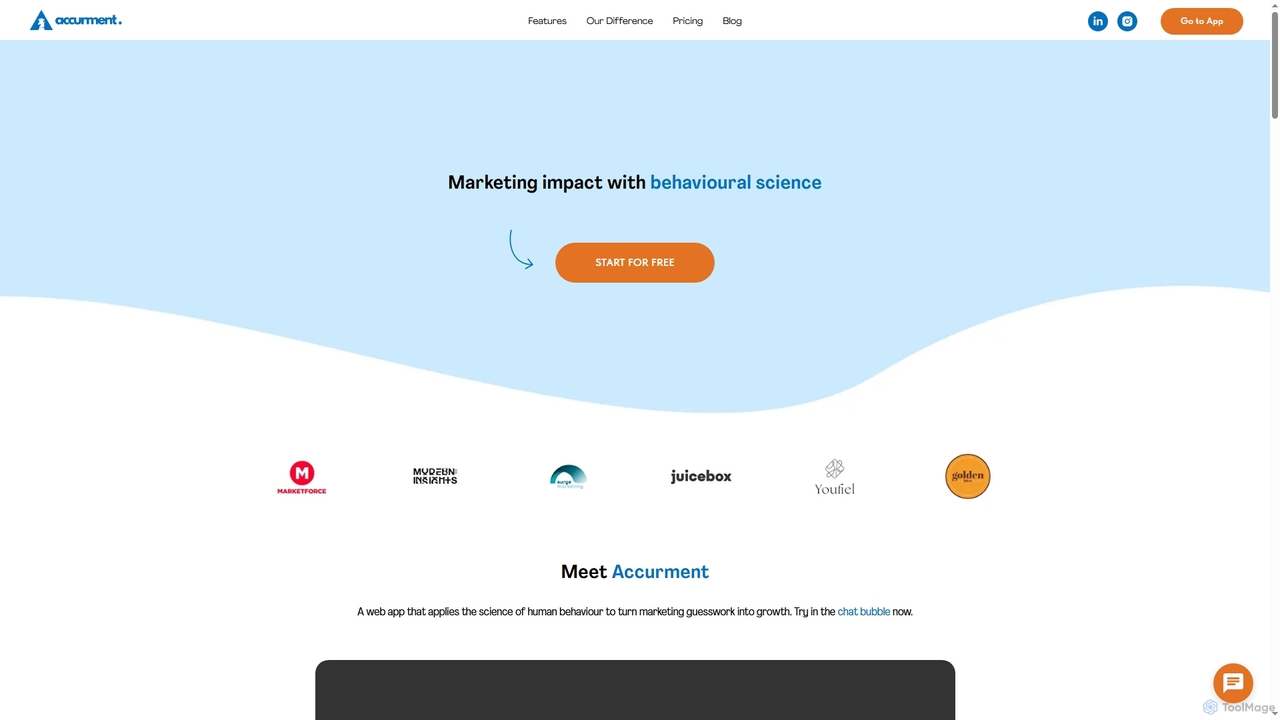
Accurment is an AI-powered web app that leverages behavioral science to transform marketing guesswork into strategic growth. Designed by marketing professors, it provides expert-curated insights for planning, testing, and optimizing campaigns. It helps businesses and marketers make data-backed decisions, measure impact, and achieve more credible and effective marketing outcomes.
About Behavioral Science
Behavioral Science AI tools are a specialized class of marketing technology that applies principles from psychology and cognitive science to understand, predict, and influence customer behavior. These tools use machine learning to analyze user data, identify behavioral patterns like cognitive biases, and automate personalized interventions. This enables marketers to create more persuasive campaigns, optimize user journeys, and increase conversion rates by aligning with how people naturally think and make decisions. They move beyond simple analytics to provide actionable insights on *why* users act the way they do.
Core Features
- Predictive Behavior Modeling: Forecasts user actions such as purchase, churn, or engagement based on historical data and behavioral patterns.
- Cognitive Bias Application: Identifies and automates the use of principles like scarcity, social proof, or anchoring in messaging and UI elements.
- Personalized Nudging Engine: Delivers context-aware prompts, notifications, and recommendations to guide users toward desired actions.
- Emotional and Sentiment Analysis: Analyzes customer feedback, reviews, and support interactions to gauge emotional responses and inform strategy.
- Behavioral A/B Testing: Allows for experiments based on psychological hypotheses, providing deeper insights than traditional A/B tests.
Use Cases
These tools are highly effective in data-rich environments like e-commerce, SaaS, fintech, and digital media. They are primarily used by Conversion Rate Optimization (CRO) specialists, product marketers, UX designers, and digital campaign managers to fine-tune every touchpoint of the customer journey, from ad copy to checkout flow.
How to Choose
When selecting a Behavioral Science AI tool, consider the breadth of its supported psychological principles. Evaluate its integration capabilities with your existing marketing stack (e.g., CRM, analytics platform). Assess the level of customization for nudges and interventions to ensure they align with your brand voice. Finally, inquire about ethical guardrails and data privacy compliance to ensure responsible use.

Behavioral ScienceUse Cases
Reduce Cart Abandonment with Scarcity
An e-commerce manager facing high cart abandonment rates uses a behavioral science AI tool to address the issue. The tool integrates with their online store and identifies products with low stock levels that are frequently added to carts. When a user adds one of these items, the tool automatically displays a non-intrusive message like 'Only 3 left in stock at this price'. This leverages the scarcity principle, creating a sense of urgency. As a result, the store sees a measurable decrease in abandoned carts for these items and an uplift in immediate checkouts.
Increase SaaS Sign-ups with Social Proof
A SaaS company's marketing team wants to improve the conversion rate on their sign-up page. They deploy a behavioral AI tool that adds a small, real-time notification widget. This widget displays anonymized actions of other users, such as 'Someone from New York just signed up for a Pro plan'. By showcasing the activity of other users, the tool leverages social proof, making potential customers feel more confident and validating their decision to sign up. This simple addition leads to a higher sign-up conversion rate by reducing hesitation and building trust.
Optimize Pricing Pages with Anchoring Effect
A product marketer wants to optimize the pricing page to guide users towards the most valuable plan. They use a behavioral science tool to run an A/B test based on the anchoring effect. The tool helps create a variation where the most expensive plan is visually highlighted or listed first. This 'anchors' the user's perception of value, making the other, more popular plans seem more reasonably priced in comparison. The platform tracks conversions for each variation, allowing the marketer to definitively measure the impact of this psychological principle on revenue and plan selection.
Improve User Onboarding with the Zeigarnik Effect
A product manager for a new mobile app notices that users drop off during the onboarding process. They implement a behavioral AI tool to create a dynamic onboarding checklist with a visible progress bar. This design leverages the Zeigarnik effect—the human tendency to better remember uncompleted tasks. As users complete steps like 'Create Profile' or 'Connect Contacts', the progress bar fills up, creating a psychological need to 'close the loop' and finish the setup. The tool tracks completion rates, showing a significant increase in users who fully complete the onboarding process.
Personalize Email Campaigns with Emotional Analysis
A CRM manager wants to move beyond simple demographic segmentation for their email campaigns. They use a behavioral science AI tool that analyzes past customer support tickets, reviews, and survey responses to assign an emotional profile to different customer segments. For a segment identified as 'anxious' or 'cautious', the AI suggests using reassuring language and highlighting guarantees. For an 'enthusiastic' segment, it recommends more exciting, benefit-driven language. This allows for hyper-personalized communication that resonates on an emotional level, leading to higher open rates and engagement.
Boost Feature Adoption with Gamification Principles
A user engagement specialist for a project management software wants to encourage users to explore advanced features. They use a behavioral science platform to implement gamification elements. The platform helps create a system of badges, points, and leaderboards tied to specific actions, like 'Creating your first automated workflow' or 'Inviting 5 team members'. This applies behavioral principles of achievement, status, and competition. The AI can also suggest personalized 'next-step' challenges to users based on their current usage, creating a guided path to mastery and significantly increasing the adoption rate of key features.