
ToolMage
Sign in

Best 1 Go To Market Strategy AI tools for Marketing

Popular Go To Market Strategy AI tools in Marketing include Rava AI, helping you work more efficiently.

Rava AI
Freemium

Rava AI

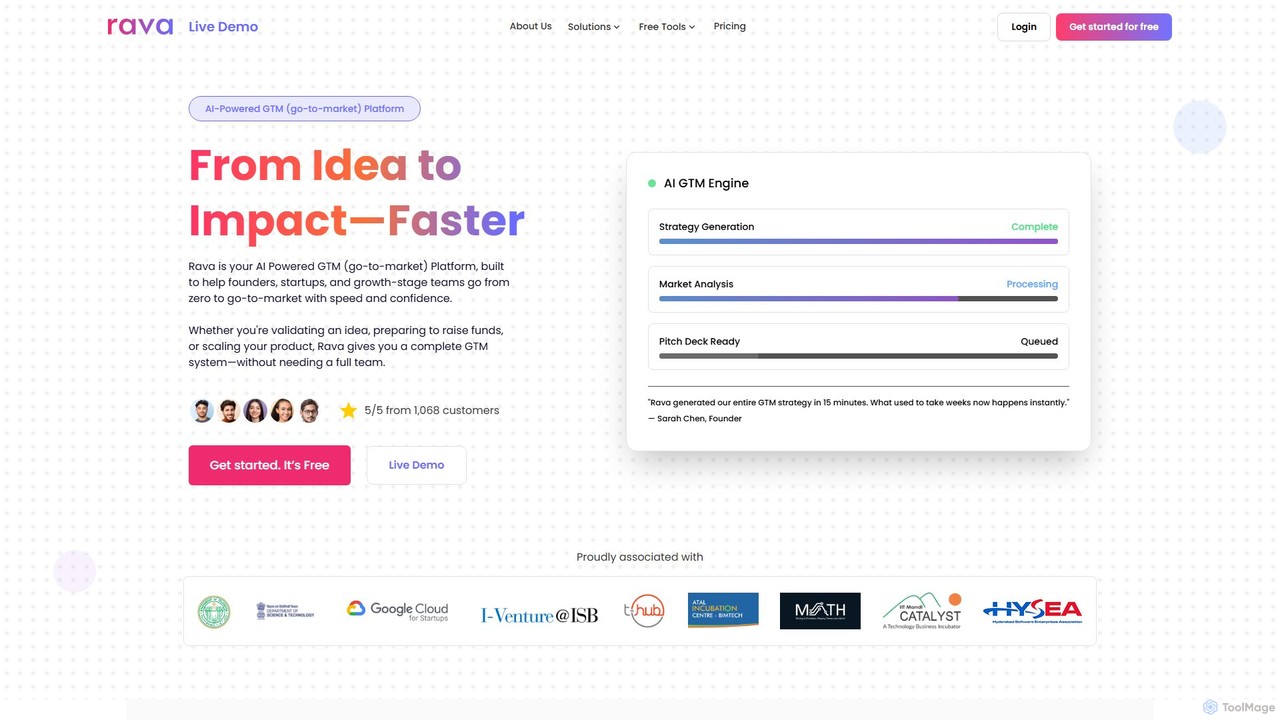
Rava AI is an AI-powered Go-To-Market (GTM) platform designed for founders, startups, and growth teams. It streamlines the process from idea validation to market launch by generating comprehensive business strategies, marketing plans, and investor-ready pitch decks, helping ventures scale with speed and confidence.

Startup Tools
Visits 7.2KFavorites 189Likes 165

About Go To Market Strategy

Go To Market Strategy tools are AI-powered platforms that help businesses plan, execute, and optimize the launch of new products or services. These tools leverage data analysis and predictive modeling to identify ideal customer profiles, analyze competitive landscapes, and recommend the most effective marketing channels. By automating complex market research and strategic planning, they enable companies to reduce launch risks, accelerate time-to-market, and maximize market penetration. They provide a data-driven framework for making critical decisions before significant resources are invested.

Core Features

  • Ideal Customer Profile (ICP) Generation: Automatically analyzes market data to define and segment the most profitable target audiences.
  • Competitive Intelligence: Monitors competitors' strategies, market positioning, and customer sentiment in real-time.
  • Channel Optimization: Recommends the most effective marketing and sales channels based on target audience behavior and cost-effectiveness.
  • Market Sizing (TAM/SAM/SOM): Provides data-backed estimations of the Total Addressable Market, Serviceable Addressable Market, and Serviceable Obtainable Market.
  • Launch Plan Automation: Generates structured GTM plans with timelines, key milestones, and recommended actions.

Applicable Scenarios

These tools are invaluable for startups launching their first product, established enterprises entering new geographic or vertical markets, and product managers planning a major feature release. For instance, a B2B SaaS company can use a GTM tool to identify high-potential industries and tailor its sales outreach, while a consumer brand can use it to understand regional preferences before a national launch.

Selection Criteria

When choosing a Go To Market Strategy tool, consider the quality and breadth of its data sources. Evaluate its integration capabilities with your existing CRM and marketing automation platforms. Assess the depth of its analytical features, such as persona creation and competitive benchmarking. Finally, consider the tool's ease of use and whether its pricing model aligns with your budget and expected ROI.

Go To Market Strategy use cases

1

Planning a Startup's First Product Launch

A founder of a new B2B SaaS startup needs to develop a comprehensive go-to-market strategy before launch. They use an AI GTM tool to analyze the market landscape. The tool identifies three high-potential niche segments, generates detailed personas for each, and maps out the key competitors. Based on the data, it recommends a content marketing strategy focused on LinkedIn and industry blogs as the primary channels, saving the startup from wasting its limited budget on less effective paid ads. This data-driven approach helps secure initial investor confidence and guides the first six months of marketing efforts.

2

Validating a New Market for Expansion

A product marketing manager at an established enterprise is tasked with evaluating Europe as a potential new market. Instead of months of manual research, they use an AI GTM platform. The tool analyzes demographic data, online behavior, and competitive density across different countries. It reveals that Germany has the highest concentration of their ICP with the least saturated competitive landscape. The platform also provides insights into local regulations and preferred marketing channels, allowing the manager to build a strong business case for expansion and present a data-backed entry strategy to the leadership team in weeks, not months.

3

Optimizing a Major Feature Relaunch

A product manager for a popular project management software plans to relaunch a core feature with significant updates. To ensure a successful adoption, they use a GTM tool to analyze current usage data. The AI identifies power users who would be ideal for a beta program and segments other users based on their feature interaction. This allows for targeted communication: an early-access offer for power users, a tutorial campaign for moderate users, and a 'what's new' announcement for infrequent users. The tool's recommendations help the team create a phased rollout plan that maximizes positive reception and minimizes user confusion.

4

Generating Data for an Investor Pitch Deck

A founder preparing for a seed funding round needs to present a compelling market opportunity. They use a GTM strategy tool to generate credible, third-party validated data for their pitch deck. The tool provides a detailed TAM, SAM, and SOM analysis, a competitive matrix showing their unique positioning, and a profile of their target beachhead market. Instead of spending weeks on manual research and expensive market reports, the founder generates these crucial slides in a few hours. This allows them to present a professional, data-backed case that clearly articulates the market size and their strategy to capture it, significantly strengthening their pitch.

5

Defining Sales Territories for a New Sales Team

A sales director is building a new regional sales team and needs to define territories that are both equitable and high-potential. Using a GTM tool, they input their ICP criteria and target industries. The AI platform overlays this with geographic data, firmographics, and market density information. It then generates several optimized territory maps, balancing the number of target accounts, potential revenue, and travel time for each sales representative. This data-driven approach replaces guesswork, ensuring a fair distribution of opportunities and setting the new team up for success from day one.

6

Identifying and Vetting Channel Partners

A business development manager for a hardware company wants to expand into new vertical markets through channel partners. They use a GTM strategy tool to identify potential resellers and distributors. The AI analyzes companies based on their existing product lines, customer base demographics, and market reach. It generates a prioritized list of potential partners, scoring each on their alignment with the company's ICP. This allows the manager to focus their outreach efforts on the most promising candidates, accelerating the partner recruitment process and increasing the likelihood of forming successful, mutually beneficial relationships.

Go To Market Strategy FAQ

What are AI Go To Market Strategy tools?

AI Go To Market (GTM) Strategy tools are specialized software platforms that use artificial intelligence to help businesses plan and execute the launch of new products or services. They automate the analysis of vast amounts of market data to provide strategic insights. Key functions include identifying ideal customer profiles (ICPs), assessing market size (TAM/SAM/SOM), analyzing competitors, and recommending optimal marketing channels. These tools transform the GTM process from being intuition-based to data-driven, significantly increasing the probability of a successful launch.

How to choose the right Go To Market Strategy tool?

Choosing the right GTM tool depends on your specific needs. Consider these factors:

  • Data Quality and Sources: Ensure the tool uses reliable, up-to-date, and relevant data sources for your industry and region.
  • Analytical Depth: Evaluate if the tool provides the level of analysis you need, from basic ICP generation to complex market sizing and competitive intelligence.
  • Integration Capabilities: Check if it integrates smoothly with your existing tech stack, such as CRM (e.g., Salesforce) and marketing automation platforms.
  • Usability and Customization: The tool should be intuitive for your team to use and allow for customization to fit your unique business context.
  • Pricing Model: Assess whether the pricing aligns with your budget and the value you expect to receive.
What's the difference between GTM tools and marketing automation platforms?

The primary difference lies in their focus and stage in the customer lifecycle. GTM Strategy tools are strategic and focus on the pre-launch and launch phases. They help answer 'who' to target, 'where' to find them, and 'what' the market opportunity is. Their goal is to build a solid foundation for market entry. In contrast, marketing automation platforms are tactical and focus on the post-launch phase of executing and scaling marketing campaigns to an already-defined audience. They manage ongoing communication, lead nurturing, and campaign performance tracking. Essentially, GTM tools help you build the map, while marketing automation tools help you drive the car.

Who benefits most from using AI GTM Strategy tools?

While many roles can benefit, these tools are particularly valuable for:

  • Startup Founders & Entrepreneurs: Who need to quickly validate ideas, understand market potential, and create a data-backed plan to attract investors and first customers.
  • Product Marketers & Managers: Who are responsible for launching new products or features and need to define target audiences, positioning, and messaging.
  • Corporate Strategy & Business Development Teams: Who explore new market opportunities, analyze competitive threats, and plan for geographic or vertical expansion.
  • Sales Leaders: Who need to define sales territories, identify high-potential accounts, and align sales efforts with the overall market strategy.
Can GTM tools predict the success of a product launch?

AI GTM tools cannot guarantee success, but they can significantly increase its probability. They replace guesswork and intuition with data-driven analysis, which helps in making more informed strategic decisions. By accurately identifying the right target market, understanding the competitive landscape, and choosing the most effective channels, these tools help businesses avoid common pitfalls that lead to launch failures. They provide a strong strategic foundation, but a successful launch still depends on the quality of the product, the execution of the marketing plan, and the ability to adapt to market feedback.