ToolMage
Sign in

Best 1 Go To Market AI tools for Marketing

Popular Go To Market AI tools in Marketing include Product Roadmap, helping you work more efficiently.

Product Roadmap
Freemium

Product Roadmap

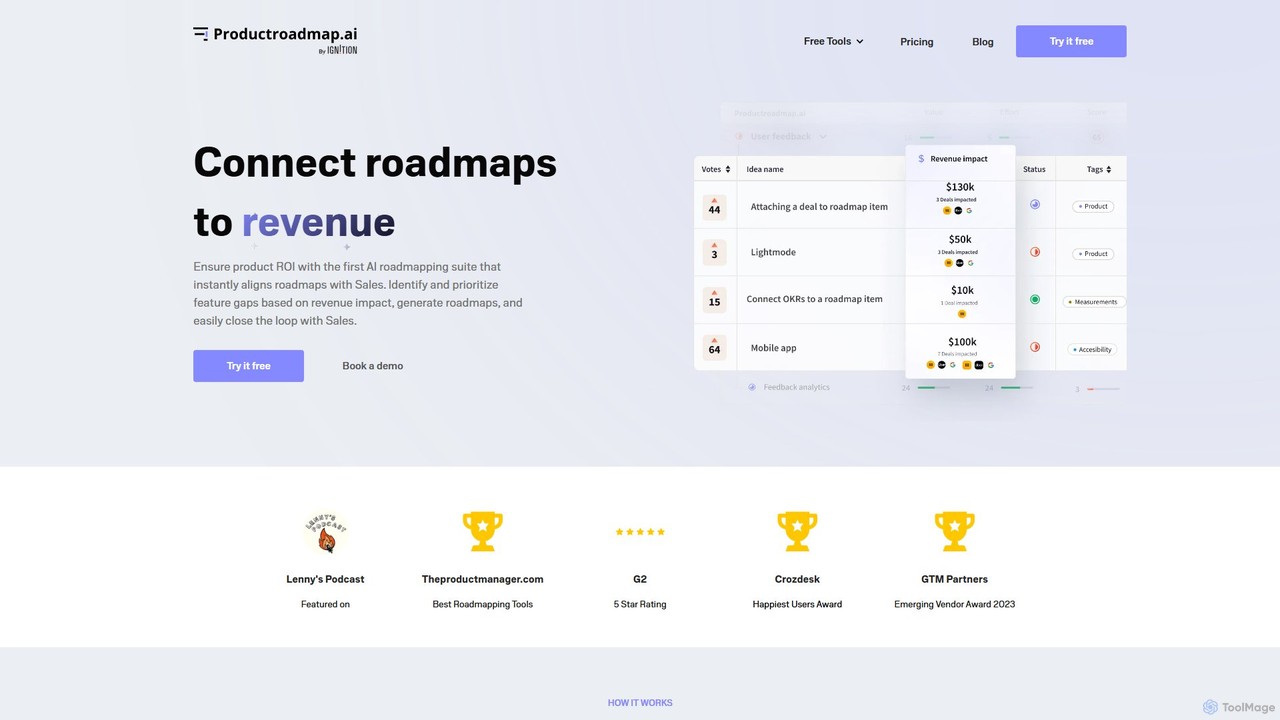
Product Roadmap is an AI-powered platform designed to align product, marketing, and sales teams. It helps automate product operations, build dynamic roadmaps, create go-to-market plans, and analyze customer feedback to connect product strategy directly with revenue.

Customer Feedback
Visits 7.6KFavorites 174Likes 182

About Go To Market

Go To Market AI tools are specialized artificial intelligence applications designed to streamline and enhance the strategic process of launching new products, services, or features into target markets. These tools leverage AI to analyze market data, predict consumer behavior, and automate various aspects of market entry, from audience identification to campaign execution. By providing data-driven insights and automating repetitive tasks, Go To Market AI solutions empower businesses to achieve faster, more effective, and more efficient product launches, significantly improving their chances of market success.

Core Features

  • Market Intelligence: AI-driven analysis of market trends, competitor strategies, and consumer sentiment to identify optimal market entry points.
  • Audience Segmentation: Advanced algorithms to precisely segment target audiences based on demographics, psychographics, and behavioral data for tailored messaging.
  • Content Generation: AI assistance in creating compelling marketing copy, ad creatives, and sales enablement materials for launch campaigns.
  • Campaign Optimization: Real-time monitoring and AI-powered adjustments to marketing campaigns to maximize reach, engagement, and conversion rates during launch.
  • Predictive Analytics: Forecasting market reception, potential sales, and identifying risks to refine launch strategies before execution.

Use Cases

Businesses across various sectors utilize Go To Market AI tools to navigate complex launch landscapes. For instance, a tech startup can use these tools to identify underserved market niches and craft hyper-targeted messaging for their new SaaS product. E-commerce brands can leverage AI to analyze seasonal trends and competitor pricing, ensuring their new product line launches with optimal positioning and promotional strategies. These tools are crucial for any organization aiming to minimize launch risks and maximize impact.

How to Choose

When selecting Go To Market AI tools, consider their specific functionalities: do they cover market research, content creation, campaign management, or all three? Evaluate their integration capabilities with existing CRM, marketing automation, and analytics platforms to ensure a seamless workflow. Assess the accuracy and depth of their data analysis and predictive models. Finally, consider the scalability and pricing structure to match your business size and launch frequency, ensuring the tool can grow with your market expansion needs.

Go To Market use cases

1

Accelerate New Product Launch Planning

A product manager uses Go To Market AI to analyze market demand, competitive landscapes, and potential customer segments for a new software feature. The AI generates a comprehensive market entry strategy, including pricing recommendations and target audience profiles, significantly reducing the manual research time from weeks to days and ensuring a data-backed launch plan.

2

Optimize Digital Ad Campaigns for Market Entry

A digital marketing team deploys an AI GTM tool to create and optimize ad creatives and copy for a new mobile app launch. The AI continuously A/B tests different variations across platforms, identifies high-performing segments, and adjusts bidding strategies in real-time, leading to a 30% lower cost-per-acquisition and higher initial user adoption rates.

3

Generate Localized Marketing Content at Scale

An international brand launching a product in multiple regions leverages AI GTM tools to generate culturally relevant marketing copy and visuals for each target market. The AI ensures brand consistency while adapting messaging to local nuances, accelerating content creation by 70% and improving engagement in diverse markets without extensive manual translation and localization efforts.

4

Predict Market Reception and Sales Performance

A sales director uses predictive analytics within a Go To Market AI platform to forecast the initial sales volume and market reception for a new B2B service. By analyzing historical data, industry trends, and early customer feedback, the AI provides accurate sales projections, allowing the sales team to set realistic targets and allocate resources effectively for the launch period.

5

Enhance Sales Enablement for New Offerings

A sales enablement specialist utilizes AI GTM tools to automatically generate personalized sales pitches, battle cards, and training materials for a newly launched product. The AI pulls relevant product information and market insights, tailoring content for different sales scenarios and buyer personas, equipping the sales force with up-to-date and effective resources for their initial outreach.

6

Identify Untapped Market Niches for Expansion

A business development manager employs Go To Market AI to scan vast datasets for emerging trends and underserved customer needs. The AI identifies specific micro-segments with high potential for a new product variant, providing detailed insights into their pain points and preferred communication channels, enabling the company to strategically expand into profitable, less competitive areas.

Go To Market FAQ

What are Go To Market AI tools?

Go To Market (GTM) AI tools are artificial intelligence applications designed to assist businesses in the strategic planning, execution, and optimization of new product or service launches. They leverage AI to analyze market data, predict consumer behavior, automate campaign creation, and provide insights to ensure a successful market entry. These tools aim to reduce risks, accelerate time-to-market, and maximize the impact of new offerings.

How do Go To Market AI tools differ from general Marketing AI tools?

While Go To Market AI tools fall under the broader umbrella of Marketing AI, their primary focus is on the specific phase of launching a new product or service. General Marketing AI tools cover a wider range of ongoing marketing activities like SEO, social media management, or customer relationship management. GTM AI tools are specialized for pre-launch analysis, launch campaign execution, and initial market penetration strategies, making them distinct in their concentrated application.

What key features should I look for in a Go To Market AI tool?

When evaluating Go To Market AI tools, prioritize features such as robust market intelligence and competitive analysis capabilities, advanced audience segmentation, and AI-powered content generation for various marketing assets. Look for tools offering real-time campaign optimization, predictive analytics for sales forecasting, and seamless integration with your existing marketing and sales tech stack. Strong reporting and analytics are also crucial for measuring launch success.

Who benefits most from using Go To Market AI tools?

Go To Market AI tools are highly beneficial for product managers, marketing teams, sales leaders, and business development professionals involved in launching new initiatives. Startups can use them to validate product-market fit and craft initial launch strategies. Established enterprises can leverage them to streamline complex global launches and optimize resource allocation. Essentially, any organization aiming for a more data-driven and efficient market entry process will find significant value.

Can Go To Market AI tools help with international product launches?

Yes, Go To Market AI tools are particularly effective for international product launches. They can analyze diverse global markets, identify cultural nuances, and assist in generating localized marketing content and strategies at scale. By providing insights into regional consumer preferences and regulatory landscapes, these tools help businesses adapt their offerings and messaging for different countries, significantly reducing the complexities and risks associated with global market expansion.