ToolMage
Sign in

Best 2 Prompt Engineering AI tools for Marketing

Popular Prompt Engineering AI tools in Marketing include Phewture and eCommercePrompts.com, helping you work more efficiently.

eCommercePrompts.com
Free

eCommercePrompts.com

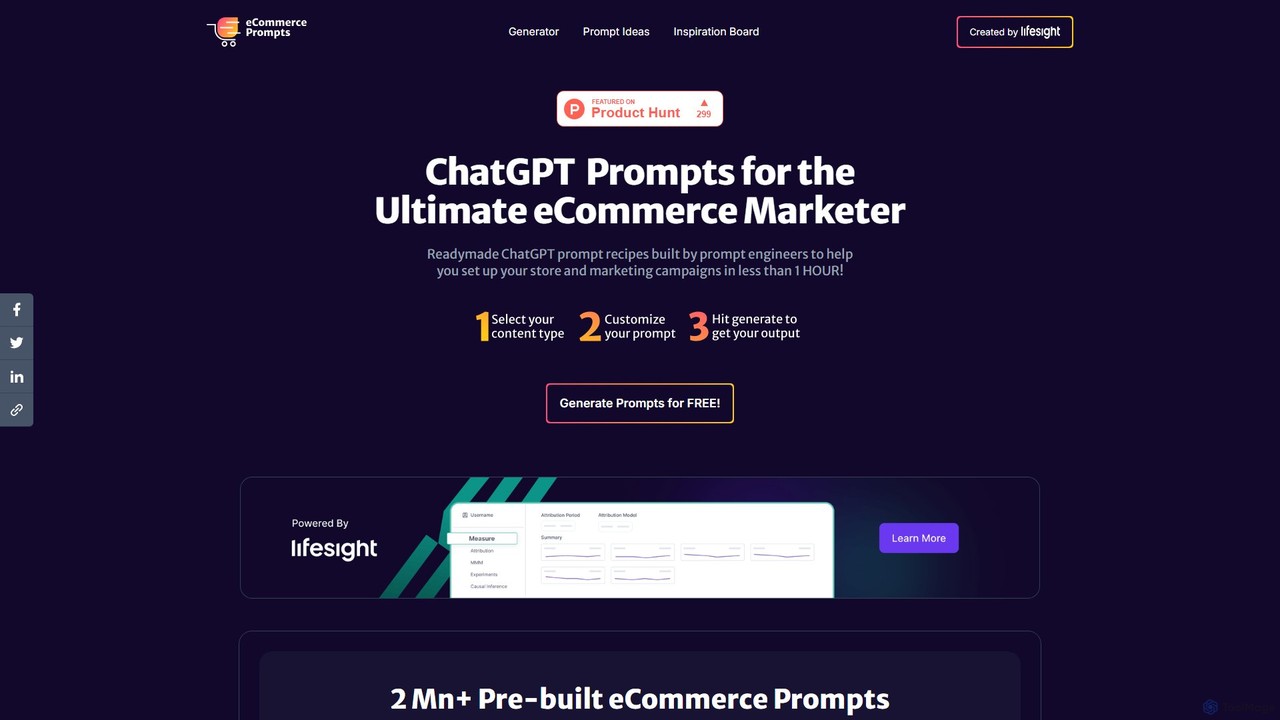
A free AI prompt generator offering over 2 million pre-built, customizable prompts for eCommerce. It empowers marketers to rapidly create high-quality content for websites, ads, emails, and social media using expert-crafted ChatGPT prompt templates.

Content Creation
Visits 5.5KFavorites 166Likes 157
Phewture
Freemium

Phewture

Phewture is an AI knowledge platform offering over 1,000 expertly crafted AI prompts and recipes for marketers, creators, and entrepreneurs. It combines 40 years of marketing wisdom with advanced prompt engineering to help users boost creativity, enhance productivity, and create unique, high-impact content.

Learning
Visits 5.6KFavorites 184Likes 167

About Prompt Engineering

Prompt Engineering tools are specialized applications designed to help users craft, refine, and manage effective instructions for large language models (LLMs). These tools go beyond simple text input, providing structured interfaces, templates, and optimization features to control AI output with greater precision. They are crucial for marketers aiming to generate consistent, on-brand, and high-performing content at scale. By mastering the input, users can significantly improve the quality, relevance, and creativity of AI-generated text and images.

Core Features

  • Prompt Templates & Libraries: Access pre-built, tested prompts for common marketing tasks like ad copy, emails, and social media posts.
  • Prompt Optimization: Receive suggestions to improve prompt clarity, structure, and effectiveness for better AI responses.
  • Version Control & History: Track changes to prompts, compare different versions, and revert to previous iterations.
  • Parameter Tuning: Fine-tune advanced AI model settings like temperature and top-p directly within the tool for creative or factual outputs.
  • Team Collaboration: Share, comment on, and manage a central library of prompts for consistent use across a marketing team.

Use Cases

Prompt Engineering tools are essential for digital marketing teams, content creators, and performance marketers. They are used to standardize the creation of brand-aligned blog posts, generate hundreds of ad copy variations for A/B testing, and develop complex, multi-touch email campaigns with a consistent narrative.

How to Choose

When selecting a Prompt Engineering tool, consider its integration with the AI models you use (e.g., GPT-4, Claude). Evaluate the quality and variety of its prompt library, the sophistication of its optimization features, and its collaboration capabilities for team-based workflows. Also, assess the user interface's ease of use and whether its pricing scales with your usage needs.

Prompt Engineering use cases

1

Generate Hyper-Personalized Ad Copy Variations

A performance marketer needs to create ad campaigns for five different customer segments on three social media platforms. Instead of manually writing each ad, they use a Prompt Engineering tool to build a master prompt. This prompt includes variables for audience persona, product features, and platform format. The tool then systematically combines these variables, generating dozens of unique, highly-targeted ad copy and headline combinations in minutes. This allows for extensive A/B testing, leading to a higher click-through rate and lower cost per acquisition.

2

Maintain a Consistent Brand Voice in Content Creation

A content marketing manager for a B2B SaaS company needs to ensure all AI-generated content, from blog posts to case studies, adheres to their specific brand voice: professional, insightful, and data-driven. They create a "Brand Voice" prompt template that defines the tone, target audience (e.g., CTOs), key terminology to use, and topics to avoid. Team members and freelancers use this foundational prompt, ensuring all AI-generated drafts start with a consistent, on-brand base, reducing editing time by over 50%.

3

Automate Market Research Analysis and Summarization

A market analyst is tasked with analyzing hundreds of customer reviews from various online platforms. Manually reading and categorizing this feedback would take days. Instead, the analyst uses a prompt engineering tool to design a multi-step prompt. The first step instructs the AI to identify the sentiment (positive, negative, neutral) of each review. Subsequent steps ask the AI to extract key themes, such as 'pricing', 'customer support', or 'feature requests', and then to generate a concise executive summary of the findings. This process transforms unstructured qualitative data into an actionable report in under an hour.

4

Develop Complex Email Marketing Sequences

An email marketer wants to build a 5-part welcome email series for new subscribers. Crafting each email to be engaging and consistent is time-consuming. Using a prompt engineering platform, they create a 'chain prompt' that builds on the previous output. The first prompt generates the initial welcome email. The second prompt takes that output as context and writes a follow-up email introducing a key product feature. This continues for all five emails, ensuring a coherent narrative, consistent tone, and logical progression throughout the entire sequence, all generated in a fraction of the time it would take manually.

5

Optimize SEO Content Briefs for AI Writers

An SEO specialist needs to create a detailed content brief for a new blog post. Instead of a simple list of keywords, they use a prompt engineering tool to construct a comprehensive prompt. This prompt includes the primary keyword, long-tail variations, target audience, search intent, a required article structure with H2/H3 headings, internal linking suggestions, and a negative keyword list. This structured prompt acts as a highly detailed set of instructions for an AI writing tool, guiding it to produce a draft that is not only well-written but also highly optimized for search engines from the very first version, significantly reducing revision cycles.

6

Craft Engaging Social Media Campaigns from Templates

A social media manager is launching a new product and needs content for Twitter, LinkedIn, and Instagram. Using a prompt engineering tool with a template library, they select a 'Product Launch Campaign' template. The template prompts them to input the product name, key benefits, target audience, and a call-to-action. The tool then generates a suite of platform-specific content: a witty Twitter thread, a professional LinkedIn announcement, and several engaging Instagram caption ideas with relevant hashtag suggestions. This approach ensures consistency across the campaign while saving hours of creative brainstorming.

Prompt Engineering FAQ

What is Prompt Engineering?

Prompt Engineering is the process of designing and refining inputs (prompts) to guide generative AI models toward producing specific, high-quality outputs. It's more than just asking a question; it involves using specific keywords, structuring information, providing context, and defining constraints to control the AI's response. In a marketing context, this skill is used to create content that is accurate, on-brand, and tailored to a specific audience or campaign goal.

How do I choose a Prompt Engineering tool for marketing?

To choose the right tool for marketing, evaluate these four key areas:

  • Model Compatibility: Ensure it supports the AI models your team uses (like GPT-4, Claude, Gemini).
  • Marketing-Specific Features: Look for features like brand voice templates, A/B testing for prompts, and libraries with pre-built marketing prompts.
  • Usability: The interface should be intuitive for marketers, not just developers, allowing for easy creation and management of complex prompts.
  • Collaboration: Check if it allows team members to share, comment on, and manage a centralized prompt library to ensure brand consistency.

What's the difference between using a standard AI chatbot and a Prompt Engineering tool?

A standard AI chatbot is the end-user application that people interact with. A Prompt Engineering tool is a 'behind-the-scenes' application used to build and perfect the instructions (the 'system prompt' or logic) that control how that chatbot behaves and responds. In essence, you use a Prompt Engineering tool to make a standard AI chatbot smarter, more accurate, and more aligned with your specific marketing goals, such as lead generation or customer support.

Why is Prompt Engineering important for marketing?

Prompt Engineering is crucial for marketing because it directly impacts the quality and consistency of AI-generated content. A well-crafted prompt ensures that content aligns with brand voice, targets the correct audience, and achieves specific goals like driving conversions or engagement. It moves marketers from being passive users of AI to active directors of its output. This control is essential for scaling content production without sacrificing quality, maintaining brand identity, and ultimately achieving a better return on investment from AI tools.

What are some key techniques in Prompt Engineering?

Several key techniques help create effective prompts. Zero-shot prompting is giving a direct instruction without examples. Few-shot prompting includes a few examples in the prompt to guide the AI's output style. Chain-of-thought prompting encourages the AI to 'think step-by-step' to solve complex problems. Another technique is using personas, where you instruct the AI to act as an expert (e.g., 'Act as a senior copywriter') to improve the quality and tone of the response. Prompt engineering tools often help users apply these techniques through structured interfaces and templates.