Marketing Best in category 1 results Saas AI Tool

Popular AI tools in the Saas field of Marketing include ShipFast, etc., helping you quickly improve efficiency.

ShipFast

ShipFast

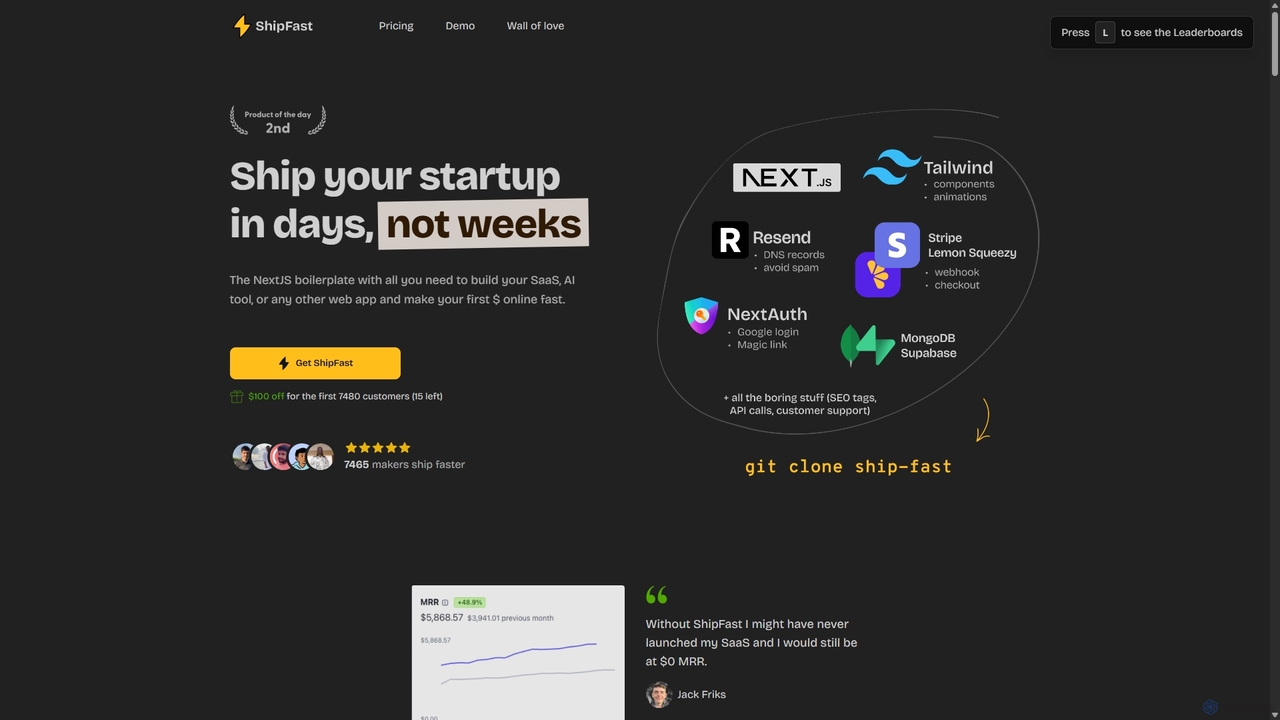
ShipFast is a Next.js boilerplate designed for developers and entrepreneurs to launch SaaS, AI tools, and web applications …

104.3K

About Saas

AI for SaaS tools are specialized marketing platforms using machine learning to analyze user behavior and automate growth for subscription businesses. These tools process in-app event data and customer interactions to predict outcomes like churn, conversion, and lifetime value (LTV). This enables SaaS companies to personalize user onboarding, optimize pricing, and proactively improve retention. They often integrate directly with product analytics and CRM systems, providing a unified view of the entire customer lifecycle within the marketing context.

Core Features

  • Churn Prediction: Identifies users at risk of canceling their subscription based on behavioral patterns.
  • User Segmentation: Automatically groups users based on their in-app actions, engagement levels, and predicted value.
  • Onboarding Personalization: Delivers tailored in-app guides, tutorials, and messages to new users to increase activation rates.
  • Pricing Optimization: Analyzes usage data and customer segments to recommend optimal pricing tiers and strategies.
  • Lead Scoring (PQL): Identifies Product-Qualified Leads who are most likely to convert to paying customers based on their trial usage.

Use Cases

These tools are primarily used by Growth Managers, Product Marketers, and Customer Success teams within SaaS companies. They are crucial for implementing product-led growth (PLG) strategies, reducing revenue churn, and identifying upselling opportunities by understanding precisely how users derive value from the product.

How to Choose

When selecting an AI for SaaS tool, consider its integration capabilities with your existing tech stack (e.g., Segment, Mixpanel, Salesforce). Evaluate the accuracy and transparency of its predictive models. Also, assess its data privacy and security compliance (like GDPR and CCPA) and ensure its pricing model aligns with your business scale and growth stage.

SaasUse Cases

1

Predicting and Reducing Customer Churn

A Growth Manager at a B2B SaaS company uses an AI tool to analyze product usage data from thousands of users. The AI identifies subtle behavioral patterns that correlate with churn, such as decreased feature usage or a drop in session frequency. Based on these predictions, the system automatically triggers targeted retention campaigns, like offering a discount or a personalized training session to at-risk users, effectively reducing churn by proactively addressing user issues before they decide to cancel.

2

Personalizing the User Onboarding Experience

A Product Marketer aims to increase the activation rate for new trial users. They use an AI for SaaS tool to segment new users in real-time based on their role, company size, and initial in-app actions. The AI then delivers a personalized onboarding flow for each segment, highlighting the most relevant features. For example, a developer is shown API documentation first, while a marketer sees dashboard and reporting features. This tailored experience helps users find value faster, significantly boosting the trial-to-paid conversion rate.

3

Optimizing SaaS Pricing Strategies

A SaaS company wants to revise its pricing tiers to maximize revenue. An AI tool analyzes feature usage data across different customer segments and pricing plans. It identifies which features are most valued by high-LTV customers and which are underutilized. The model then simulates revenue outcomes for various new pricing packages, recommending a revised structure that bundles high-value features into a premium tier. This data-driven approach helps the company move away from guesswork and confidently introduce pricing that better reflects customer value.

4

Automating Feature Adoption Campaigns

A Customer Success Manager needs to drive adoption for a newly released feature. Instead of sending a generic email blast, they use an AI tool that identifies the user segment most likely to benefit from the new feature based on their past behavior. The system then triggers automated, in-app messages and personalized email sequences to this specific segment. The AI monitors engagement with these messages and feature usage, optimizing the campaign in real-time to maximize adoption rates with minimal manual effort.

5

Identifying Product-Qualified Leads (PQLs)

A sales team at a SaaS company struggles to prioritize which trial users to contact. An AI tool analyzes the in-app behavior of all trial users and assigns a PQL score to each. The score is based on actions that indicate a high purchase intent, such as inviting team members, using advanced features, or integrating with other tools. The sales team can then focus their efforts on the highest-scoring PQLs, leading to more efficient outreach, higher conversion rates, and a shorter sales cycle.

6

Generating AI-Powered Content for In-App Guides

A content team needs to create helpful tooltips and guides for hundreds of features within their SaaS product. Using an AI for SaaS tool with generative capabilities, they can automatically create draft content for these guides. The AI analyzes the feature's functionality and common user questions to generate clear, concise explanations and step-by-step instructions. This process accelerates content creation, ensures consistency across all in-app help documentation, and allows the team to focus on refining and publishing high-quality content faster.

SaasFrequently Asked Questions