theysaid
theysaid is an AI-powered survey platform that transforms traditional data collection into dynamic, conversational experiences. It helps businesses …
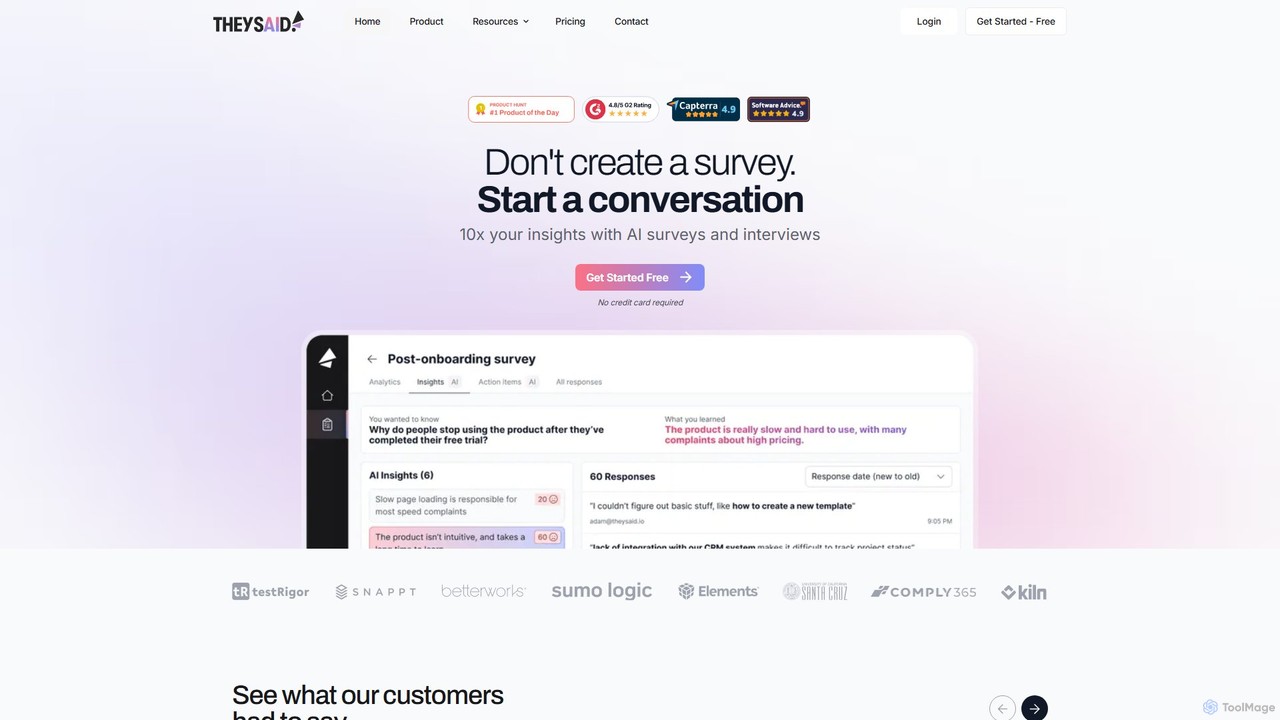
theysaid is an AI-powered survey platform that transforms traditional data collection into dynamic, conversational experiences. It helps businesses gather deep qualitative feedback at scale through AI-driven surveys, interviews, and forms, automatically analyzing responses to uncover actionable insights and themes.
About Surveys & Feedback
AI Surveys & Feedback tools are a class of applications that use artificial intelligence to create, distribute, and analyze surveys and user feedback. These tools leverage Natural Language Processing (NLP) and machine learning to interpret open-ended text responses, identifying sentiment, key themes, and actionable insights automatically. They transform raw qualitative data into structured, quantitative results, enabling organizations to understand customer and employee opinions at scale. This allows for faster, data-driven decision-making in product development, marketing strategy, and customer experience management.
Core Features
- AI Question Generation: Automatically creates relevant, unbiased, and context-aware survey questions based on a specified goal.
- Sentiment & Thematic Analysis: Analyzes unstructured text feedback to detect emotions (positive, negative, neutral) and group comments into recurring themes.
- Conversational Forms: Builds interactive, chat-like surveys that adapt questions in real-time based on the user's previous answers.
- Automated Insight Reporting: Generates dynamic dashboards and summary reports that highlight key findings, trends, and significant data points without manual effort.
- Predictive Analytics: Uses feedback data to forecast trends, predict customer churn, or identify potential areas of dissatisfaction.
Use Cases
These tools are widely used by product managers, marketing teams, customer experience (CX) specialists, and HR departments. Common applications include analyzing product feedback to prioritize feature development, measuring customer satisfaction through NPS/CSAT surveys and analyzing the qualitative reasons behind the scores, and conducting employee engagement studies to understand workplace sentiment.
How to Choose
When selecting an AI Surveys & Feedback tool, consider the sophistication of its NLP and text analysis engine, as this determines the quality of insights. Evaluate its integration capabilities with your existing CRM, helpdesk, or marketing automation platforms. Also, assess the flexibility of the survey builder, the clarity of the reporting dashboards, and the platform's data security and privacy compliance.

Surveys & FeedbackUse Cases
Analyze Product Feature Feedback at Scale
A product manager for a software company needs to understand user sentiment about a newly launched feature. Instead of manually reading through hundreds of open-ended survey responses and support tickets, they use an AI feedback tool. The tool automatically ingests all the text data, performs sentiment analysis on each comment, and clusters the feedback into key themes like 'UI Confusion,' 'Performance Lag,' and 'Feature Request: Export Option.' This provides a clear, data-backed summary in minutes, allowing the product team to quickly identify and prioritize the most critical improvements for the next development cycle.
Automate Net Promoter Score (NPS) Analysis
A marketing team runs quarterly NPS surveys to gauge customer loyalty. While calculating the score is simple, understanding the 'why' behind it is challenging. They implement an AI survey tool that automatically analyzes the open-ended comments accompanying each score. The AI categorizes feedback from 'Detractors' to identify common pain points (e.g., 'high price,' 'poor customer service') and analyzes 'Promoters' comments to find key strengths ('intuitive design,' 'fast delivery'). This automation saves the team dozens of hours and provides actionable insights to improve the customer experience and increase the NPS score over time.
Create Dynamic Employee Engagement Surveys
An HR department wants to move beyond static annual surveys to get more nuanced feedback. They use an AI tool to build a conversational survey. When an employee gives a low score on 'Work-Life Balance,' the AI form dynamically asks a follow-up question like, 'Could you tell us more about what aspects are challenging?'. This interactive approach feels more like a conversation, encouraging more detailed responses. The AI then analyzes all qualitative data to highlight key concerns across different departments, such as 'meeting overload' in engineering or 'lack of flexible hours' in marketing, enabling HR to propose targeted solutions.
Generate Market Research Surveys Instantly
A startup's marketing lead needs to quickly create a survey to understand consumer perceptions of a new product concept. Lacking a dedicated research team, they use an AI survey generator. They simply input the objective: 'Assess market viability for a plant-based protein shake for athletes.' The AI instantly generates a comprehensive draft survey, including questions on demographics, current habits, price sensitivity, and feature preferences. The marketer can then review and refine the questions, saving hours of brainstorming and ensuring the survey covers all critical research areas before launching it to a target audience.
Triage Real-time Customer Support Feedback
A customer support manager wants to proactively identify and address poor service experiences. They integrate an AI feedback tool with their helpdesk software. After a support ticket is closed, a micro-survey is sent to the customer. The AI analyzes the response in real-time. If it detects strong negative sentiment or keywords like 'unresolved' or 'frustrated,' it automatically creates a high-priority follow-up ticket and assigns it to a senior support agent or manager. This system ensures that negative experiences are addressed within hours, not days, helping to recover customer relationships and reduce churn.
Analyze Open-Ended Feedback from Website Widgets
A UX designer places a feedback widget on a newly redesigned checkout page to gather user impressions. The widget simply asks, 'What do you think of our new checkout process?'. It collects hundreds of unstructured comments daily. An AI feedback tool is connected to this widget's data feed. It continuously analyzes new entries, categorizing them into 'Positive Feedback,' 'Bug Reports,' 'Usability Issues,' and 'Suggestions.' The designer can view a dashboard that visualizes these categories over time, allowing them to quickly spot emerging problems (e.g., a spike in 'Bug Reports' after a new browser update) without reading every single comment.