Phare
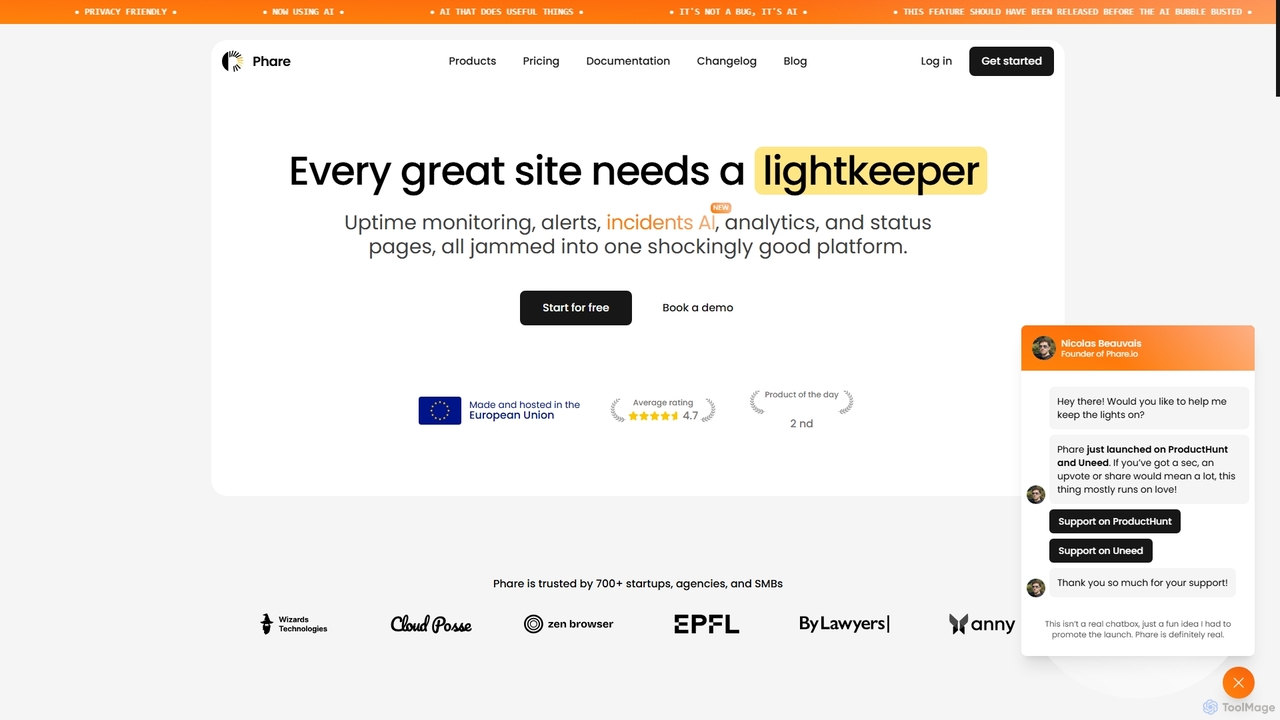
Phare is a comprehensive platform for website uptime monitoring, incident management, and custom status pages. It offers real-time …
Phare is a comprehensive platform for website uptime monitoring, incident management, and custom status pages. It offers real-time alerts, AI-powered incident summaries, and a flexible pricing model to ensure your online services run successfully and reliably.
Amarsia
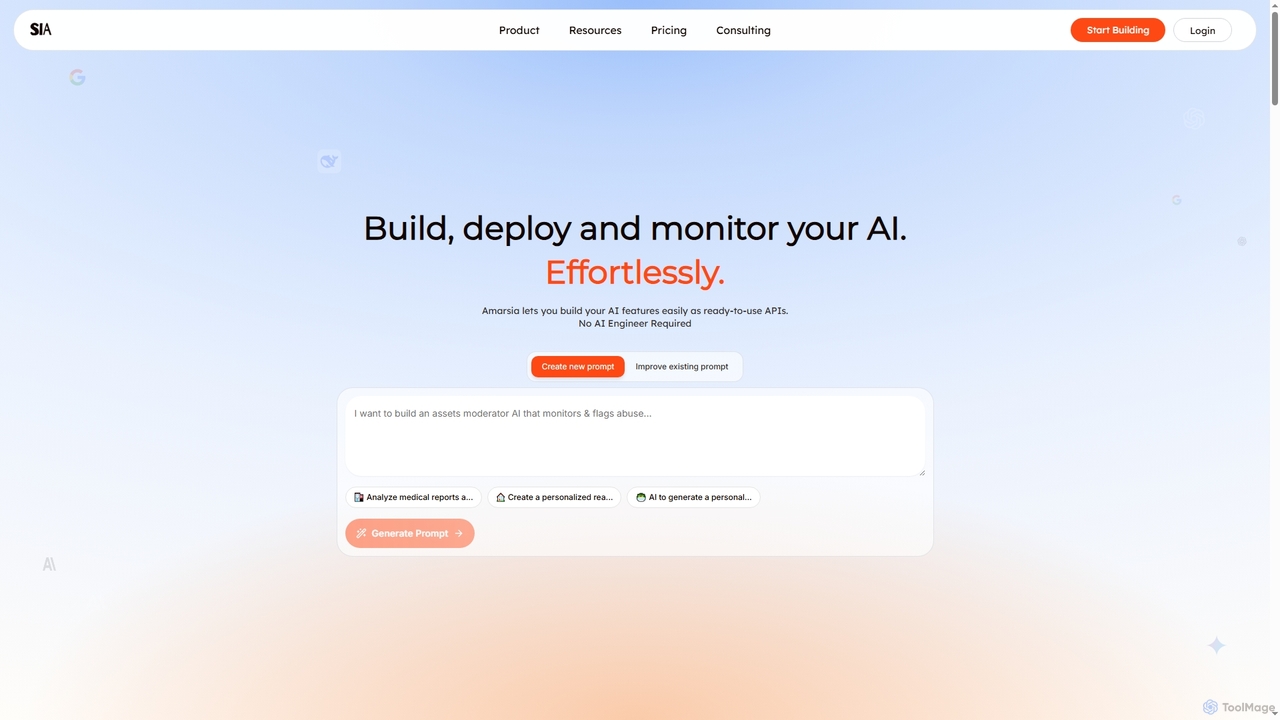
Amarsia is an intuitive platform designed to help teams effortlessly build, deploy, and monitor custom AI features as …
Amarsia is an intuitive platform designed to help teams effortlessly build, deploy, and monitor custom AI features as ready-to-use APIs. It eliminates the need for extensive coding or AI engineering expertise, enabling rapid development of intelligent workflows, knowledge bases, and multimodal AI solutions with built-in version control and performance monitoring.
About Monitoring
AI Monitoring tools are a class of software that leverages machine learning and data science to automatically observe, analyze, and manage the health and performance of complex systems. These tools process vast amounts of data from sources like logs, metrics, and traces to identify patterns, detect anomalies, and predict potential issues before they impact users. Their primary value lies in transforming reactive problem-solving into proactive system management, significantly improving reliability and operational efficiency. By providing deep insights and automating analysis, they empower teams to maintain optimal performance in dynamic IT environments.
Core Features
- Anomaly Detection: Automatically identifies unusual patterns and outliers in data that deviate from established baselines, signaling potential problems.
- Predictive Analytics: Uses historical data to forecast future trends, resource needs, and potential system failures, enabling preemptive action.
- Root Cause Analysis (RCA): Correlates events and data points across multiple systems to pinpoint the underlying source of an issue, reducing troubleshooting time.
- Intelligent Alerting: Groups related alerts, suppresses noise, and prioritizes critical notifications to prevent alert fatigue and focus teams on what matters.
- Automated Reporting: Generates dynamic dashboards and reports that visualize system health, performance trends, and key operational metrics.
Applicable Scenarios
These tools are essential for IT Operations (AIOps), DevOps, and Site Reliability Engineering (SRE) teams managing large-scale applications and infrastructure. They are also widely used in cybersecurity for threat detection and in business operations to monitor the performance of critical processes. For example, an e-commerce platform uses AI monitoring to predict traffic spikes and prevent downtime during sales events, while a financial institution uses it to detect fraudulent transaction patterns in real-time.
Selection Criteria
When choosing an AI Monitoring tool, consider its data source compatibility and integration capabilities with your existing stack (e.g., cloud services, databases). Evaluate the sophistication and transparency of its machine learning models for accurate anomaly detection and RCA. Assess its scalability to handle your data volume and the quality of its alerting system to ensure it provides actionable insights without excessive noise. Finally, consider the total cost of ownership, including implementation and maintenance efforts.
MonitoringUse Cases
Proactive IT Infrastructure Management
For a Site Reliability Engineer (SRE) managing a global cloud infrastructure, manually tracking thousands of metrics is impossible. By deploying an AI Monitoring tool, the SRE can automate the analysis of CPU utilization, memory usage, and network latency across all servers. The AI establishes dynamic performance baselines and predicts when a server cluster is likely to exceed its capacity based on recent growth trends. This allows the SRE team to provision new resources proactively, preventing performance degradation and potential outages, thereby maintaining a high service level agreement (SLA).
Advanced Cybersecurity Threat Detection
A Security Operations Center (SOC) analyst is tasked with protecting a corporate network from sophisticated cyberattacks. Traditional rule-based systems often miss novel threats. Using an AI Monitoring tool specialized in security, the analyst can continuously analyze network traffic and user behavior data. The AI model learns normal activity patterns and automatically flags anomalous behavior, such as an employee accessing sensitive files at an unusual time or data being exfiltrated to an unknown IP address. This allows the SOC team to investigate and neutralize threats much faster than manual analysis would permit, significantly reducing the risk of a major data breach.
Optimizing Application Performance (APM)
A development team for a popular mobile banking app needs to ensure a smooth user experience. An AI-powered Application Performance Monitoring (APM) tool is used to trace every user transaction, from login to fund transfer. The tool automatically identifies slow database queries or inefficient API calls that cause delays. Instead of just flagging an error, the AI correlates the performance issue with specific code commits or infrastructure changes, providing developers with a direct pointer to the root cause. This reduces the mean time to resolution (MTTR) from hours to minutes, ensuring app responsiveness and high user satisfaction ratings.
Monitoring Business KPIs and User Experience
A product manager for an e-commerce website wants to monitor the real-time impact of a new feature on user engagement and sales. An AI Monitoring tool is configured to track key business metrics like conversion rates, cart abandonment, and revenue per user. The AI detects a sudden drop in the conversion rate shortly after a new software deployment. It automatically correlates this business metric dip with a spike in page load times on checkout pages, identifying the performance issue as the likely cause. This allows the product team to quickly alert engineering and roll back the change, minimizing financial losses and protecting the user experience.
Automated Log Analysis and Management
An IT administrator for a large enterprise is responsible for systems that generate millions of log entries per hour. Manually searching through these logs for errors is impractical. By feeding all log data into an AI Monitoring platform, the system automatically clusters similar log messages, identifies rare or anomalous entries, and detects error patterns across different applications. When a critical application fails, the AI can surface the exact error logs related to the crash in seconds, along with contextual logs from associated services, providing a complete picture of the failure event without manual effort.
Cloud Cost Optimization and Forecasting
A FinOps manager aims to control the escalating cloud computing costs for their organization. An AI Monitoring tool focused on cloud environments analyzes resource usage patterns across services like AWS EC2 and Azure VMs. It identifies underutilized instances that can be downsized and recommends purchasing Reserved Instances for workloads with predictable usage, generating immediate cost savings. Furthermore, its predictive models forecast future cloud spend based on project pipelines and historical growth, allowing the manager to set accurate budgets and avoid unexpected overages, optimizing the company's cloud investment by over 20%.