ProductLoop
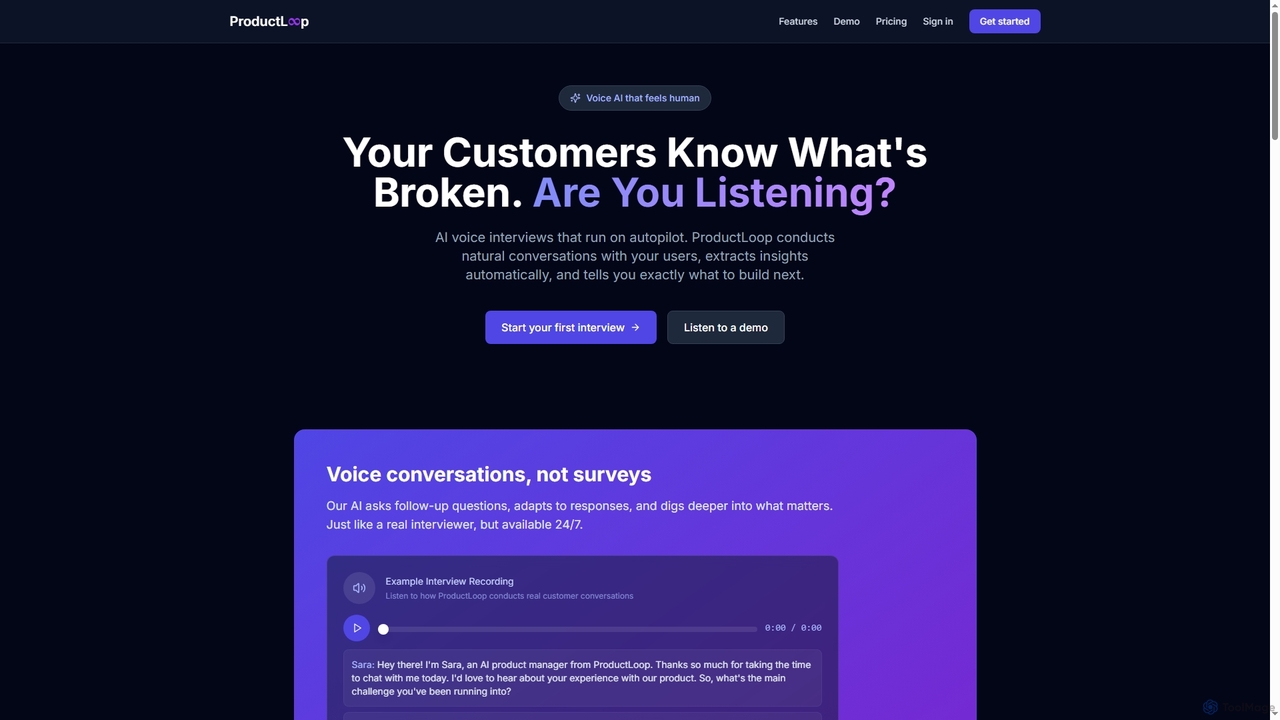
ProductLoop is an AI-powered platform that automates customer voice interviews to gather deep, actionable insights for product teams …
ProductLoop is an AI-powered platform that automates customer voice interviews to gather deep, actionable insights for product teams and service companies. It conducts natural conversations, extracts key data like pain points and feature requests, and provides aggregated feedback to inform product development and service quality improvements.
Reddit Problem Finder
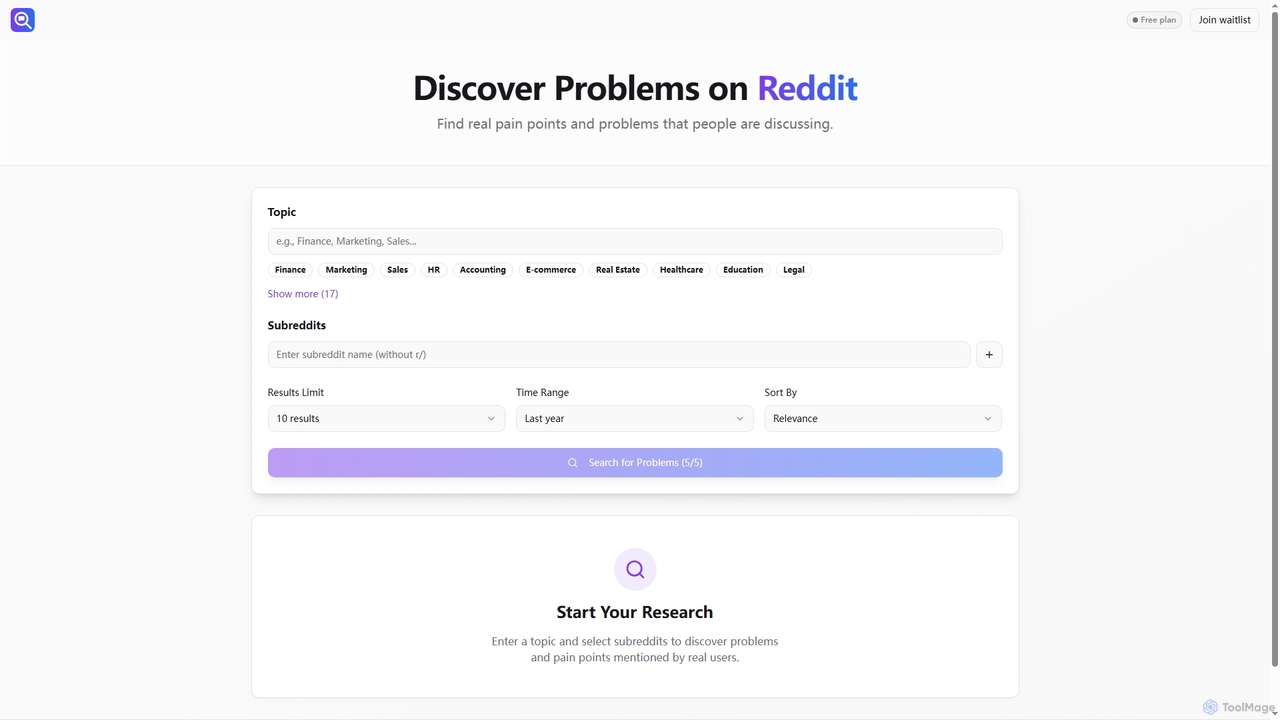
Reddit Problem Finder is an AI-powered tool designed to uncover real pain points and market insights by analyzing …
Reddit Problem Finder is an AI-powered tool designed to uncover real pain points and market insights by analyzing discussions on Reddit. It helps users identify problems, trends, and unmet needs across various topics and subreddits, offering valuable data for product development, content creation, and strategic planning.
About User Feedback
AI User Feedback tools are platforms that use natural language processing (NLP) and machine learning to automatically analyze customer comments, reviews, and support tickets. They work by identifying key themes, sentiment, and user intent from unstructured text data across multiple channels. This allows product teams to quickly synthesize vast amounts of qualitative data into actionable insights, accelerating product improvement cycles. Their key advantage is transforming raw, messy feedback into structured, quantifiable data for strategic decision-making within the product management lifecycle.
Core Features
- Sentiment Analysis: Automatically determines the emotional tone (positive, negative, neutral) of feedback to gauge user satisfaction.
- Topic & Theme Clustering: Groups similar feedback points together to identify recurring issues, bugs, or feature requests without manual tagging.
- Multi-Channel Integration: Connects with sources like app stores, social media, support chats, and surveys to centralize all feedback in one place.
- Insight Prioritization: Uses AI to score and rank feedback based on urgency, frequency, or potential business impact, helping teams focus on what matters most.
Use Cases
Primarily used by product managers, UX researchers, and customer support teams. These tools are essential for monitoring product health in real-time, validating new ideas with qualitative evidence, and prioritizing development roadmaps based on aggregated user needs rather than guesswork.
How to Choose
When selecting an AI User Feedback tool, evaluate its integration capabilities with your existing stack (e.g., Jira, Slack, Zendesk). Assess the accuracy of its NLP and sentiment analysis models, especially for industry-specific jargon. Also, consider the quality of its data visualization features for reporting and its ability to handle multiple languages if you serve a global audience.

User FeedbackUse Cases
Automating App Store Review Analysis
A product manager for a mobile app uses an AI feedback tool to connect to the Apple App Store and Google Play Store. Instead of manually reading hundreds of new reviews each week, the AI automatically aggregates, translates, and analyzes them. It tags reviews by feature (e.g., 'UI', 'login', 'performance'), identifies emerging bugs, and flags reviews with negative sentiment for urgent attention. This process reduces manual analysis time by over 90% and provides a real-time dashboard of user satisfaction, enabling the team to quickly address critical issues and prioritize improvements for the next update.
Prioritizing Feature Requests from Support Tickets
A B2B SaaS company integrates its AI feedback tool with its customer support platform (e.g., Zendesk or Intercom). The AI analyzes thousands of support conversations and tickets, automatically identifying and clustering feature requests. It quantifies the demand for each feature by tracking how many different customers request it. This provides the product team with a data-driven list of the most requested features, ranked by volume and customer segment. As a result, they can confidently prioritize their development roadmap based on clear user needs, rather than relying on anecdotal evidence from the sales or support teams.
Gauging Sentiment After a New Feature Launch
A marketing team wants to measure the reception of a major new feature. They use an AI feedback tool to monitor social media mentions, blog comments, and community forums related to their product. The tool provides a real-time sentiment analysis dashboard, showing the ratio of positive, negative, and neutral comments. It also surfaces the most common keywords and phrases associated with the launch. This allows the team to quickly identify what users love (e.g., 'easy to use'), what they dislike (e.g., 'confusing navigation'), and address any misinformation, ensuring a successful launch and rapid iteration based on immediate feedback.
Identifying Churn Risks from NPS Surveys
A customer success manager analyzes the open-ended responses from their quarterly Net Promoter Score (NPS) survey. Instead of just relying on the numerical score, they feed the text comments into an AI feedback tool. The AI analyzes comments from 'Detractors' (scores 0-6) and identifies common themes like 'high price,' 'missing integration with X,' or 'slow customer support.' This provides actionable insights into the root causes of dissatisfaction. The manager can then share a quantified report with the product and support teams to address these specific issues and proactively reduce customer churn.
Validating a Product Hypothesis with Beta Tester Feedback
A UX researcher is testing a new prototype with a group of beta testers. Feedback is collected through various channels, including a dedicated Slack channel, emails, and video call transcripts. The researcher uses an AI tool to centralize all this unstructured feedback. The AI clusters comments into themes, such as 'onboarding confusion,' 'positive feedback on dashboard,' and 'requests for mobile version.' This allows the researcher to quickly see if their initial product hypotheses are being validated or invalidated by real user interactions, providing clear, evidence-based direction for the next design iteration without days of manual sorting.
Consolidating Feedback for Quarterly Product Planning
A Head of Product needs to prepare for the quarterly roadmap planning meeting. They use an AI feedback tool to create a unified 'Voice of the Customer' dashboard. This dashboard pulls in and analyzes data from all feedback channels over the past quarter: app store reviews, support tickets, NPS surveys, and social media. The tool presents a high-level overview of the top 10 most requested features, the top 5 most reported bugs, and overall sentiment trends. This single, consolidated view provides the leadership team with objective, quantitative data to make strategic decisions about where to invest development resources in the upcoming quarter.