SmallVill
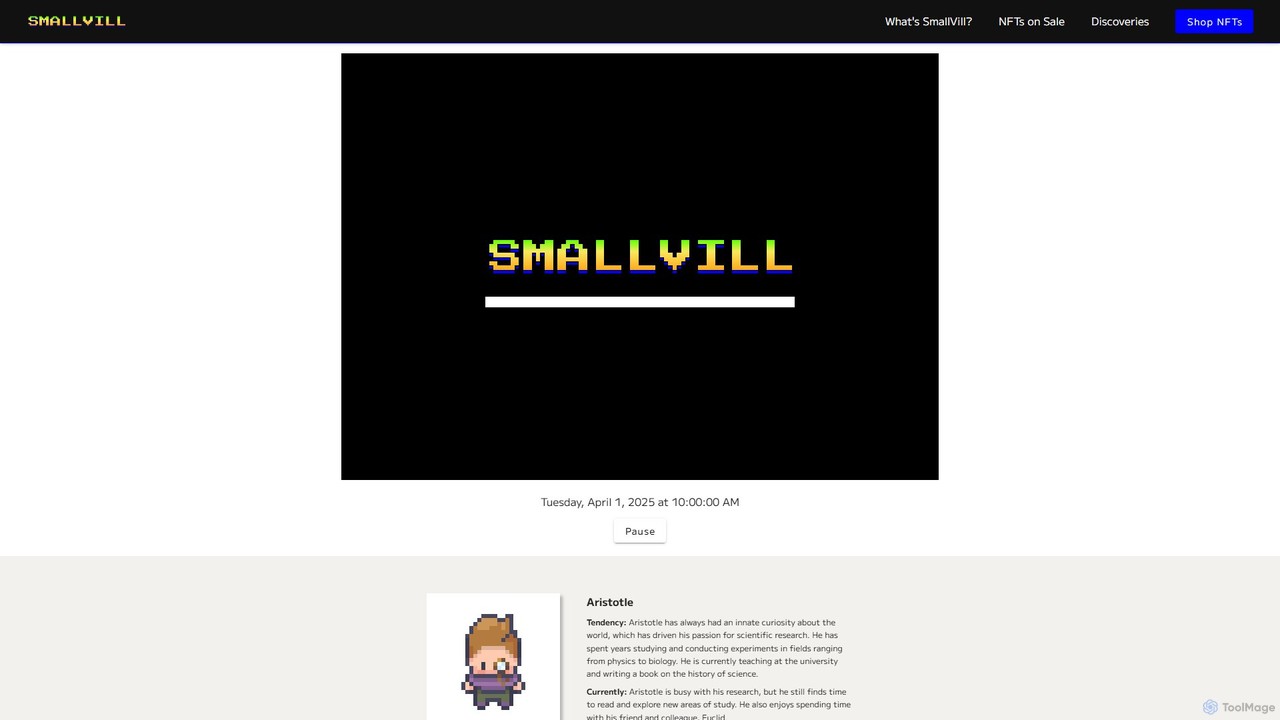
SmallVill is a groundbreaking virtual environment simulating the lives and interactions of dozens of AI agents. Inspired by …
SmallVill is a groundbreaking virtual environment simulating the lives and interactions of dozens of AI agents. Inspired by Stanford's research, it allows users to observe emergent social behaviors, from romantic planning to career changes, in a dynamic, modern village setting. It also features an exclusive NFT collection tied to its unique AI characters.
TheirTube
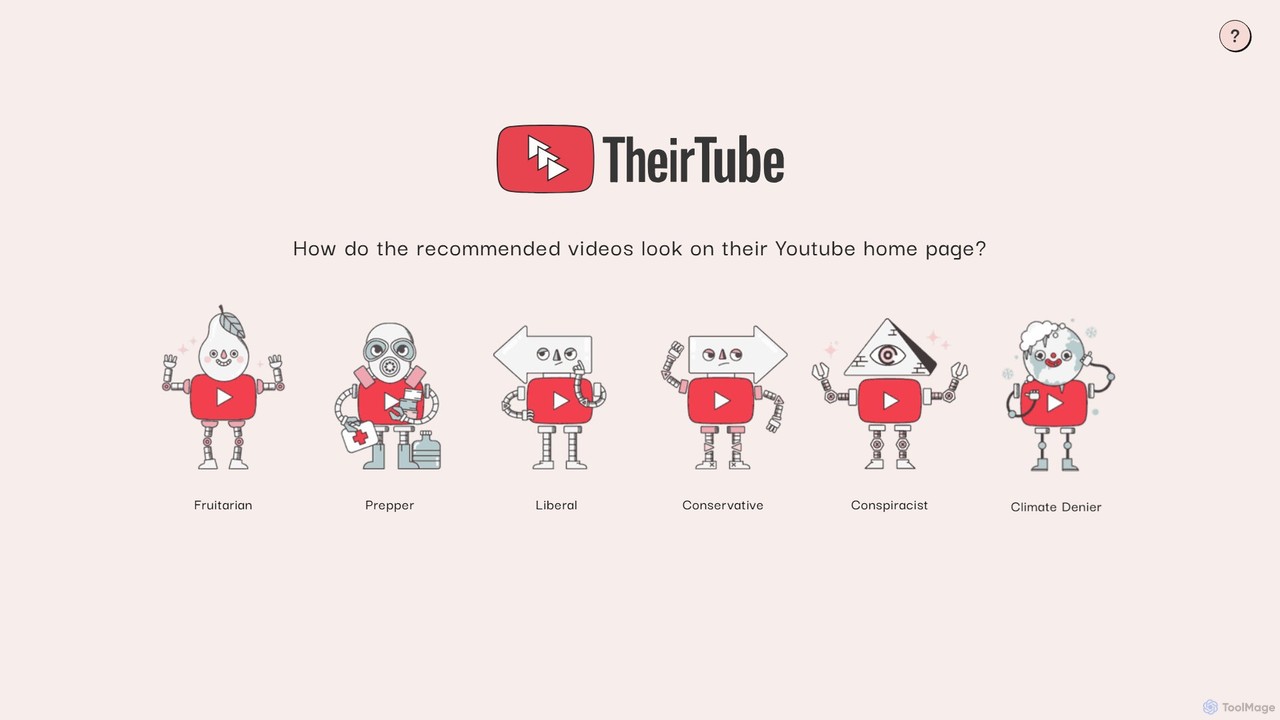
TheirTube is an educational tool that simulates YouTube's homepage to reveal how algorithmic filter bubbles work. By selecting …
TheirTube is an educational tool that simulates YouTube's homepage to reveal how algorithmic filter bubbles work. By selecting different user personas like 'Conservative' or 'Climate Denier,' you can see the specific video recommendations they would receive, offering a powerful insight into online echo chambers and media polarization.
About Social Science
AI Social Science tools are a specialized category of research software designed to analyze complex human behavior, social structures, and cultural data. These tools leverage Natural Language Processing (NLP) and machine learning to process and interpret large volumes of qualitative and quantitative information, such as interview transcripts, survey responses, and historical texts. They empower researchers to uncover deep patterns, sentiments, and thematic connections that are difficult to identify through manual methods alone. This enables more efficient, extensive, and nuanced analysis in fields like sociology, anthropology, and political science.
Core Features
- Qualitative Data Analysis: Automatically identifies themes, topics, and sentiment from unstructured text like interviews, focus groups, and open-ended survey answers.
- Quantitative Modeling & Simulation: Creates predictive models of social trends and runs agent-based simulations to test hypotheses about social dynamics.
- Automated Literature Review: Systematically finds, screens, summarizes, and synthesizes vast amounts of academic papers and reports to accelerate research.
- Network Analysis: Visualizes and analyzes relationships and connections between individuals, groups, or concepts within a dataset.
- Discourse & Narrative Analysis: Examines language use, framing, and storytelling structures within texts to understand underlying ideologies and perspectives.
Use Cases
These tools are primarily used by academic researchers, PhD students, policy analysts, and market researchers. For instance, a sociologist might use an AI tool to perform thematic analysis on hundreds of interview transcripts, or a political scientist could analyze social media data to gauge public opinion on a new policy. They are also valuable in digital humanities for analyzing historical archives and in UX research for processing user feedback at scale.
How to Choose
When selecting an AI Social Science tool, consider the following: First, ensure it supports your specific research methodology (e.g., grounded theory, content analysis). Second, check its compatibility with your data types (text, audio, survey data). Third, evaluate the transparency of its algorithms—good tools explain how they arrive at their conclusions. Finally, consider its integration capabilities with other research software and its collaboration features for team-based projects.

Social ScienceUse Cases
Automate Thematic Analysis of Interview Data
A sociologist conducting a study on urban displacement needs to analyze 50 hour-long interview transcripts. Manually coding this volume of text could take months. By using an AI Social Science tool, the researcher uploads all transcripts, and the AI automatically identifies recurring themes, concepts, and sentiment. It can group related quotes and generate visual maps of thematic connections, reducing the initial coding time by over 80%. This allows the researcher to focus on higher-level interpretation and theory-building rather than tedious manual labor.
Analyze Public Opinion on Social Media
A policy analyst needs to understand public reaction to a new environmental regulation. Instead of relying on traditional surveys, they use an AI tool to collect and analyze millions of public posts from social media platforms over a month. The tool performs sentiment analysis to classify posts as positive, negative, or neutral. It also uses topic modeling to identify the main arguments and concerns being discussed by the public, such as economic impact, effectiveness, and fairness. This provides real-time, large-scale insights that are more dynamic than periodic polls.
Accelerate Systematic Literature Reviews
A PhD student in public health is required to conduct a systematic review, which involves screening thousands of academic articles. This process is prone to human error and is extremely time-consuming. Using an AI-powered literature review tool, the student inputs their research questions and inclusion/exclusion criteria. The AI then scans databases and screens articles by title and abstract, presenting a shortlist of the most relevant papers. Some advanced tools can even extract key data points and synthesize findings, transforming a year-long process into a matter of weeks.
Model Complex Social Dynamics
An urban planner wants to predict the effects of a new public transit line on neighborhood gentrification. Using an agent-based modeling (ABM) tool powered by AI, they can create a virtual city populated by autonomous 'agents' representing residents with different income levels and preferences. The planner can run simulations to see how these agents react to the new transit line over time. The AI can optimize the simulation parameters to find scenarios that minimize displacement, providing data-driven evidence to support more equitable urban planning decisions.
Analyze Open-Ended Survey Responses at Scale
A market research firm collects a survey with 10,000 responses, including a critical open-ended question: 'What could we do to improve our service?'. Manually reading and categorizing these responses is impractical. They use an AI tool that processes all 10,000 text answers in minutes. The tool automatically clusters similar responses into categories like 'Better Customer Support,' 'Lower Prices,' and 'Faster Shipping.' It also provides sentiment scores for each category, allowing the firm to quickly prioritize the most urgent areas for improvement based on customer feedback.
Analyze Historical Texts for Digital Humanities
A historian is studying the evolution of the concept of 'liberty' in 18th-century political pamphlets. They have a digitized corpus of thousands of documents. Using an AI tool for discourse analysis, they can track the frequency of the word 'liberty' and its associated terms over time. The tool can perform co-occurrence analysis to reveal which concepts (e.g., 'property,' 'rights,' 'slavery') were most frequently discussed alongside 'liberty' in different decades. This provides a quantitative, macro-level view of conceptual change that complements traditional close reading.