ToolMage
Sign in

Best 1 Ai Risk Assessment AI tools for Risk Management

Popular Ai Risk Assessment AI tools in Risk Management include Infinidatum, helping you work more efficiently.

Infinidatum
Freemium

Infinidatum

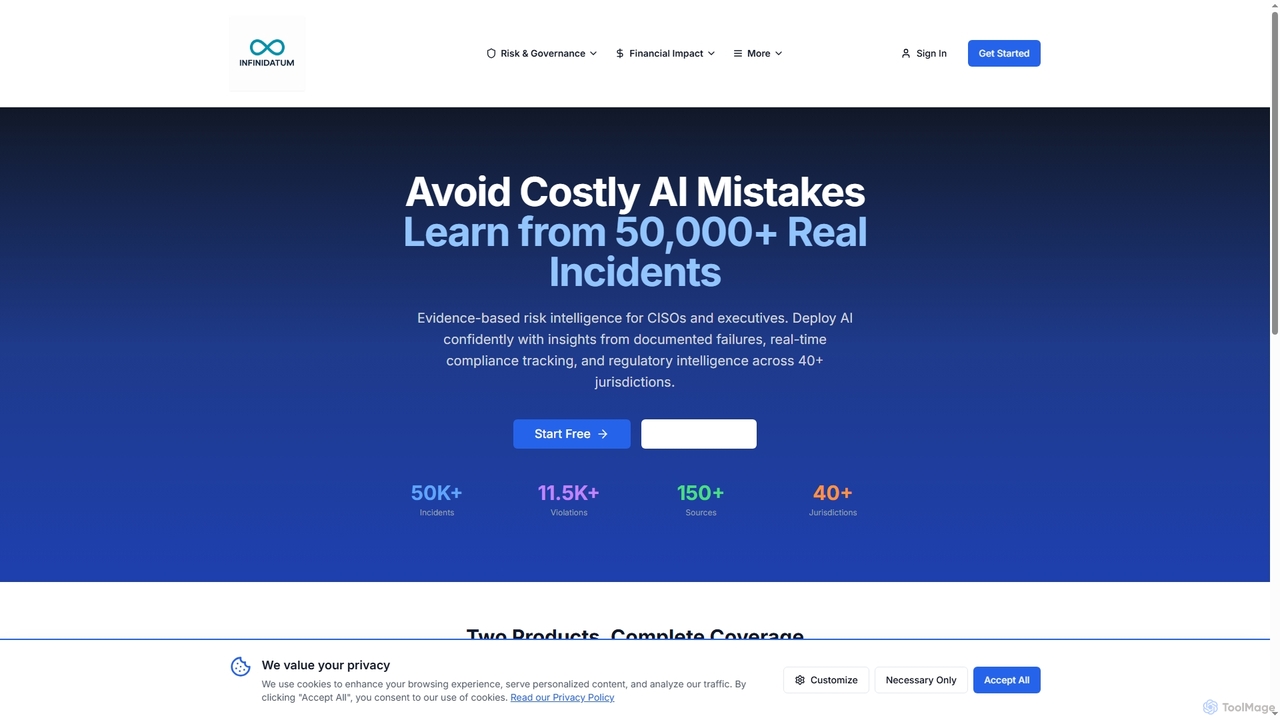
Infinidatum is an enterprise risk intelligence platform that empowers CISOs and executives to confidently deploy AI by providing evidence-based risk assessment and real-time compliance monitoring. It leverages insights from over 50,000 real incidents and tracks 11,500+ regulatory violations across 40+ jurisdictions.

Regulatory Monitoring
Visits 6KFavorites 125Likes 118

About Ai Risk Assessment

AI Risk Assessment tools are specialized platforms designed to identify, analyze, evaluate, and mitigate potential risks associated with Artificial Intelligence systems. These tools leverage advanced methodologies and frameworks to systematically uncover vulnerabilities, biases, and compliance issues inherent in AI models and their deployment. Their primary value lies in enabling organizations to develop and deploy AI responsibly, ensuring ethical considerations, data privacy, and regulatory adherence are proactively addressed.

Core Features

  • Bias Detection & Mitigation: Identifies and helps correct unfair biases in AI models, ensuring equitable outcomes across different demographic groups.
  • Data Privacy Compliance: Assesses AI systems for adherence to data protection regulations like GDPR or CCPA, minimizing privacy breach risks.
  • Model Explainability (XAI): Provides insights into how AI models make decisions, enhancing transparency and auditability for critical applications.
  • Security Vulnerability Scanning: Detects potential attack vectors and weaknesses in AI systems, such as adversarial attacks or data poisoning.
  • Regulatory Compliance Mapping: Maps AI system characteristics against relevant industry standards and legal frameworks, ensuring governance.

Applicable Scenarios

Organizations across various sectors utilize AI Risk Assessment tools to ensure responsible AI adoption. Financial institutions employ them to scrutinize AI-driven lending algorithms for fairness and regulatory compliance. Healthcare providers use them to assess diagnostic AI tools for accuracy, bias, and patient data privacy. Furthermore, any enterprise developing or deploying AI for critical decision-making benefits from these tools to manage ethical, operational, and reputational risks.

How to Choose

When selecting an AI Risk Assessment tool, consider its scope of risk coverage (e.g., bias, privacy, security, ethics). Evaluate its integration capabilities with existing MLOps pipelines and data governance frameworks. Assess the level of explainability and reporting features it offers, crucial for auditing and stakeholder communication. Finally, consider the tool's scalability and adaptability to evolving AI technologies and regulatory landscapes.

Ai Risk Assessment use cases

1

Ensuring Fairness in AI-Powered Lending

A financial institution's risk management team uses AI Risk Assessment tools to analyze their AI-driven loan approval system. They identify potential biases against specific demographic groups in the training data and model outputs. The tool helps them pinpoint the source of bias and suggests mitigation strategies, ensuring fair and non-discriminatory lending practices while complying with anti-discrimination laws.

2

Validating Patient Data Privacy in Healthcare AI

A healthcare technology company developing an AI diagnostic assistant employs these tools to verify compliance with HIPAA and GDPR. The tools scan the AI model's data handling processes, identifying any potential vulnerabilities where sensitive patient information could be exposed or misused. This ensures robust data privacy and builds patient trust.

3

Assessing AI Model Security Against Adversarial Attacks

An autonomous vehicle manufacturer utilizes AI Risk Assessment platforms to test their perception AI systems against adversarial attacks. The tools simulate various malicious inputs designed to trick the AI, helping engineers understand the system's vulnerabilities and implement defenses to prevent misclassification or dangerous decision-making in real-world scenarios.

4

Achieving Regulatory Compliance for AI in Critical Infrastructure

An energy grid operator deploying AI for predictive maintenance uses these tools to ensure their systems meet stringent industry regulations and safety standards. The assessment identifies gaps in governance, data lineage, and model transparency, providing a clear roadmap for achieving full compliance and minimizing operational risks.

5

Evaluating Ethical Implications of AI in Human Resources

A large corporation implementing an AI-powered hiring tool uses risk assessment to evaluate its ethical implications. The tool helps identify if the AI inadvertently discriminates based on gender, age, or background, ensuring the hiring process remains fair, transparent, and aligned with the company's diversity and inclusion goals.

6

Monitoring AI Performance Drift and Reliability

An e-commerce platform relies on AI for personalized recommendations. They use AI Risk Assessment to continuously monitor the recommendation engine for performance drift and reliability issues. The tools alert them to changes in model behavior that could lead to irrelevant suggestions or negative user experiences, allowing for proactive adjustments and maintaining customer satisfaction.

Ai Risk Assessment FAQ

What are AI Risk Assessment tools?

AI Risk Assessment tools are specialized software solutions designed to systematically identify, analyze, and mitigate potential risks associated with the development and deployment of Artificial Intelligence systems. These risks can include algorithmic bias, data privacy breaches, security vulnerabilities, ethical concerns, and regulatory non-compliance. They provide frameworks and automated checks to ensure AI systems are responsible, fair, and robust.

How do AI Risk Assessment tools differ from general risk management software?

While general risk management software covers broad organizational risks, AI Risk Assessment tools are specifically tailored to the unique complexities of AI. They focus on risks inherent to machine learning models, such as data bias, model explainability, adversarial attacks, and AI-specific regulatory compliance (e.g., AI Act). General tools lack the specialized algorithms and frameworks needed to evaluate these nuanced AI-specific challenges.

What key factors should I consider when choosing an AI Risk Assessment tool?

When selecting an AI Risk Assessment tool, prioritize its ability to cover a comprehensive range of AI-specific risks, including bias, privacy, security, and ethics. Look for strong integration capabilities with your existing MLOps and data governance platforms. Evaluate the tool's explainability features, reporting dashboards, and its adherence to emerging AI regulatory standards. Scalability and ease of use are also crucial for long-term adoption.

What types of risks do AI Risk Assessment tools typically address?

AI Risk Assessment tools address a wide array of risks. These include algorithmic bias (unfair outcomes for certain groups), data privacy risks (non-compliance with regulations like GDPR), security vulnerabilities (e.g., adversarial attacks, data poisoning), ethical concerns (societal impact, misuse), performance reliability (model drift, accuracy degradation), and regulatory compliance (adherence to AI-specific laws and standards).

Who benefits most from using AI Risk Assessment tools?

Organizations that develop, deploy, or extensively use AI systems benefit most. This includes enterprises in highly regulated industries like finance, healthcare, and critical infrastructure, where AI failures can have severe consequences. Data scientists, AI engineers, risk managers, compliance officers, and legal teams within these organizations leverage these tools to ensure their AI initiatives are responsible, compliant, and trustworthy.