Science Best in category 1 results Neuroscience AI Tool

Popular AI tools in the Neuroscience field of Science include Mind-Video, etc., helping you quickly improve efficiency.

Free
Mind-Video

Mind-Video

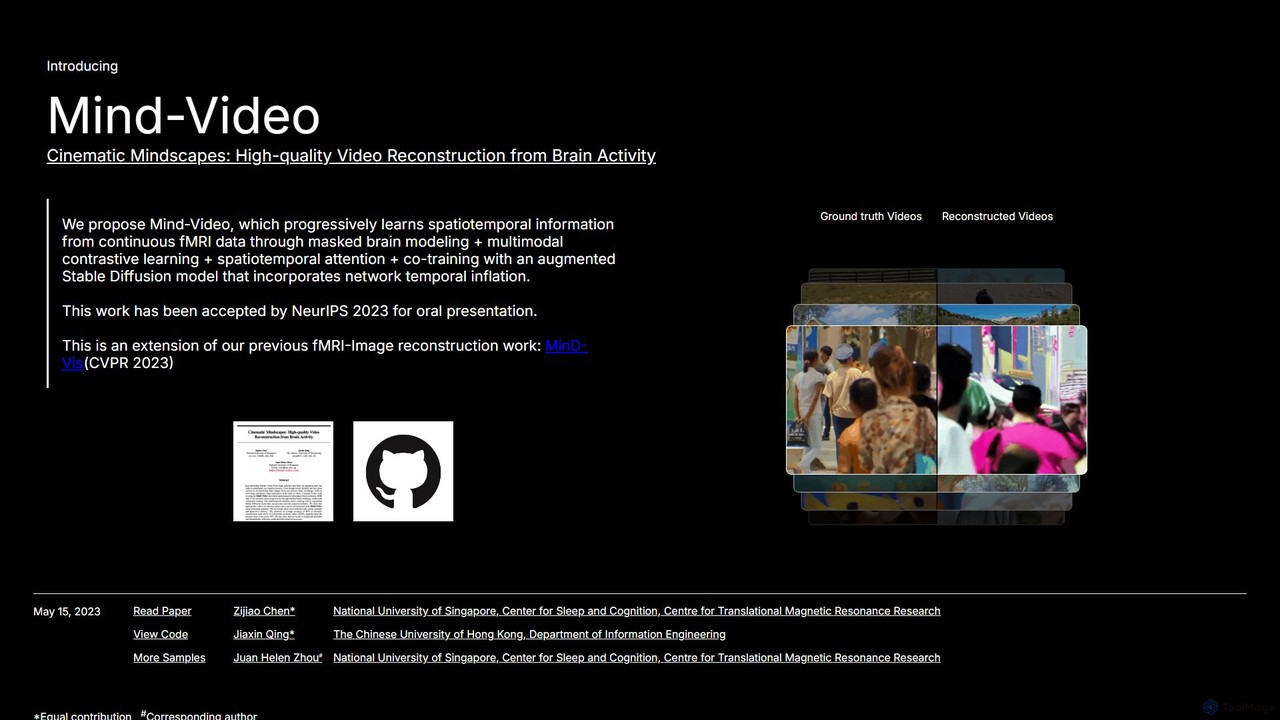
Mind-Video is a pioneering AI research project that reconstructs high-quality, dynamic videos directly from human brain activity recorded …

6.6K

About Neuroscience

AI Neuroscience tools are a specialized class of software that applies machine learning and deep learning algorithms to analyze complex brain data. These tools are designed to process high-dimensional datasets from sources like EEG, fMRI, and MEG to uncover patterns, model neural circuits, and decode brain activity. Their primary value lies in automating and scaling the analysis of neural signals and brain imagery, enabling researchers and clinicians to test hypotheses and derive insights that are difficult to obtain through manual methods. This technology is accelerating discoveries in cognitive science, neurology, and the development of brain-computer interfaces.

Core Features

  • Neural Signal Processing: Tools for filtering, segmenting, and extracting features from time-series data like EEG and MEG.
  • Brain Image Analysis: Automated segmentation of brain structures, functional connectivity mapping, and pattern recognition in MRI and fMRI scans.
  • Computational Modeling: Platforms for simulating neural networks and brain circuits to test theories of brain function.
  • BCI Algorithm Development: Frameworks for decoding neural intent from real-time brain signals to control external devices.
  • Predictive Diagnostics: Using machine learning models to identify biomarkers in brain data for the early detection of neurological disorders.

Use Cases

These tools are primarily used by academic researchers in neuroscience and psychology labs, clinical neurologists in hospitals, and engineers in neurotechnology companies. For instance, a researcher might use an AI tool to classify sleep stages from EEG data, while a clinician could use another to predict stroke recovery outcomes based on initial fMRI scans. They are essential for any work involving large-scale neural data analysis.

How to Choose

When selecting an AI Neuroscience tool, consider its compatibility with your specific data modality (e.g., EEG, fMRI, calcium imaging). Evaluate the transparency and validation of its underlying algorithms. Assess its integration capabilities with existing analysis pipelines, such as Python or MATLAB environments. Finally, consider the computational requirements and whether it offers cloud-based processing or requires local high-performance computing resources.

NeuroscienceUse Cases

1

Automated fMRI Data Analysis for Cognitive Studies

A cognitive neuroscientist is investigating brain regions involved in decision-making. They have collected fMRI data from 100 participants performing a complex task. Manually preprocessing and analyzing this volume of data would take weeks. By using an AI Neuroscience tool, they can automate the entire pipeline: motion correction, spatial normalization, and statistical mapping. The tool's machine learning model then identifies significant activation patterns across the group, revealing a previously unknown neural circuit. This reduces analysis time by over 80% and increases the statistical power of their findings.

2

EEG Signal Classification for BCI Control

A neurotechnology startup is developing a brain-computer interface (BCI) to help individuals with paralysis communicate. Their system relies on accurately classifying EEG signals corresponding to different imagined letters. They use an AI platform with pre-trained deep learning models for EEG classification. The platform allows them to rapidly train and fine-tune a model on a new user's brainwave data. The resulting classifier achieves over 95% accuracy in real-time, enabling the user to type text by simply thinking of the letters, demonstrating a viable product for assistive communication.

3

Predicting Neurological Disease Progression

A clinical research team at a hospital aims to predict the progression of Parkinson's disease. They use an AI tool to analyze a multimodal dataset including MRI scans, DaTscans, and clinical assessment scores from hundreds of patients over several years. The AI model identifies subtle, combined patterns across these data types that are invisible to human experts. The resulting predictive model can forecast a patient's likely motor symptom progression over the next two years with high accuracy, helping clinicians to personalize treatment plans and manage patient expectations more effectively.

4

Modeling Neural Circuits of Learning

A computational neuroscientist wants to test a hypothesis about how synaptic plasticity supports learning. Instead of complex biological experiments, they use an AI modeling platform to build a large-scale, spiking neural network that simulates a specific brain region. They can then run thousands of simulated learning trials under different conditions, adjusting parameters like neurotransmitter levels or cell firing rates. The AI tool visualizes the network's activity and changes in connectivity, providing evidence to support or refute their hypothesis and guiding future wet-lab experiments more efficiently.

5

High-Throughput Analysis of Microscopy Images

A cellular neuroscientist is studying the effect of a potential new drug on dendritic spine density. Their research involves analyzing thousands of high-resolution microscopy images, a task that is tedious and prone to human error when done manually. They employ an AI-powered image analysis tool that uses a convolutional neural network (CNN) to automatically detect, segment, and count dendritic spines across all images. The tool provides quantitative data in a fraction of the time, enabling the researcher to rapidly assess the drug's efficacy and accelerate the pace of their research.

6

Real-time Seizure Detection from EEG Data

A neurology clinic is implementing a system for long-term monitoring of patients with epilepsy. They use an AI-powered wearable device that continuously records EEG data. The device runs a lightweight machine learning model trained to recognize the specific neural signatures of a patient's seizures. When the model detects an impending seizure, it sends an alert to the patient and their caregivers via a smartphone app. This allows for timely intervention, such as administering medication, and provides a detailed log of seizure activity for clinicians to review and adjust treatment plans.

NeuroscienceFrequently Asked Questions