Zomory
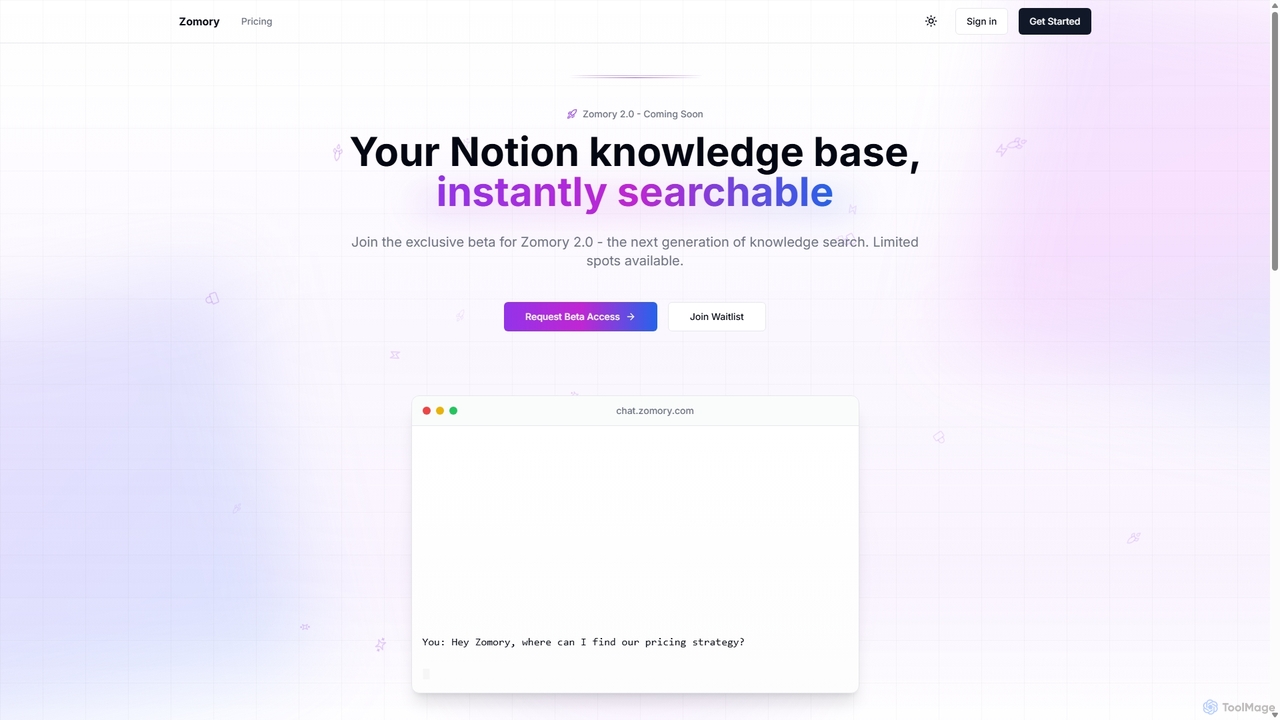
Zomory is an AI-powered search tool that transforms your Notion knowledge base into an instantly searchable resource. Integrated …
Zomory is an AI-powered search tool that transforms your Notion knowledge base into an instantly searchable resource. Integrated directly with Slack, it allows teams to find information using natural language, ask follow-up questions, and get answers in milliseconds without switching context.

AIChatOne
AIChatOne is an all-in-one AI assistant that integrates leading models like GPT-4, Claude 3, and Gemini into a …
AIChatOne is an all-in-one AI assistant that integrates leading models like GPT-4, Claude 3, and Gemini into a single, streamlined interface. It enhances productivity with features like web access, a prompt library, chat organization, and document analysis. Available as a browser extension and desktop/web app, it provides a superior, privacy-focused chat experience for writing, research, and daily tasks.
SearchMyDocs.ai
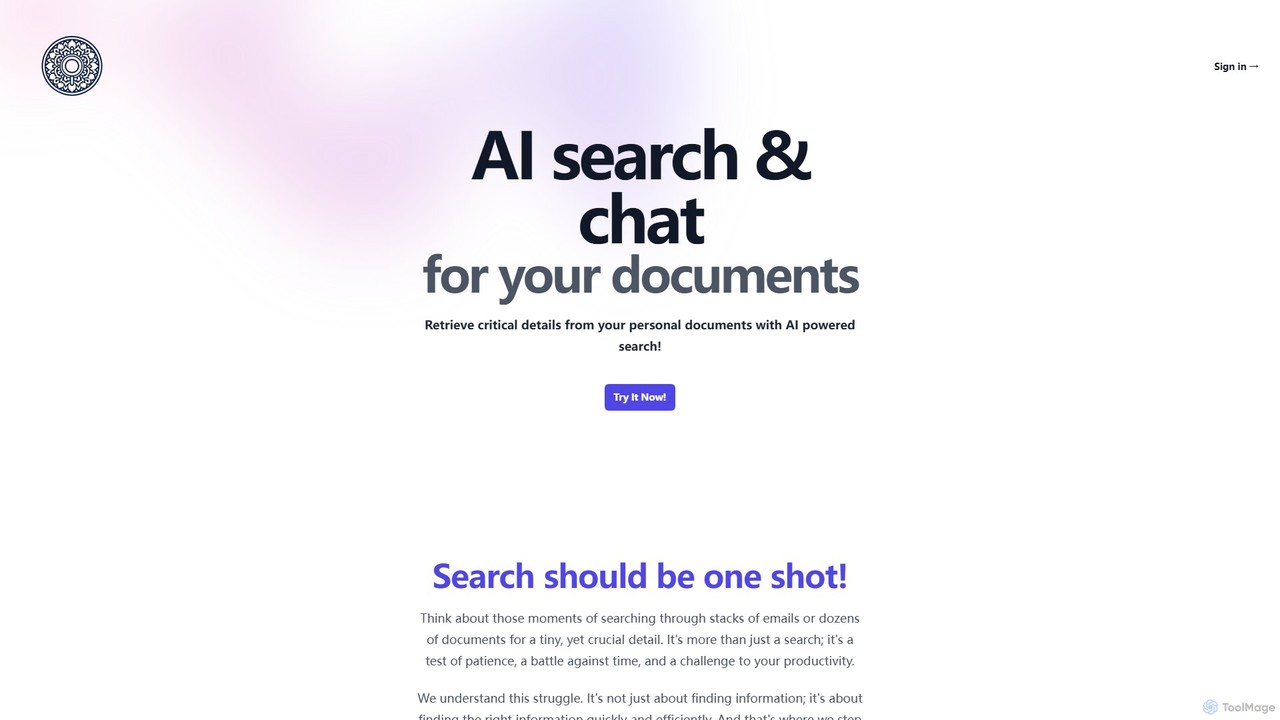
SearchMyDocs.ai is an AI-powered search engine that allows you to chat with your private documents. Upload files like …
SearchMyDocs.ai is an AI-powered search engine that allows you to chat with your private documents. Upload files like PDFs, Word docs, and images, and ask questions to retrieve specific information instantly. It acts as a secure, private ChatGPT for your personal document library, ensuring quick and precise answers while prioritizing data privacy with robust encryption.
About Ai Search
AI Search tools represent a new generation of search engines that provide direct, conversational answers instead of just a list of links. They leverage Large Language Models (LLMs) to understand the intent behind complex queries, synthesize information from multiple web sources, and generate a single, coherent response. This approach transforms the search experience from finding documents to getting solutions, making it ideal for in-depth research and complex problem-solving. The key advantage is the ability to receive comprehensive summaries with cited sources, saving significant time and effort.
Core Features
- Conversational Answers: Delivers direct responses in natural, easy-to-understand language.
- Information Synthesis: Summarizes and combines information from various web pages into a unified answer.
- Source Citation: Provides links to the original sources used to formulate the response for verification.
- Follow-up Questions: Allows users to refine, expand, or clarify their search through an interactive dialogue.
- Multi-Modal Input: Accepts queries in various formats, including text, voice, and sometimes images.
Use Cases
AI Search is particularly valuable for researchers, students, developers, and content creators. It excels in scenarios requiring the rapid synthesis of complex information, such as conducting market research, debugging code with contextual errors, or generating a structured outline for an article. It's also used for personal tasks like planning detailed travel itineraries or comparing products based on multiple criteria.
How to Choose
When selecting an AI Search tool, consider the reliability and transparency of its source citations. Evaluate the recency of its information access—whether it provides real-time results or relies on a static dataset. Data privacy policies are crucial, so understand how your search history is used. Also, assess specialized features like code interpretation, image analysis, or integration capabilities that may be relevant to your needs.
Ai SearchUse Cases
Accelerating Academic and Market Research
A market analyst needs to understand the competitive landscape for a new software product. Instead of manually opening and reading dozens of articles and reports, they use an AI Search tool. They ask a complex query like, 'Summarize the key competitors for enterprise CRM software, focusing on their pricing models, target audience, and unique selling propositions.' The tool synthesizes information from industry reports, news articles, and company websites to provide a concise, structured summary with cited sources, reducing research time from hours to minutes.
Debugging Code and Technical Problem-Solving
A software developer encounters a cryptic error message while working on a project. Instead of searching through forums like Stack Overflow and trying to find a matching scenario, they paste the error message and the relevant code snippet directly into an AI Search tool. They ask, 'Why am I getting this specific error in my Python code, and how can I fix it?' The AI analyzes the code's context, identifies the likely cause of the error, and provides a corrected code snippet along with a clear explanation of the fix.
Streamlining Content Creation and Idea Generation
A content marketer needs to create a comprehensive guide on 'sustainable urban farming.' To start, they use an AI Search tool as a brainstorming partner. They ask for 'an outline for a blog post on sustainable urban farming, including key trends, challenges, and case studies.' The tool generates a structured outline. They can then ask follow-up questions like 'What are some innovative vertical farming techniques?' or 'Find statistics on the growth of community gardens in North America' to quickly gather specific data points and ideas for each section of the article.
Planning Complex Trips and Itineraries
A family is planning a 7-day trip to Japan and feels overwhelmed by the options. They use an AI Search engine and ask a multi-faceted question: 'Create a 7-day itinerary for a family with two young children in Tokyo and Kyoto, focusing on cultural experiences, kid-friendly activities, and efficient travel between cities.' The AI synthesizes information from travel blogs, public transport schedules, and attraction websites to generate a day-by-day plan, complete with activity suggestions, restaurant ideas, and travel instructions.
Making Informed Purchase Decisions
A consumer is looking to buy a new high-end camera for wildlife photography. They use an AI Search tool to get a direct comparison. They ask, 'Compare the Sony A1 and the Canon R5 for wildlife photography, focusing on autofocus speed, sensor resolution, and performance in low light.' Instead of reading multiple reviews, the tool generates a comparative summary, often in a table format, that highlights the key specifications, pros, and cons of each model for their specific use case, helping them make a faster, more informed decision.
Interactive Learning and Explaining Complex Topics
A student is struggling to understand the concept of 'general relativity.' Reading a textbook is proving difficult. They turn to an AI Search tool and ask, 'Explain general relativity as if I were a high school student, using a simple analogy.' The tool provides a simplified explanation using the analogy of a bowling ball on a trampoline. The student can then ask follow-up questions like 'How does this relate to black holes?' or 'What is gravitational lensing?' to build their understanding interactively, piece by piece.