
Freemium
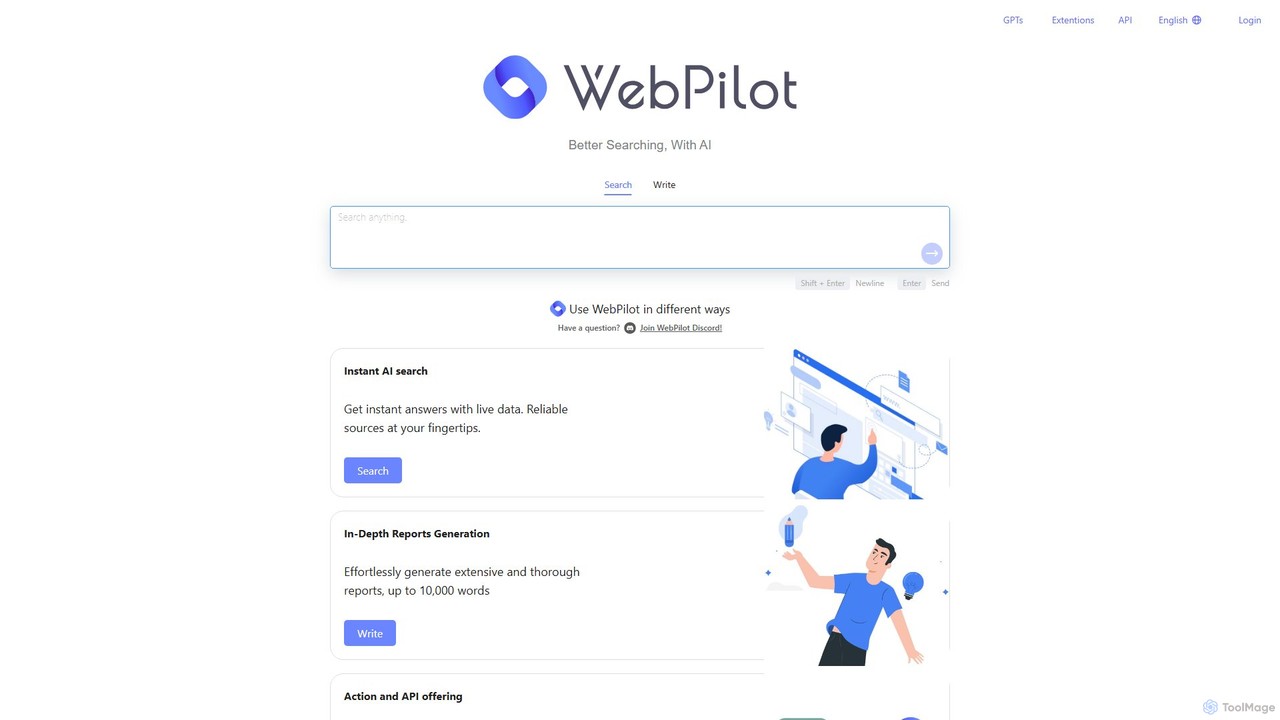
Popular Web Search AI tools in Search Engines include WebPilot, helping you work more efficiently.
AI Web Search tools are a specialized type of search engine that uses artificial intelligence to understand and answer complex queries about information on the public World Wide Web. They leverage large language models (LLMs) and natural language processing (NLP) to grasp user intent, context, and semantic meaning, moving beyond simple keyword matching. This allows them to deliver more relevant, contextualized, and often directly summarized answers. Unlike traditional search engines that primarily provide a list of links, many AI web search tools synthesize information from multiple sources into a single, coherent response, complete with citations.
These tools are widely used by researchers, students, and journalists for in-depth topic exploration and fact-checking. Content creators and marketers utilize them to gather background information and analyze market trends efficiently. For everyday users, they provide quick, synthesized answers to complex questions, from planning travel itineraries to solving technical problems.
When selecting an AI Web Search tool, evaluate the accuracy and relevance of its answers. Prioritize tools that offer transparent source citation to verify information. Consider the user interface—whether you prefer a direct answer engine or a traditional search results page augmented with AI features. Finally, review the tool's privacy policy to understand how your search data is handled.
A graduate student working on a thesis needs to gather comprehensive information on 'quantum computing's impact on cryptography.' Instead of sifting through hundreds of search links, they use an AI Web Search tool. They ask the question directly and receive a synthesized summary of the current state of research, key challenges, and major researchers in the field. The student then uses the conversational feature to ask follow-up questions like 'Explain the Shor's algorithm in simple terms' and 'Which encryption standards are most vulnerable?', receiving detailed, contextual answers with direct links to academic papers and technical articles for deeper study.
A marketing manager at a consumer electronics firm wants to understand emerging trends in 'wearable health technology for seniors.' Using an AI Web Search tool, they input this query. The tool provides a concise report summarizing recent product launches, key technological advancements (like fall detection and remote monitoring), consumer sentiment from review sites, and links to market research reports. This allows the manager to quickly grasp the competitive landscape and identify potential opportunities for a new product line without spending days on manual research.
A software developer encounters a cryptic error message: 'segmentation fault (core dumped)' in their C++ application. Instead of manually searching forums like Stack Overflow, they paste the error message into an AI Web Search tool and add context like 'in a multi-threaded application.' The tool synthesizes information from various programming forums, official documentation, and blog posts, providing a list of common causes (e.g., null pointer dereference, race conditions) and suggested debugging strategies. This accelerates the troubleshooting process significantly compared to traditional keyword-based searching.
A journalist is writing an article on the health benefits of the Mediterranean diet. They use an AI Web Search tool to ask, 'What are the scientifically proven benefits of the Mediterranean diet?' The tool provides a summarized list, such as improved cardiovascular health and reduced risk of certain cancers, and directly cites studies from reputable sources like the New England Journal of Medicine and the World Health Organization. This allows the journalist to quickly gather accurate, well-sourced information and verify claims, ensuring the article's credibility and saving valuable research time.
A user is planning a 7-day family trip to Costa Rica and is interested in nature and adventure activities suitable for children. They ask an AI Web Search tool: 'Plan a 7-day family-friendly itinerary for Costa Rica focusing on wildlife and easy hikes.' The AI generates a day-by-day plan, suggesting locations like Manuel Antonio National Park and the Monteverde Cloud Forest. For each day, it recommends specific activities, estimates travel times, and provides links to tour operators and accommodation options, drawing information from travel blogs, official tourism sites, and review platforms.
A home cook is preparing a meal and realizes they are out of a key ingredient. They ask their AI Web Search tool, 'What is the best substitute for buttermilk in pancakes?' Instead of getting a list of recipe blogs, they receive a direct, synthesized answer. The tool lists several options like milk with lemon juice or vinegar, yogurt, and sour cream, explaining the ratio for each substitution and the scientific reason why it works (i.e., providing the necessary acidity to react with the baking soda). This provides an immediate, actionable solution without requiring the user to click through multiple websites.
AI Web Search tools are advanced search engines that use artificial intelligence, particularly large language models (LLMs), to understand the context and intent of user queries. Unlike traditional search engines that match keywords to a list of web pages, AI search tools aim to provide a direct, synthesized answer by summarizing information from multiple reliable sources. They often feature conversational capabilities, allowing for more natural and interactive information discovery.
The primary difference lies in the output. Traditional search engines (like early Google) use algorithms like PageRank to index and rank a list of relevant web pages for you to visit. AI Web Search tools go a step further by processing the information on those top pages and synthesizing a direct answer or summary. Key differences include:
When selecting an AI Web Search tool, consider the following factors:
Not always. While AI Web Search tools are powerful, they can sometimes produce inaccurate information, a phenomenon known as 'hallucination.' They might misinterpret data from a source or combine information from different sources incorrectly. It is critical for users to maintain a healthy level of skepticism, especially for important or sensitive topics. Always use the provided source links to verify critical information directly from the original web page.
A wide range of users can benefit from AI Web Search tools. Students and researchers can accelerate their literature reviews and gather background information. Professionals in fields like marketing, finance, and law can quickly analyze trends and find specific data points. Content creators and journalists can use them for fact-checking and brainstorming. Finally, everyday users can get quick, comprehensive answers to complex questions, from planning a vacation to understanding a medical condition or solving a DIY project challenge.