
ToolMage
Sign in

Best 1 Search Enhancement AI tools for Search Engines

Popular Search Enhancement AI tools in Search Engines include Duckduckgpt, helping you work more efficiently.

Duckduckgpt
Free

Duckduckgpt

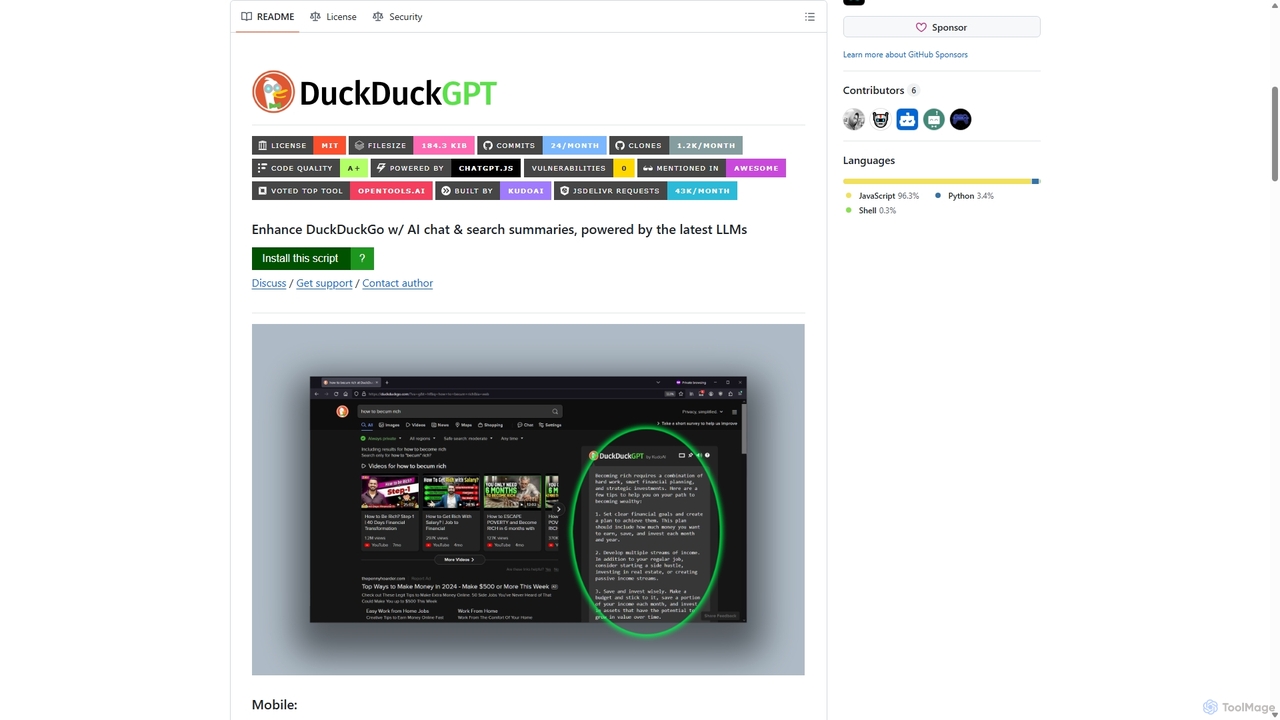
A powerful browser extension that supercharges the DuckDuckGo search engine with AI chat and search summaries. It seamlessly integrates responses from the latest LLMs like GPT-4o directly into your search results, providing instant, intelligent answers while maintaining your privacy.

Browser Extensions
Visits 6KFavorites 125Likes 135

About Search Enhancement

Search Enhancement tools are AI-powered solutions designed to significantly improve the relevance, accuracy, and depth of search results beyond traditional keyword matching. These tools leverage advanced natural language processing (NLP), machine learning, and semantic understanding to interpret user intent and context. They enable users to discover more precise information, uncover hidden connections, and make better-informed decisions across vast datasets.

Core Features

  • Semantic Search: Understands the meaning and intent behind queries, not just keywords, for more relevant results.
  • Personalized Results: Tailors search outcomes based on individual user history, preferences, and roles.
  • Contextual Filtering: Refines results by considering the broader context of the query and related information.
  • Knowledge Graph Integration: Connects disparate data points and entities to provide comprehensive, interconnected answers.
  • Natural Language Querying: Allows users to ask complex questions in conversational language, similar to human interaction.

Use Cases

These tools are invaluable for professionals needing to navigate complex information landscapes. They are used in academic research to pinpoint specific studies, in enterprise knowledge management to quickly locate internal documents, and in e-commerce to deliver highly personalized product recommendations, transforming how users interact with information.

How to Choose

When selecting a Search Enhancement tool, prioritize its integration capabilities with existing systems, the accuracy and relevance of its AI models, and its scalability to handle growing data volumes. Also, consider the level of customization offered to tailor the search experience to specific domain knowledge and user needs.

Search Enhancement use cases

1

Enhanced Academic & Market Research

Researchers in academia or market analysis utilize Search Enhancement tools to sift through vast scientific databases, journals, or market reports. By employing semantic queries, they can precisely locate specific methodologies, data points, or emerging trends that keyword-based searches might miss, significantly accelerating discovery and insight generation.

2

Intelligent Enterprise Knowledge Management

Large organizations deploy these tools to empower employees to quickly find critical information within internal knowledge bases, document repositories, and communication archives. Using natural language queries, employees can retrieve exact policies, project details, or expert contacts, reducing time spent searching and improving operational efficiency.

3

Personalized E-commerce Product Discovery

Online retailers integrate Search Enhancement AI to offer a superior shopping experience. The tools analyze customer intent, browsing history, and product attributes to provide highly relevant product recommendations and search results, even for vague queries, leading to increased conversion rates and customer satisfaction.

4

Advanced Legal Document Review

Legal professionals leverage Search Enhancement for efficient review of extensive legal documents, case files, and precedents. The AI can identify subtle connections between clauses, relevant case law, and factual patterns that are crucial for building arguments or conducting due diligence, drastically reducing manual review time.

5

Optimized Customer Support Knowledge Base

Customer service departments use Search Enhancement to power their knowledge bases and chatbots. When a customer or agent poses a complex query, the AI quickly retrieves the most accurate and contextually relevant solution from a vast repository, improving first-contact resolution rates and overall service quality.

6

Content Creation & Discovery for Media

Journalists, content creators, and media professionals utilize these tools to discover related topics, credible sources, and background information more effectively. By understanding the semantic relationships between articles and trends, AI helps in generating fresh content ideas and ensuring comprehensive coverage.

Search Enhancement FAQ

What are Search Enhancement tools?

Search Enhancement tools are AI-driven applications that go beyond basic keyword matching to deliver more intelligent and relevant search results. They use technologies like natural language processing (NLP) and machine learning to understand the meaning and context of queries, providing users with deeper insights and more precise information from various data sources.

How does AI enhance search capabilities?

AI enhances search by enabling semantic understanding, meaning it interprets the intent behind a query rather than just matching keywords. It also powers personalized results based on user behavior, integrates knowledge graphs to connect related information, and allows for natural language querying, making search more intuitive, comprehensive, and accurate than traditional methods.

What's the difference between traditional search and AI-powered Search Enhancement?

Traditional search primarily relies on keyword matching and indexing, often returning results based on exact word presence. AI-powered Search Enhancement, however, uses machine learning and NLP to understand context, intent, and semantic relationships. This allows it to provide more relevant, personalized, and comprehensive answers, even for complex or ambiguous queries, by interpreting meaning rather than just words.

Who benefits most from Search Enhancement tools?

Individuals and organizations dealing with large volumes of unstructured data benefit significantly. This includes researchers, legal professionals, customer support teams, e-commerce businesses, and enterprise employees who need to quickly find precise information, uncover insights, or personalize user experiences. Anyone seeking to move beyond basic information retrieval to true knowledge discovery will find these tools invaluable.

What should I consider when selecting a Search Enhancement tool?

Key considerations include the tool's ability to integrate with your existing data sources and systems, the accuracy and relevance of its AI models for your specific domain, and its scalability to handle future data growth. Additionally, evaluate its customization options, user-friendliness, and the level of support for natural language queries to ensure it meets your specific operational and user needs.