
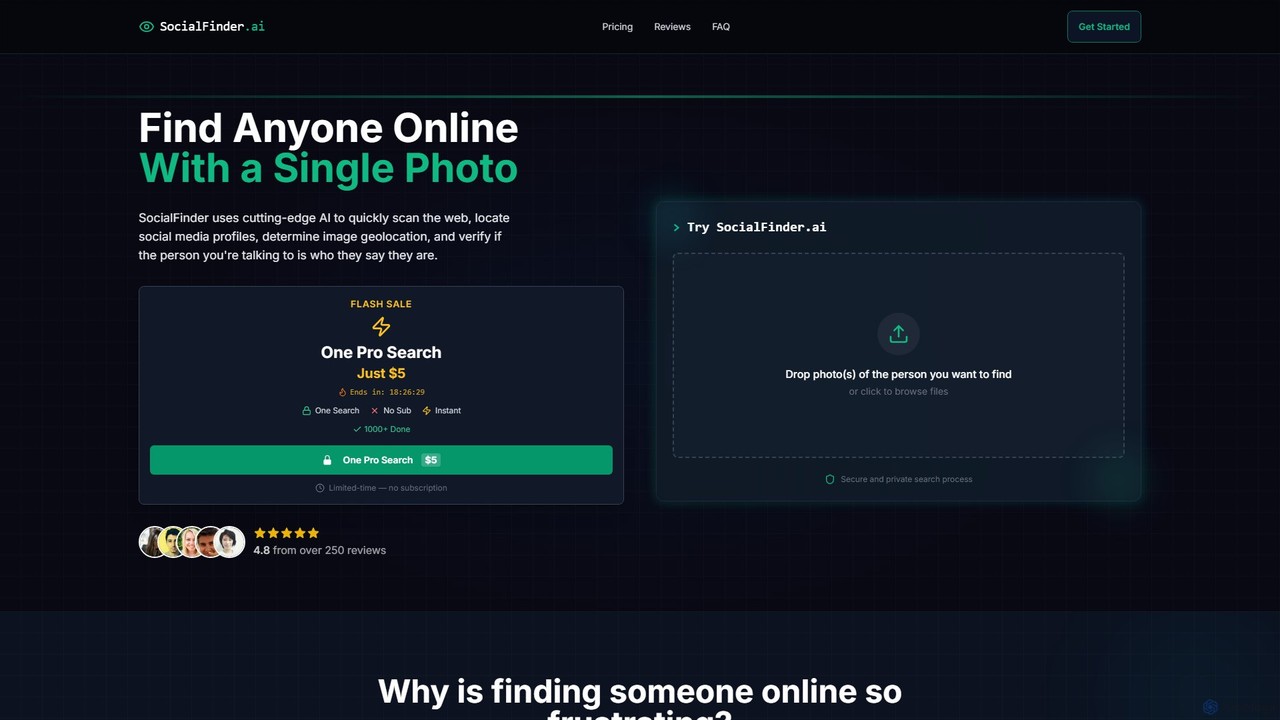
SocialFinder.ai
SocialFinder.ai is an AI-powered reverse image search engine that finds anyone online using a single photo. It scans …
SocialFinder.ai is an AI-powered reverse image search engine that finds anyone online using a single photo. It scans the web for social media profiles, determines image geolocation, and helps verify a person's identity, providing a comprehensive digital footprint in seconds.
About People Search Engine
A People Search Engine is a specialized online tool designed to find detailed information about individuals by aggregating data from public records, social media profiles, and various online sources. Unlike general search engines, these platforms utilize advanced algorithms to cross-reference disparate data points, creating comprehensive profiles. They are primarily used for reconnecting with people, verifying identities, and conducting background research for professional or personal purposes. These tools provide a structured and efficient way to access publicly available information that would otherwise be difficult to find and compile manually.
Core Features
- Data Aggregation: Consolidates personal information from public records, social media, and online databases into a single, easy-to-read report.
- Contact Information Retrieval: Uncovers current and past phone numbers, email addresses, and physical addresses.
- Background Checks: Provides access to public records such as criminal history, court records, marriage/divorce records, and property ownership.
- Online Presence Mapping: Identifies an individual's social media profiles, personal websites, and other online footprints across the web.
- Relationship Network Analysis: Maps out known associates, relatives, and professional connections based on public data.
Use Cases
These tools are widely used by recruiters for candidate vetting, journalists for investigative research, and legal professionals for locating witnesses or performing due diligence. Sales and marketing teams use them for lead enrichment, while individuals use them to reconnect with lost friends and family or to monitor their own online reputation.
How to Choose
When selecting a People Search Engine, consider the breadth and accuracy of its data sources. Evaluate its compliance with privacy regulations like the FCRA and GDPR, especially for professional use. Also, assess the search capabilities, the clarity of the reports generated, and whether the pricing model (subscription vs. per-report) aligns with your usage frequency.
People Search EngineUse Cases
Vetting Job Candidates Pre-Interview
An HR manager for a tech company needs to verify the background of a promising candidate for a senior developer role. Before extending an offer, they use a People Search Engine to confirm the candidate's educational background and employment history listed on their resume. The tool aggregates public records and professional network data, revealing any major discrepancies or red flags, such as undisclosed criminal records or falsified credentials. This process helps ensure a safe hiring decision and protects the company from potential risks, all while complying with relevant employment laws.
Locating Witnesses for a Legal Case
A paralegal is tasked with finding a key witness who has moved several times and has a common name. Using a People Search Engine, they input the witness's last known address and name. The platform searches billions of public records, providing a list of potential current addresses, phone numbers, and even known associates. This allows the legal team to efficiently locate and contact the witness, saving valuable time and resources that would have been spent on manual investigation or hiring a private investigator.
Enriching Sales Leads with Contact Data
A B2B sales representative has a list of target companies but lacks direct contact information for the decision-makers. They use a People Search Engine's business-focused features to look up the VPs of Marketing at these companies. The tool provides direct work email addresses, phone numbers, and links to their professional profiles. This enriched data allows the sales rep to bypass gatekeepers and personalize their outreach, significantly increasing their connection and meeting booking rates.
Reconnecting with a Long-Lost Relative
An individual wants to find a childhood friend they lost contact with 20 years ago. They only remember the friend's name and the city they used to live in. By entering this information into a People Search Engine, they receive a report that includes possible current locations, phone numbers, email addresses, and social media profiles. The report also lists potential relatives, which helps confirm they have found the right person. This enables them to re-establish contact after decades.
Investigative Journalism Research
An investigative journalist is working on a story about a local politician. To build a comprehensive profile, they use a People Search Engine to uncover public information like property records, business affiliations, and past court cases. The tool helps connect dots between different entities and individuals, revealing potential conflicts of interest or previously unknown connections. This provides a solid, fact-based foundation for their reporting, ensuring accuracy and depth in their story.
Monitoring Your Own Online Footprint
A privacy-conscious professional wants to know what personal information is publicly available about them online. They run a search on their own name using a People Search Engine. The results show them what data brokers are selling, which of their old social media profiles are still active, and if any incorrect information is associated with their name. This allows them to take action, such as requesting data removal or updating privacy settings on their accounts, to manage their digital reputation effectively.