Security Best in category 6 results Network Security AI Tool

Popular AI tools in the Network Security field of Security include Cloudflare、Broadcom、Vectra AI、Quantum Network Monitor、CensysGPT Beta、Hive Defender, etc., helping you quickly improve efficiency.

CensysGPT Beta

CensysGPT Beta

CensysGPT Beta is an AI-powered tool that simplifies cybersecurity reconnaissance by translating natural language into precise Censys search …

3.3K
Hive Defender

Hive Defender

Hive Defender is an advanced, AI-powered DNS security service that provides comprehensive protection against a wide range of …

2.5K
Vectra AI

Vectra AI

Vectra AI is an advanced cybersecurity platform that uses patented AI-driven Attack Signal Intelligence™ to detect and stop …

212.5K
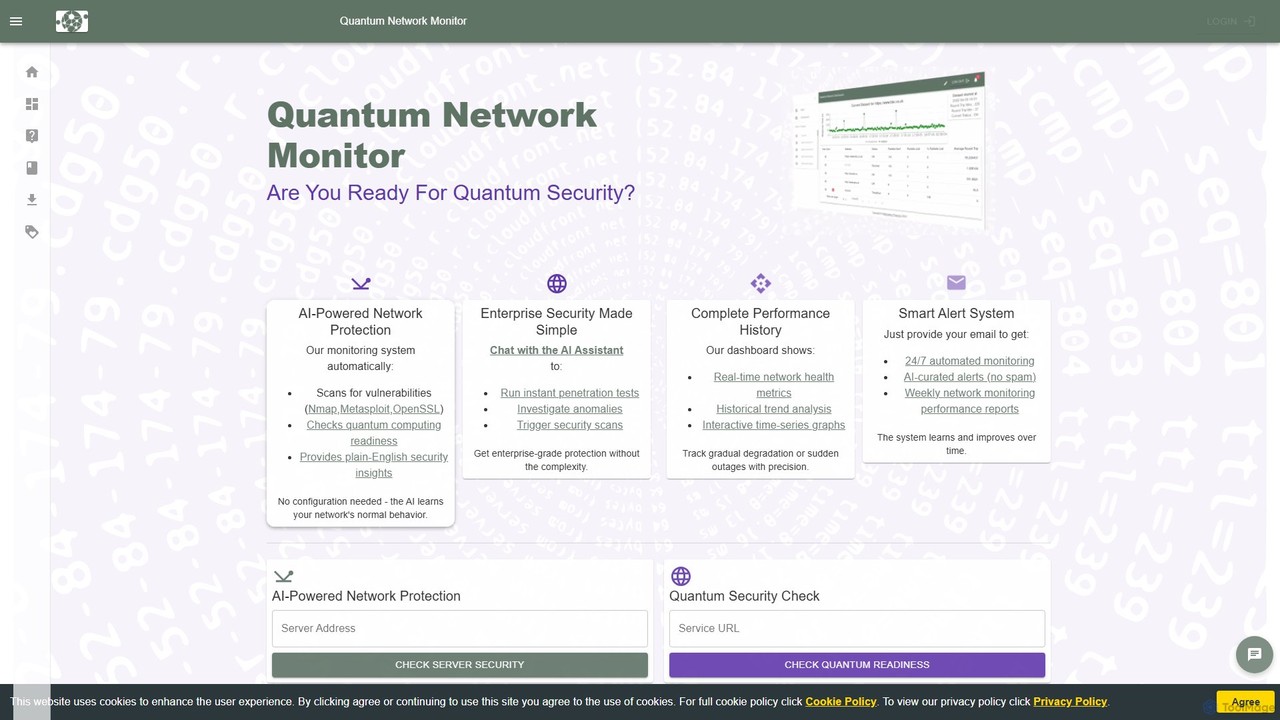
Quantum Network Monitor

Quantum Network Monitor

An AI-powered network security and monitoring platform that automates vulnerability scanning, provides quantum readiness checks, and offers an …

4.2K
Broadcom

Broadcom

Broadcom is a global technology leader providing a comprehensive portfolio of semiconductor and infrastructure software solutions. Its products …

4.9M
Cloudflare

Cloudflare

Cloudflare is a global connectivity cloud platform offering a comprehensive suite of services for security, performance, and reliability. …

50.9M

About Network Security

AI Network Security tools are a class of solutions that leverage artificial intelligence to proactively detect, analyze, and respond to threats within computer networks. They utilize machine learning algorithms to continuously monitor network traffic, establish baseline behaviors, and identify anomalies that signal sophisticated attacks. This enables organizations to automate threat hunting and incident response, significantly reducing detection times and protecting critical infrastructure from zero-day exploits, ransomware, and advanced persistent threats (APTs). These tools move beyond traditional signature-based defenses to provide adaptive and predictive security.

Core Features

  • AI-Powered Threat Detection: Uses behavioral analysis and anomaly detection to identify novel and unknown threats that evade traditional security measures.
  • Automated Incident Response: Automatically quarantines compromised devices, blocks malicious IP addresses, or terminates suspicious processes to contain threats in real-time.
  • Predictive Threat Intelligence: Analyzes global threat data and internal network patterns to forecast potential attack vectors and vulnerabilities before they are exploited.
  • Network Traffic Analysis (NTA): Provides deep visibility into all network communications, including encrypted traffic, to uncover hidden threats and malicious activities.

Use Cases

These tools are essential for organizations with complex IT environments, such as financial institutions, healthcare providers, and large enterprises. Security Operations Center (SOC) analysts and network administrators use them to monitor hybrid cloud infrastructures, secure IoT/OT devices, and defend against state-sponsored cyberattacks, enhancing their overall security posture.

How to Choose

When selecting an AI Network Security tool, consider its detection accuracy and false positive rate to minimize alert fatigue. Evaluate its integration capabilities with your existing security stack (e.g., SIEM, SOAR, firewalls). Assess its scalability to handle your network's traffic volume and its level of automation to ensure it aligns with your team's operational capacity.

Network SecurityUse Cases

1

Automating Intrusion Detection and Prevention

A Security Operations Center (SOC) analyst at a large financial firm is tasked with monitoring a vast and complex network. Using an AI Network Security tool, the system continuously analyzes terabytes of traffic data. It detects a subtle, previously unseen malware propagation pattern that mimics legitimate user activity. Instead of just raising an alert, the AI automatically blocks the source IP address, isolates the handful of initially affected endpoints, and pushes a new defensive rule to firewalls network-wide, all within seconds. This prevents a potential widespread breach before the analyst even begins a manual investigation.

2

Securing IoT and Operational Technology (OT) Networks

A manufacturing plant's network administrator needs to secure thousands of connected IoT sensors and OT controllers, many of which cannot run traditional security agents. An AI Network Security tool is deployed to monitor all traffic. The AI learns the normal communication patterns of each device—which servers they talk to, what protocols they use, and at what times. When a compromised IoT camera suddenly attempts to connect to an unknown external server, the AI immediately flags this anomalous behavior and blocks the connection, preventing a potential pivot point for an attacker to enter the sensitive OT network.

3

Predicting and Preventing Ransomware Attacks

A healthcare organization, holding sensitive patient data, uses an AI Network Security tool for proactive defense. The tool analyzes internal east-west traffic patterns. It detects a series of unusual remote desktop protocol (RDP) connections and file share access attempts originating from a single workstation, consistent with the lateral movement phase of a ransomware attack. Before any data is encrypted, the AI flags the activity as high-risk, automatically isolates the workstation from the network, and alerts the security team with a detailed incident report, effectively neutralizing the threat in its early stages.

4

Enhancing Cloud Network Security Monitoring

A DevOps team at a fast-growing tech company relies on a multi-cloud environment. Manually tracking security across AWS, Azure, and GCP is challenging. They integrate an AI Network Security tool that provides a unified view of all cloud network traffic. The tool automatically detects security misconfigurations, such as an overly permissive security group or a publicly exposed database. It also identifies suspicious cross-VPC traffic that could indicate a compromised container, allowing the team to remediate vulnerabilities quickly without slowing down development cycles.

5

Reducing Alert Fatigue for Security Analysts

A Managed Security Service Provider (MSSP) serves dozens of clients, generating thousands of security alerts daily. Their analysts are overwhelmed. By implementing an AI Network Security platform, the system automatically investigates and correlates low-level alerts. It pieces together a series of minor, seemingly unrelated events across the network into a single, high-confidence incident report detailing a coordinated attack. This reduces thousands of raw alerts to a handful of actionable incidents, allowing analysts to focus their expertise on genuine threats instead of chasing false positives.

6

Uncovering Insider Threats through Behavioral Analysis

An e-commerce company is concerned about insider threats, both malicious and accidental. Their AI Network Security tool establishes a baseline of normal network behavior for every user and device. When an employee's credentials are used to access a sensitive customer database outside of normal working hours and from an unusual geographic location, the AI flags this deviation. It correlates this with the fact that the same user account is also attempting to exfiltrate large volumes of data to a personal cloud storage service. The system automatically restricts the user's network access and alerts the security team to a high-probability insider threat.

Network SecurityFrequently Asked Questions