Pentest Copilot
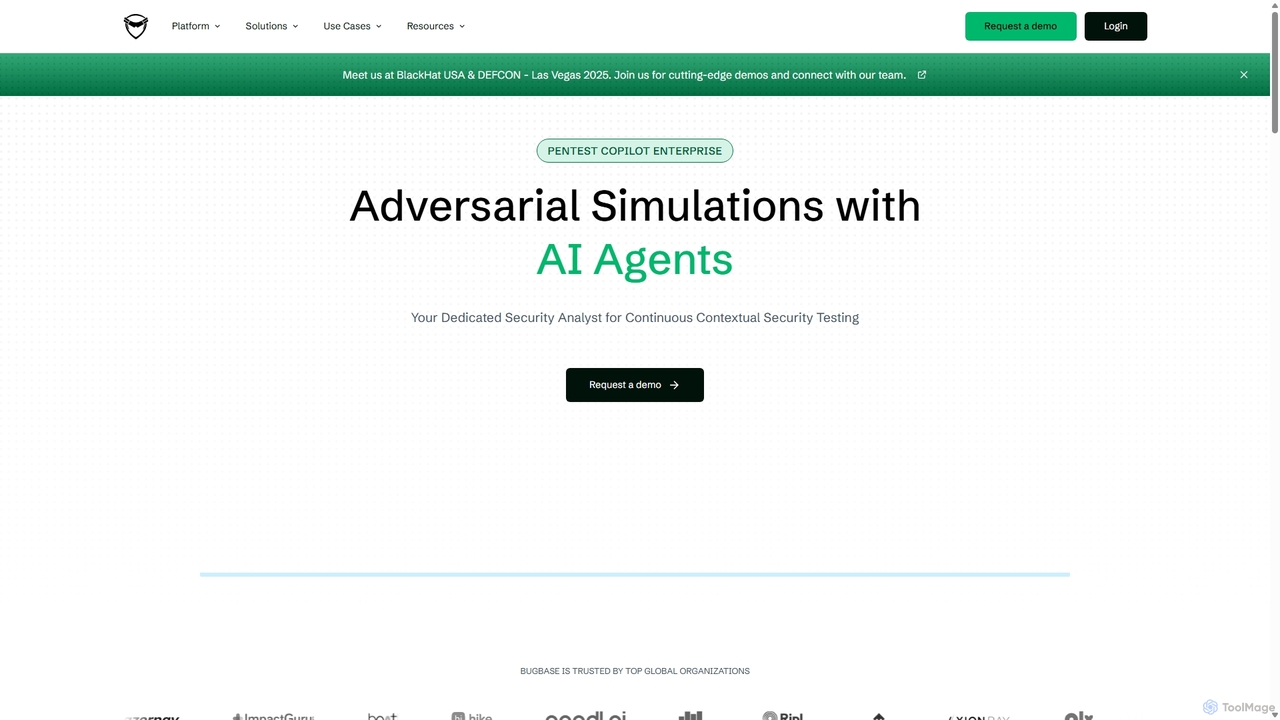
Pentest Copilot is an AI-powered adversarial exposure validation platform that automates red teaming and penetration testing. It uses …
Pentest Copilot is an AI-powered adversarial exposure validation platform that automates red teaming and penetration testing. It uses AI agents to conduct continuous, context-driven security assessments, including external, internal, phishing, and credential compromise simulations. The platform visualizes attack paths with dynamic graphs and provides prioritized, actionable remediation reports for enterprises.
OnSecurity
OnSecurity is an AI-augmented penetration testing platform that combines the efficiency of AI automation with the ingenuity of …
OnSecurity is an AI-augmented penetration testing platform that combines the efficiency of AI automation with the ingenuity of expert ethical hackers. It offers CREST-approved, continuous cybersecurity services, including pentesting, vulnerability scanning, and threat intelligence, all managed through a single, flexible subscription-based platform for faster, more accurate results.
Pentra
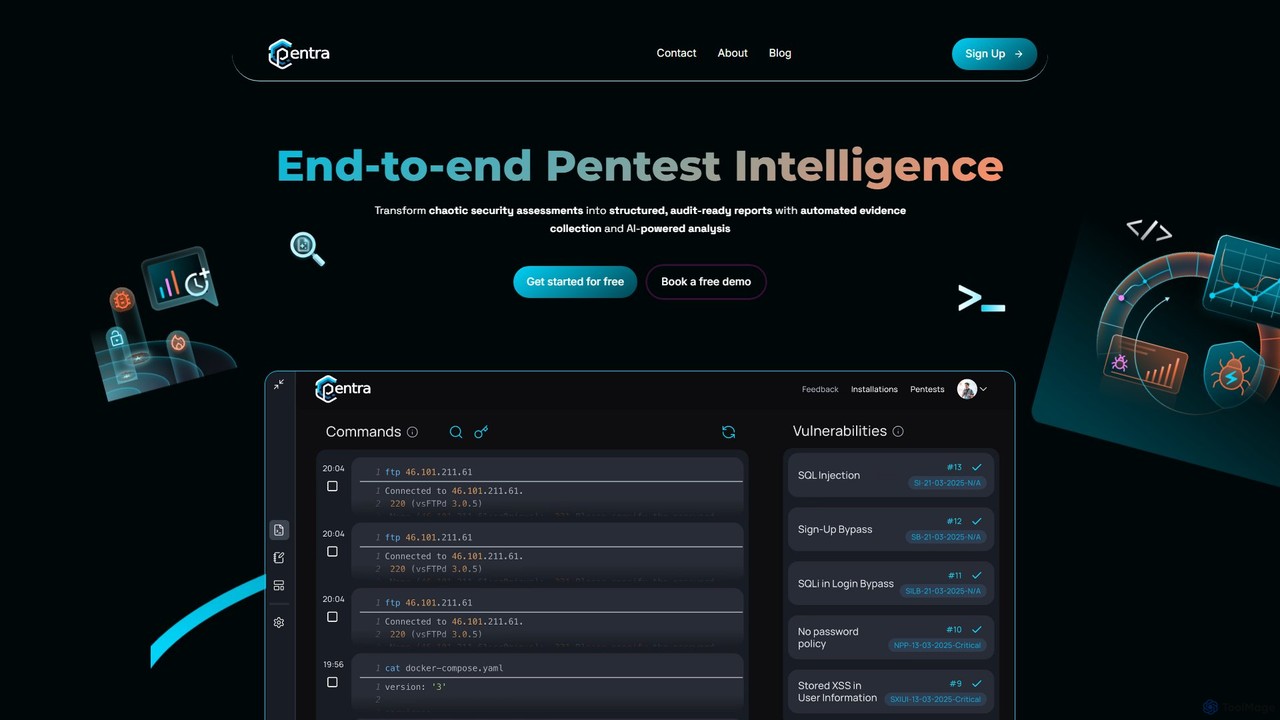
Pentra is an AI-powered platform designed for penetration testers to streamline their workflow. It automatically logs CLI commands, …
Pentra is an AI-powered platform designed for penetration testers to streamline their workflow. It automatically logs CLI commands, transforms raw data into polished findings, and generates customizable, professional reports, significantly reducing administrative overhead and improving efficiency.
ethiack
Ethiack is an autonomous ethical hacking platform that combines AI-powered automated penetration testing with elite human hackers. It …
Ethiack is an autonomous ethical hacking platform that combines AI-powered automated penetration testing with elite human hackers. It provides continuous 24/7 security testing to identify and prioritize vulnerabilities across your entire digital infrastructure, helping you stay compliant and secure before threats are exploited.
About Penetration Testing
Penetration Testing tools are AI-powered solutions designed to simulate cyberattacks on systems, networks, or applications to identify security vulnerabilities. These tools leverage advanced AI algorithms, including machine learning and natural language processing, to automate the discovery, exploitation, and reporting of security weaknesses. They provide a proactive approach to cybersecurity, helping organizations strengthen their defenses by uncovering exploitable flaws before malicious actors can. As a critical component within the broader Security category, AI penetration testing enhances traditional methods with speed, scale, and intelligence.
Core Features
- Automated Vulnerability Scanning: Intelligently identifies and prioritizes security flaws across diverse IT environments.
- Intelligent Exploit Generation: Automatically crafts and tests potential exploits for discovered vulnerabilities to assess real-world impact.
- Attack Path Mapping: Visualizes and predicts potential attack vectors and lateral movement within a network.
- Compliance Reporting: Generates detailed reports aligned with industry standards and regulatory requirements.
- Continuous Monitoring: Provides ongoing assessment of security posture, detecting new vulnerabilities as systems evolve.
Use Cases
Cybersecurity teams utilize these tools to conduct comprehensive security assessments, identifying weaknesses in infrastructure, applications, and cloud environments. Developers integrate them into CI/CD pipelines for automated security testing, ensuring code is secure from the outset. Compliance officers leverage AI for efficient auditing and reporting against various regulatory frameworks.
How to Choose
When selecting an AI penetration testing tool, consider its scope of testing (network, web, cloud, mobile), the accuracy and depth of its vulnerability detection, and its ability to generate actionable remediation advice. Evaluate integration capabilities with existing security information and event management (SIEM) or development tools, as well as its compliance reporting features and the level of customization offered for testing scenarios.

Penetration TestingUse Cases
Automated Discovery of Zero-Day Vulnerabilities
Cybersecurity researchers and ethical hackers use AI penetration testing tools to continuously scan vast datasets of code, network traffic, and system configurations. The AI identifies anomalous patterns and potential logic flaws that might indicate previously unknown (zero-day) vulnerabilities, significantly accelerating discovery beyond manual methods and enhancing proactive threat intelligence.
Validating Exploitability in Web Applications
Web application security teams integrate AI penetration testing into their development lifecycle. The AI automatically tests new code deployments for common vulnerabilities like SQL injection or XSS, and then attempts to generate and execute proof-of-concept exploits. This validates whether a discovered flaw is truly exploitable, providing developers with immediate, actionable feedback to fix critical issues before production.
Simulating Advanced Persistent Threats (APTs)
Enterprise security operations centers (SOCs) employ AI tools to simulate sophisticated, multi-stage APTs against their internal networks. The AI learns from the network's architecture and existing defenses to intelligently navigate and attempt to breach critical assets, revealing complex attack paths and identifying weaknesses in detection and response capabilities that might otherwise go unnoticed.
Automating Cloud Security Posture Management (CSPM)
Cloud security engineers utilize AI penetration testing to continuously assess their cloud infrastructure (AWS, Azure, GCP) for misconfigurations, insecure access policies, and exposed services. The AI identifies potential attack vectors stemming from these issues, simulates breaches, and provides prioritized recommendations to harden cloud environments, ensuring compliance and reducing attack surface.
Streamlining Compliance Audits for Data Regulations
Compliance and risk management teams leverage AI penetration testing to automate the assessment of systems against specific data protection regulations like GDPR or HIPAA. The AI scans for non-compliant data handling practices, insecure storage, or unauthorized access points, generating comprehensive audit reports and highlighting areas requiring immediate attention to meet regulatory standards.
Proactive Security for IoT and Embedded Devices
Manufacturers and security consultants for IoT devices use AI penetration testing to identify vulnerabilities in firmware, communication protocols, and device configurations. The AI can analyze device behavior and network interactions to uncover weaknesses specific to embedded systems, helping to secure smart devices from potential remote exploits and ensuring product integrity before deployment.