Self Hosted Best in category 1 results Open Source AI Tool

Popular AI tools in the Open Source field of Self Hosted include Presenton, etc., helping you quickly improve efficiency.

Presenton

Presenton

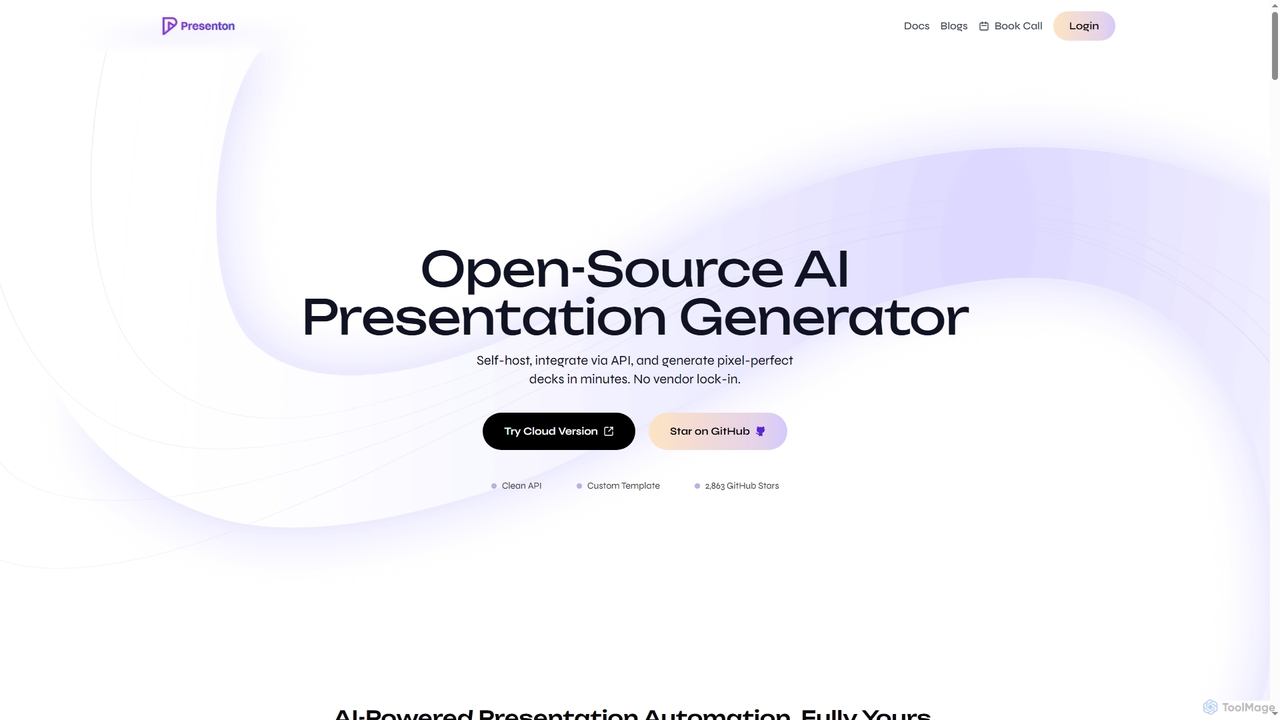
Presenton is an open-source AI presentation generator designed for developers and teams. It allows for self-hosting, API integration, …

63.2K

About Open Source

Open Source AI tools are software solutions with publicly accessible source code, allowing users to inspect, modify, and distribute them freely. These tools are built on principles of transparency and community collaboration, often deployed in self-hosted environments for maximum control. They empower developers, researchers, and organizations to achieve deep customization, cost efficiency, and full data sovereignty over their AI infrastructure.

Core Features

  • Code Transparency: Allows users to review, understand, and modify the underlying source code.
  • High Customizability: Users can adapt functionalities and integrate new modules to meet specific project requirements.
  • Community Support: Benefits from active developer communities providing documentation, tutorials, and solutions.
  • No Licensing Fees: Typically free to use, significantly reducing deployment and operational costs.
  • Data Sovereignty: Enables full control over data when deployed on private servers, enhancing security and compliance.

Use Cases

Open Source AI tools are invaluable for academic research, where scientists modify models for experimental purposes or to validate new algorithms. Enterprises leverage them for internal deployments, ensuring data privacy and regulatory compliance by hosting AI infrastructure on their own servers. They are also widely used in education, allowing students and developers to learn AI principles by studying and experimenting with real-world codebases.

How to Choose

When selecting an Open Source AI tool, evaluate the community's activity and support, as a vibrant community ensures ongoing development and assistance. Assess the tool's technical stack compatibility with your team's skills and existing infrastructure. Prioritize projects with comprehensive documentation for easier onboarding and troubleshooting. Finally, understand the specific open-source license (e.g., MIT, GPL) to ensure it aligns with your usage and distribution needs.

Open SourceUse Cases

1

Custom AI Model Development

Developers and data scientists utilize open-source AI frameworks and libraries to build highly specialized models. By accessing and modifying the source code, they can fine-tune algorithms, integrate unique datasets, and implement novel architectures tailored precisely to their project's requirements, such as creating a custom recommendation engine or a domain-specific natural language processing model.

2

Enterprise Data Privacy and Security

Organizations with strict data privacy regulations (e.g., healthcare, finance) deploy open-source AI tools on their self-hosted infrastructure. This ensures that sensitive data never leaves their controlled environment, mitigating risks associated with third-party cloud services. They maintain complete ownership and control over data processing, audit trails, and security protocols, meeting compliance standards like GDPR or HIPAA.

3

Academic Research and Experimentation

Researchers and students in academia extensively use open-source AI tools for experimentation and validating new theories. The transparent nature of the code allows for deep inspection of algorithms, modification of parameters, and replication of results. This fosters innovation by enabling rapid prototyping of new AI concepts and contributing back to the global scientific community.

4

Edge AI and Embedded Systems

For deploying AI capabilities on resource-constrained edge devices or embedded systems (e.g., IoT devices, smart cameras), open-source tools offer unparalleled flexibility. Developers can strip down unnecessary components, optimize models for specific hardware, and integrate them directly into device firmware, enabling real-time inference without reliance on cloud connectivity, crucial for applications like industrial automation or smart home security.

5

Cost-Effective AI Infrastructure

Startups and small to medium-sized businesses (SMBs) leverage open-source AI tools to build powerful AI capabilities without incurring hefty licensing fees associated with proprietary software. By utilizing free and openly available frameworks, they can allocate their budget towards hardware, talent, and data acquisition, making advanced AI accessible and sustainable for their growth, especially when combined with self-hosting.

6

Community-Driven AI Innovation

Open-source AI projects thrive on community contributions, fostering a collaborative environment for innovation. Developers worldwide contribute to improving existing tools, fixing bugs, and adding new features. This collective effort leads to robust, well-tested, and rapidly evolving AI solutions that benefit from diverse perspectives and expertise, driving the state-of-the-art in various AI domains.

Open SourceFrequently Asked Questions