Grum
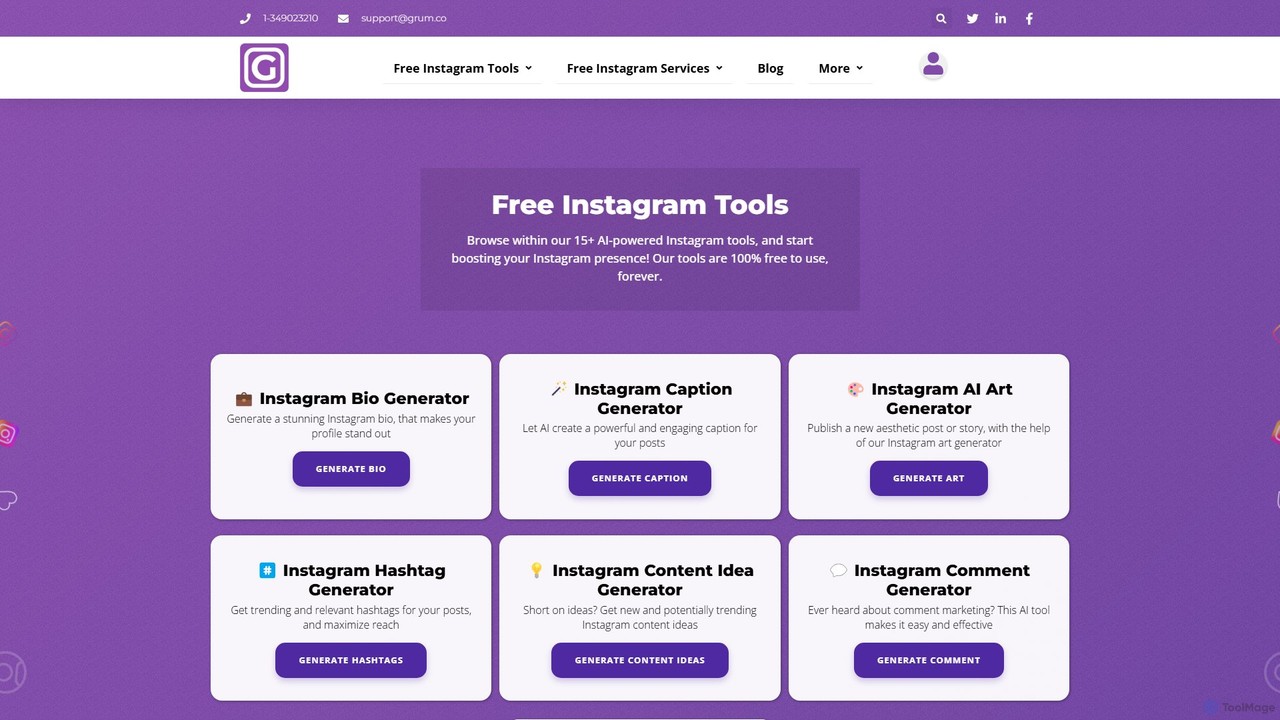
Grum offers a comprehensive suite of over 15 free AI-powered tools for Instagram marketing. From generating captions, bios, …
Grum offers a comprehensive suite of over 15 free AI-powered tools for Instagram marketing. From generating captions, bios, and hashtags to analyzing account performance with calculators for reach, earnings, and fake followers, Grum helps users boost their Instagram presence, engagement, and growth effortlessly and at no cost.
About Social Media Marketing
AI Social Media Marketing tools are specialized applications that use artificial intelligence to automate, analyze, and optimize social media strategies. These tools leverage machine learning algorithms to generate content, predict trends, analyze audience engagement, and recommend optimal posting times. Their primary value lies in enhancing efficiency and providing data-driven insights, allowing marketers to create more impactful campaigns and foster stronger community connections. Unlike general marketing platforms, they offer deep integrations and features specifically designed for the unique ecosystems of platforms like Instagram, TikTok, and LinkedIn.
Core Features
- AI Content Creation & Curation: Generates post captions, images, and video ideas, and suggests relevant user-generated content to share.
- Predictive Analytics & Trend Spotting: Identifies emerging topics, viral sounds, and hashtags before they peak, enabling proactive content strategies.
- Smart Scheduling & Optimization: Automatically determines the best times to post for maximum reach and engagement based on audience activity patterns.
- Audience & Sentiment Analysis: Analyzes comments and mentions to gauge public perception of a brand and identifies key audience demographics and interests.
- Automated Reporting & ROI Tracking: Compiles performance data into easy-to-understand reports, connecting social media activities to business goals like leads and sales.
Use Cases
These tools are essential for social media managers, digital marketing agencies, brand strategists, and small business owners. For instance, an e-commerce brand can use AI to generate dozens of ad copy variations for A/B testing on Facebook. A marketing agency can use sentiment analysis to monitor client brand health in real-time across all social channels.
How to Choose
When selecting a tool, consider which social media platforms it supports, as capabilities vary greatly between TikTok, LinkedIn, and Facebook. Evaluate the depth of its analytics and reporting features. Assess the quality and customizability of its AI content generation. Finally, check for integration capabilities with other marketing tools like CRMs or email platforms, and ensure the pricing model aligns with your number of accounts and posting volume.

Social Media MarketingUse Cases
Automate a Monthly Content Calendar
A marketing manager for a small e-commerce brand needs to maintain a consistent presence on Instagram and Facebook but lacks the time for daily content creation. Using an AI social media tool, they input key themes like 'new arrivals,' 'customer testimonials,' and 'behind-the-scenes.' The AI generates a full 30-day content calendar, complete with engaging captions, relevant hashtags, and AI-generated images that match the brand's aesthetic. The manager reviews, makes minor edits, and bulk-schedules all posts in under an hour, saving over 15 hours of work per month and ensuring a steady stream of high-quality content.
Analyze Competitor Social Media Performance
A digital marketing agency needs to benchmark a new client's performance against their top three competitors. Instead of manually tracking posts, engagement rates, and follower growth, an analyst uses an AI tool to connect the competitors' public profiles. The AI automatically generates a comprehensive report highlighting competitors' most successful content formats (e.g., Reels vs. Carousels), optimal posting times, and audience sentiment. This data-driven insight allows the agency to build a more effective strategy for their client from day one, identifying content gaps and opportunities that manual analysis would have missed.
Identify and Engage with Micro-Influencers
A beauty brand wants to launch a campaign with authentic micro-influencers. A marketing coordinator uses an AI platform to search for creators on TikTok and Instagram. They set criteria such as follower count (5k-50k), engagement rate (>3%), and keywords like 'clean beauty' and 'skincare routine.' The AI returns a curated list of potential influencers, analyzing their audience demographics to ensure alignment with the brand's target market. It even suggests personalized outreach messages based on the influencer's recent content, streamlining the entire discovery and initial contact process from days to hours.
Moderate Comments and DMs Automatically
A large gaming company's social media channels receive thousands of comments and direct messages daily. A community manager uses an AI tool to automatically filter out spam, hate speech, and inappropriate content from comment sections, flagging only borderline cases for manual review. The tool also provides AI-powered suggested replies for common questions in DMs, such as 'When is the next update?' or 'How do I report a bug?'. This automation allows the community management team to focus their time on fostering positive discussions and engaging with valuable player feedback, rather than being bogged down by moderation.
Generate A/B Testing Ideas for Ad Campaigns
A performance marketer is launching a new ad campaign on Instagram Stories for a SaaS product. To maximize ROI, they use an AI tool to generate multiple variations of the ad copy and visuals. They provide the AI with the core value proposition and target audience profile. The AI produces five different hooks, three calls-to-action, and suggests four visual styles based on top-performing ads in the industry. This provides a structured set of A/B tests that can be quickly deployed, allowing the marketer to rapidly identify the most effective combination and allocate budget more efficiently, improving campaign results from the outset.
Capitalize on Real-Time Social Trends
A fast-fashion brand's social media manager needs to stay relevant in the rapidly changing world of TikTok. They use an AI tool that constantly monitors emerging trends, viral sounds, and new challenges on the platform. The tool sends a real-time alert when a new trend relevant to 'fashion' or 'OOTD' (Outfit of the Day) starts gaining traction. It also provides a brief on how other brands are participating and suggests ways for their brand to create a unique take. This allows the manager to quickly produce and post timely content, capturing audience attention and appearing culturally relevant, a task nearly impossible with manual monitoring.