
DevBlogs
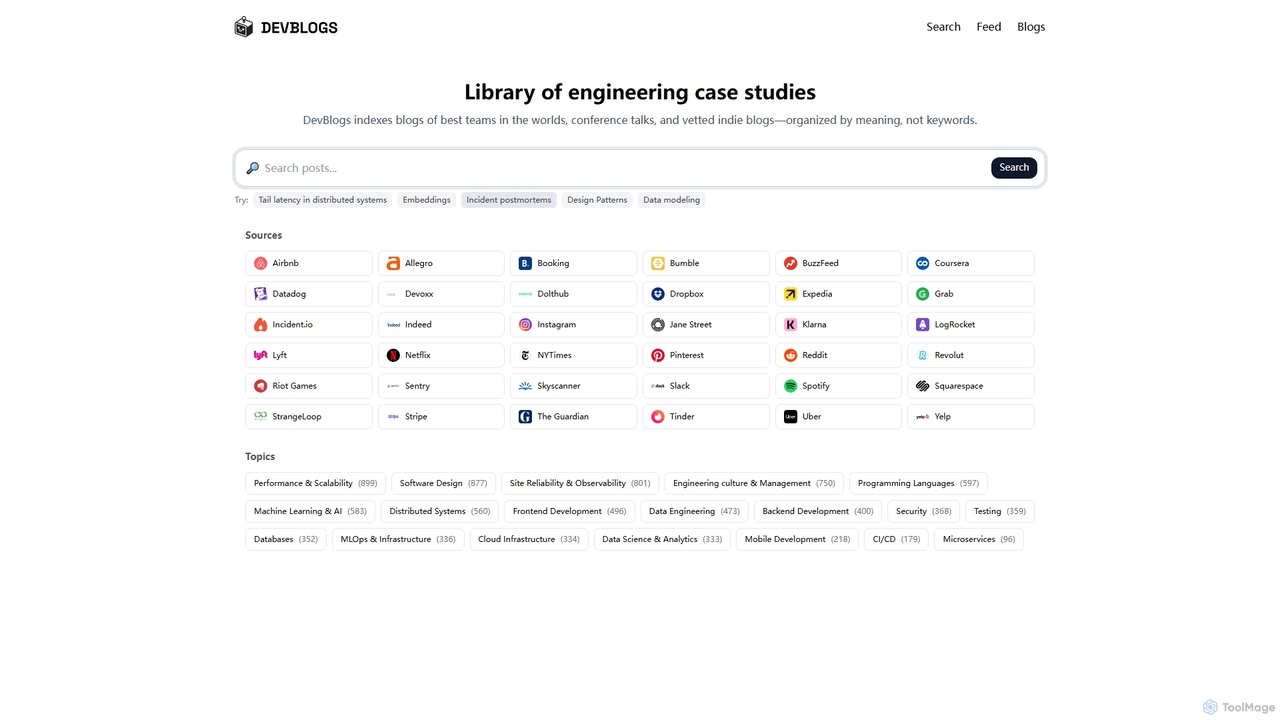
DevBlogs is a curated library indexing engineering case studies, tech blogs, and conference talks from leading global teams. …
DevBlogs is a curated library indexing engineering case studies, tech blogs, and conference talks from leading global teams. It organizes content by meaning and specific technical topics, providing a valuable resource for developers and engineers to discover insights and best practices.
About Engineering Blogs
AI-powered Engineering Blog tools are specialized platforms that use artificial intelligence to aggregate, search, and analyze technical content from leading technology companies. These tools leverage natural language processing (NLP) to index vast libraries of articles, enabling developers to find relevant solutions and insights quickly. They provide a structured way to access real-world case studies, architectural deep dives, and problem-solving techniques shared by industry experts. This helps engineers stay current with emerging technologies and best practices without manually sifting through hundreds of sources.
Core Features
- AI-Powered Semantic Search: Go beyond keywords to find articles based on concepts, problems, and technical context.
- Automated Content Summarization: Generate concise summaries of long, complex technical posts to quickly grasp key takeaways.
- Trend Analysis & Topic Discovery: Identify emerging technologies, popular architectural patterns, and trending topics across the industry.
- Personalized Feeds & Recommendations: Curate a customized reading list based on your technology stack, interests, and role.
Use Cases
These tools are invaluable for software developers, system architects, tech leads, and engineering managers. They are used for researching solutions to specific technical challenges, preparing for system design interviews by studying real-world architectures, and staying informed about the evolution of a particular tech stack (e.g., Kubernetes, serverless). Teams also use them for continuous learning and knowledge sharing.
How to Choose
When selecting a tool, consider the breadth and quality of its indexed sources—does it cover the blogs you trust? Evaluate the accuracy of its AI search and summarization features. Assess the level of personalization and filtering options available. Finally, consider the user interface and overall experience for discovering and consuming content efficiently.
Engineering BlogsUse Cases
Solving a Specific Technical Challenge
A backend developer is facing a persistent database connection pooling issue in a high-traffic microservice. Instead of generic web searches, they use an AI-powered engineering blog tool. They input a natural language query describing the problem, including their tech stack (e.g., 'PostgreSQL connection pool exhaustion in Kubernetes with Go'). The tool semantically searches across hundreds of engineering blogs and surfaces three in-depth articles from companies that solved the exact same issue. By reading these real-world case studies, the developer understands the root cause and implements a proven solution within hours, not days.
Preparing for a System Design Interview
A software engineer is preparing for senior-level system design interviews. They need to study real-world, large-scale architectures. Using an engineering blog platform, they filter for articles tagged with 'System Design,' 'Architecture,' and 'Scalability' from FAANG companies. The tool's AI summarization feature allows them to quickly review dozens of articles, identifying key patterns like caching strategies, database choices, and message queue implementations. They can then deep-dive into the most relevant posts, gaining practical insights that are far more valuable than generic textbook examples, significantly improving their interview performance.
Tracking Tech Stack Evolution
A tech lead wants to ensure her team's technology choices remain modern and effective. She sets up a personalized feed in an engineering blog tool to track posts related to her team's core stack: 'React,' 'GraphQL,' and 'AWS Lambda.' Every week, the tool delivers a digest of new articles and summaries. This allows her to see how other leading companies are using these technologies, learn about new best practices, and identify potential migration paths or alternative tools. This proactive approach to knowledge gathering helps her make informed decisions during technology planning and keeps her team's skills sharp.
Onboarding New Team Members
An engineering manager is onboarding a junior developer. To accelerate their learning, the manager curates a reading list using an engineering blog tool. They select 10 foundational articles from their company's blog and other industry leaders that explain their core architecture and coding standards. The AI summarization helps the new hire quickly get the gist of each article. This structured, high-quality reading material provides essential context and practical examples, helping the junior developer become productive much faster than by simply browsing the codebase or internal wikis alone.
Conducting Competitive Technology Analysis
A product manager and a lead architect are planning the next generation of their platform. They use an engineering blog tool to analyze the technology stacks of their competitors. By searching for posts from specific companies about their scaling and infrastructure choices, they can identify industry trends and learn from the successes and failures of others. The tool's trend analysis feature might reveal a growing adoption of a new database technology or a shift towards a specific cloud service, providing critical data to inform their own technology roadmap and strategic decisions.
Generating Content for Internal Tech Talks
An engineering team holds monthly internal tech talks to share knowledge. A senior engineer tasked with presenting on 'Observability Best Practices' uses an AI engineering blog tool for research. They search for recent, highly-regarded posts on the topic. The tool helps them quickly gather insights from multiple sources, including Netflix's, Uber's, and Shopify's engineering blogs. Using the AI-generated summaries, they structure their presentation around real-world examples and cutting-edge techniques, creating a highly relevant and engaging talk that benefits the entire team, saving hours of manual research.