ToolMage
Sign in

Best 1 Mobile App Creation AI tools for Software Development

Popular Mobile App Creation AI tools in Software Development include SupaDupaAI, helping you work more efficiently.

SupaDupaAI
Freemium

SupaDupaAI

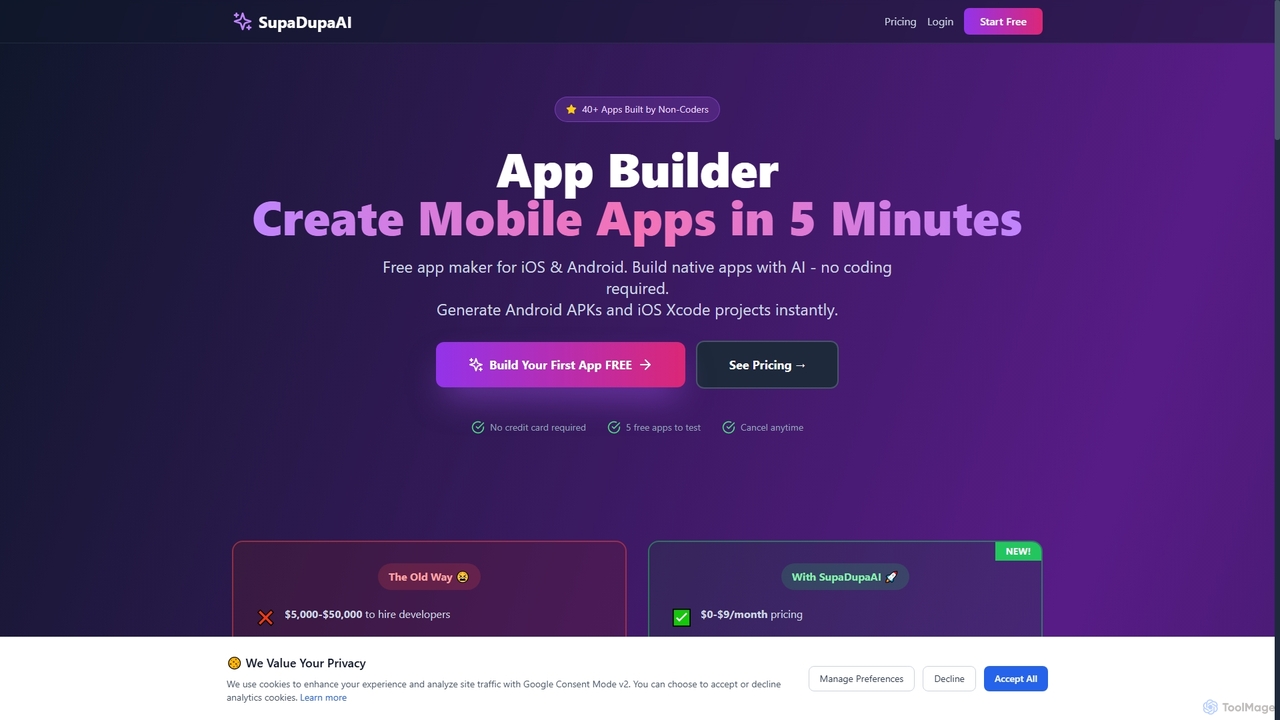
SupaDupaAI is an AI-powered no-code app builder that allows users to create native iOS and Android mobile applications in just 5 minutes using plain English descriptions. It eliminates the need for coding, enabling entrepreneurs, small businesses, and individuals to rapidly prototype, build, and launch professional-grade apps.

No Code Development
Visits 4.4KFavorites 128Likes 123

About Mobile App Creation

Mobile App Creation tools are AI-powered platforms that enable users to design, develop, and deploy mobile applications with minimal or no coding. These tools leverage visual interfaces, drag-and-drop functionalities, and machine learning algorithms to streamline the entire app development lifecycle. They democratize app development, making it accessible to entrepreneurs, small businesses, and even individuals without extensive programming knowledge, significantly reducing time and cost.

Core Features

  • Visual App Builder: Intuitive drag-and-drop interfaces for designing app layouts and user flows.
  • AI-Assisted Code Generation: Automatically generates code snippets or entire functions based on natural language prompts or visual designs.
  • Cross-Platform Deployment: Build once and deploy applications seamlessly to both iOS and Android operating systems.
  • Backend Integration: Tools for connecting apps with databases, APIs, and cloud services for data management and functionality.
  • Template Libraries & Components: Pre-built templates and reusable UI components to accelerate development.

Use Cases

These tools are ideal for small businesses needing customer-facing apps, entrepreneurs launching Minimum Viable Products (MVPs), and enterprises creating internal operational tools. They empower non-technical users to bring their app ideas to life quickly and efficiently, bypassing the complexities and costs of traditional coding.

How to Choose

When selecting a mobile app creation tool, consider its platform compatibility (iOS/Android), the level of customization offered, the sophistication of its AI capabilities (e.g., code generation, design suggestions), scalability for future growth, and the pricing model. Evaluate the ease of use for your team's technical skill level and the availability of integrations with existing systems.

Featured tool rankings

Mobile App Creation use cases

1

Creating a Customer Loyalty App for Small Businesses

A local cafe owner or small retail business can use an AI mobile app creation tool to quickly design and launch a simple loyalty program app. Customers can collect points, receive personalized offers, and redeem rewards directly through the app, enhancing customer engagement and retention without the need to hire a dedicated app developer or invest in complex coding.

2

Developing an MVP for a Startup Idea

An entrepreneur with a new service concept can utilize a no-code mobile app platform to build a functional Minimum Viable Product (MVP) within weeks. This allows them to test market demand, gather early user feedback, and attract potential investors without the significant upfront investment and time commitment typically required for custom-coded applications, accelerating their go-to-market strategy.

3

Building Internal Tools for Enterprises

Large organizations can empower non-technical departments (e.g., HR, marketing, operations) to create custom mobile applications for internal use. Examples include employee directories, leave request systems, project tracking apps, or field service management tools. This reduces the burden on IT departments, streamlines internal workflows, and improves operational efficiency by providing tailored solutions quickly.

4

Launching an Event Management Application

Event organizers can leverage AI mobile app creation tools to develop a comprehensive mobile app for conferences, festivals, or workshops. This app can feature schedules, speaker bios, venue maps, real-time updates, and interactive Q&A sessions, significantly enhancing the attendee experience and streamlining event logistics without requiring extensive technical expertise.

5

Designing Interactive Educational Apps

Educators, trainers, or e-learning platforms can create engaging and interactive mobile learning applications. These apps can include quizzes, flashcards, interactive lessons, progress tracking, and gamified elements, making educational content more accessible and dynamic for students on the go. AI can assist in personalizing learning paths and content delivery.

6

Prototyping and Iterating App Designs

UX/UI designers and product managers can leverage AI mobile app creation tools to rapidly prototype mobile app interfaces and user flows. This allows for quick iteration, testing different design concepts, and gathering stakeholder feedback much faster than traditional methods. The ability to visualize and interact with a functional prototype accelerates the design approval process and reduces development rework.

Mobile App Creation FAQ

What are Mobile App Creation tools?

Mobile App Creation tools are software platforms that allow users to build mobile applications for iOS and Android devices. They primarily use AI, low-code, or no-code approaches, enabling visual development with drag-and-drop interfaces. These tools simplify complex coding, automate repetitive tasks, and often include features for backend integration and cross-platform deployment, making app development accessible to a wider audience.

How do AI-powered mobile app creation tools work?

AI-powered mobile app creation tools typically work by providing a visual development environment where users can drag and drop pre-built components to design their app's UI. AI algorithms assist by suggesting design elements, generating code snippets based on natural language descriptions, or optimizing app performance. They often integrate with cloud services for backend functionality and enable one-click deployment to various app stores, abstracting away much of the underlying technical complexity.

Who can benefit from using mobile app creation tools?

A wide range of users can benefit from mobile app creation tools. This includes entrepreneurs and startups looking to quickly launch an MVP, small businesses needing a custom app without a large budget, and non-technical founders who lack coding skills. Additionally, large enterprises can use them for internal tools, and even individual content creators or educators can build interactive apps to engage their audience or students more effectively.

What are the key advantages of using AI for mobile app development?

Using AI in mobile app development offers several key advantages. It significantly accelerates the development process by automating code generation, suggesting optimal design elements, and streamlining testing. AI tools reduce the need for extensive coding expertise, making app creation more accessible and cost-effective. They also enable rapid prototyping and iteration, allowing for quicker market feedback and faster deployment of updates, ultimately leading to more efficient and innovative app solutions.

What is the difference between AI mobile app creation and traditional coding?

AI mobile app creation primarily uses visual development, low-code/no-code platforms, and AI assistance to automate parts of the development process. It focuses on speed, accessibility for non-developers, and rapid prototyping. Traditional coding, conversely, involves writing code from scratch using programming languages (e.g., Swift, Kotlin, React Native). While it offers maximum flexibility, customization, and performance control, it requires specialized technical skills, more time, and higher costs, making it suitable for highly complex or unique applications.