
ToolMage
Sign in

Best 1 Domain AI tools for Startup Tools

Popular Domain AI tools in Startup Tools include DomainBrainstormer, helping you work more efficiently.

DomainBrainstormer
Free

DomainBrainstormer

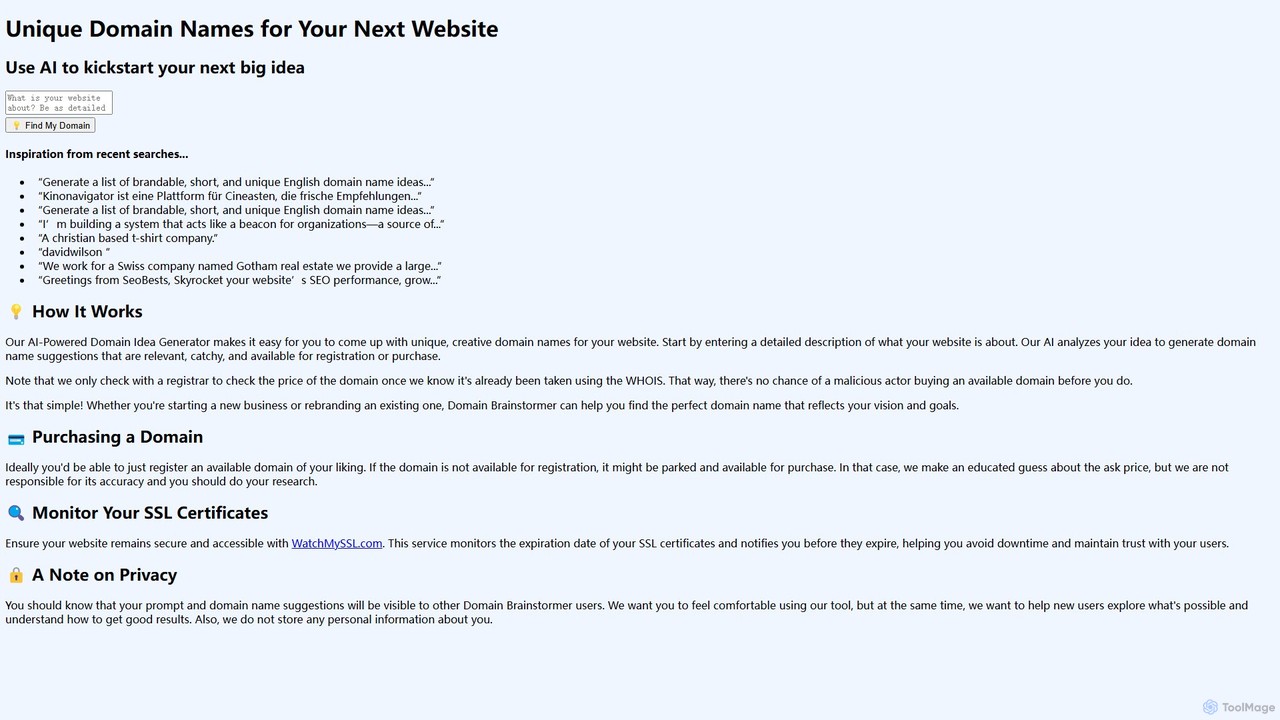
DomainBrainstormer is an AI-powered domain name generator that helps you find unique and brandable domain names for your next project. Simply describe your idea, and the AI will provide a list of creative, relevant, and available domain suggestions, complete with availability status and estimated purchase prices for premium domains.

Branding
Visits 4.2KFavorites 113Likes 96

About Domain

Domain tools are essential AI-powered platforms designed to help startups establish and manage their online identity by facilitating the discovery, registration, and administration of web addresses. These tools leverage advanced algorithms to suggest unique, brandable domain names, assess their market value, and streamline the entire acquisition process. They enable new businesses to secure a memorable digital footprint, ensuring their brand is easily discoverable and professionally represented on the internet.

Core Features

  • AI Domain Generation: Generates creative and available domain name suggestions based on keywords and branding goals.
  • Domain Search & Registration: Provides real-time availability checks and simplifies the process of registering desired domain names.
  • Domain Valuation: Estimates the market value of domain names, aiding in acquisition or sale decisions.
  • DNS Management: Offers intuitive interfaces for configuring DNS records, linking domains to websites and services.
  • Brand Protection: Helps identify and register similar or related domain names to prevent cybersquatting and brand dilution.

Applicable Scenarios

Startups launching a new product or service frequently use these tools to find a distinctive web address that resonates with their brand. Businesses undergoing rebranding efforts utilize them to secure new, more fitting domain names. Additionally, companies expanding into new markets rely on domain tools to register country-specific top-level domains (ccTLDs) and manage their global online presence effectively.

How to Choose

When selecting domain tools, consider the breadth of their AI suggestion capabilities, the range of TLDs offered, and the transparency of pricing for registration and renewals. Evaluate the ease of use of their DNS management interface, the quality of customer support, and any additional features like privacy protection or email hosting. Prioritize tools that offer robust security measures and a clear, user-friendly dashboard for managing your domain portfolio.

Featured tool rankings

Domain use cases

1

Finding a Unique Brand Domain for a New Startup

A nascent tech startup needs a memorable and available domain name that reflects its innovative service. They use AI domain generation tools to input keywords related to their business, exploring hundreds of unique suggestions and checking real-time availability across various TLDs. This process helps them quickly identify and secure a domain that aligns perfectly with their brand identity, avoiding generic or hard-to-remember addresses.

2

Leveraging AI for Creative Domain Name Brainstorming

A content creator wants to launch a new blog but struggles to find an engaging domain name. They utilize AI domain tools that offer creative brainstorming features, generating names based on themes, emotions, or even abstract concepts. The AI provides phonetic suggestions, portmanteaus, and brandable short names, significantly expanding their options beyond traditional keyword-based searches and helping them find a truly distinctive online identity.

3

Protecting Brand Identity Through Proactive Domain Registration

An established e-commerce brand is concerned about potential cybersquatting or brand impersonation. They employ domain tools to identify and register common misspellings, alternative TLDs (e.g., .net, .org, .co), and country-specific domains related to their primary brand. This proactive strategy safeguards their intellectual property, prevents competitors from leveraging similar names, and ensures customers are always directed to their official online presence.

4

Efficiently Managing a Portfolio of Multiple Startup Domains

A venture builder manages several distinct startup projects, each requiring its own domain name. They use a centralized domain management platform to oversee registrations, renewals, and DNS settings for their entire portfolio. This streamlines administrative tasks, ensures no domain expires unexpectedly, and allows for quick configuration changes, supporting the rapid deployment and iteration of new ventures.

5

Acquiring a Premium Domain Name for Strategic Growth

A startup aims to acquire a highly desirable, short, and keyword-rich domain name currently owned by another party. They use domain valuation tools to assess its fair market price and leverage domain brokering services offered by some platforms. These tools provide insights into market trends and facilitate negotiations, helping the startup make an informed decision and successfully acquire a valuable digital asset that enhances their market position.

6

Expanding Global Reach with Localized Domain Names

A SaaS company plans to enter the European and Asian markets. They use domain tools to research and register country-code top-level domains (ccTLDs) like .de for Germany, .fr for France, and .jp for Japan. This strategy allows them to establish a localized online presence, build trust with regional customers, and optimize their search engine visibility in specific geographic areas, supporting their international expansion efforts.

Domain FAQ

What are Domain tools for startups?

Domain tools for startups are specialized platforms that assist new businesses in finding, registering, and managing their internet domain names. These tools often incorporate AI to generate creative name suggestions, check availability across various top-level domains (TLDs), and streamline the registration process. They are crucial for establishing a startup's unique online identity, ensuring brand recognition, and providing a professional web address for their digital presence.

How do AI-powered domain tools help startups?

AI-powered domain tools significantly benefit startups by automating and enhancing the domain name selection process. They can generate a multitude of unique, brandable, and available domain name ideas based on keywords, industry, or desired brand attributes, saving countless hours of manual brainstorming. AI also helps in identifying premium domains, assessing their value, and suggesting variations for brand protection, making it easier for startups to secure an optimal online identity quickly and efficiently.

What should I consider when choosing a domain name for my startup?

When choosing a domain name, consider several factors: Relevance (does it reflect your brand/business?), Memorability (is it easy to remember and spell?), Uniqueness (does it stand out?), and Length (shorter is generally better). Also, check for availability across common TLDs (.com, .io, .co) and social media handles. Ensure it's easy to pronounce and avoid hyphens or numbers if possible, as these can lead to confusion. Finally, consider future scalability if your business might expand.

What's the difference between a domain registrar and a web host?

A domain registrar is a company accredited to reserve and register internet domain names. When you register a domain, you're essentially leasing the right to use that name for a period. A web host, on the other hand, provides the server space and technology required for your website to be accessible on the internet. While some companies offer both services, they are distinct: the registrar manages your address, and the host stores your website's content.

Can I transfer my domain name to another registrar?

Yes, you can typically transfer your domain name from one registrar to another. The process usually involves unlocking your domain at the current registrar, obtaining an authorization code (EPP code), and initiating the transfer with the new registrar. There are usually specific rules, such as a minimum registration period (often 60 days) before a transfer is allowed, and the domain must not be expired or in a redemption period. Transfers can take several days to complete.