
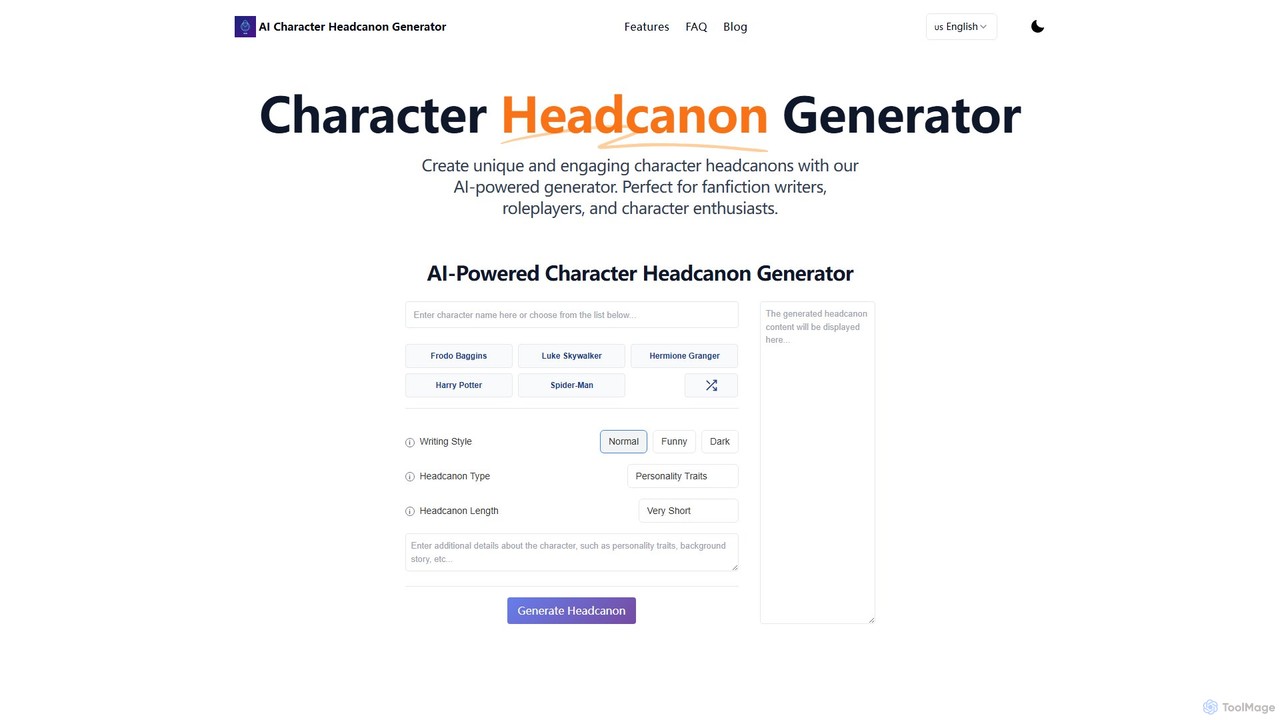
character_headcanon_generator
An AI-powered tool for writers, roleplayers, and fans to generate unique and engaging headcanons for fictional characters. Instantly …
An AI-powered tool for writers, roleplayers, and fans to generate unique and engaging headcanons for fictional characters. Instantly create detailed backstories, personality traits, relationships, secrets, and more in various styles and lengths to overcome creative blocks and enrich your storytelling.
About Character Development
Character Development tools are AI-powered platforms designed to assist creators in building deep, consistent, and compelling fictional characters. They utilize large language models and narrative databases to generate detailed backstories, personality traits, motivations, and developmental arcs. This enables writers, game designers, and screenwriters to overcome creative blocks and enrich their storytelling with lifelike personas. These specialized tools provide a structured framework for character creation that goes beyond the capabilities of general-purpose AI writers.
Core Features
- Backstory Generation: Automatically creates detailed life histories, significant events, and formative experiences for a character.
- Personality Profiling: Defines psychological traits, flaws, and motivations, often using frameworks like Myers-Briggs or the Enneagram.
- Dialogue Simulation: Generates sample dialogue that reflects a character's unique voice, dialect, and personality.
- Relationship Mapping: Visually outlines and manages the complex web of relationships between different characters.
- Character Arc Planning: Helps structure a character's growth, change, or decline over the course of a narrative.
Applicable Scenarios
These tools are invaluable for novelists crafting multi-faceted protagonists, game developers designing memorable non-player characters (NPCs), and screenwriters maintaining consistency for a series' cast. They are also used by tabletop RPG masters to quickly populate their worlds with interesting individuals and by marketers to build detailed customer personas.
How to Choose
When selecting a Character Development tool, consider the depth of detail you require—from simple trait lists to full psychological profiles. Evaluate its genre specialization (e.g., fantasy, sci-fi) and its ability to integrate with your existing writing software. Also, consider collaboration features if you work in a team and whether the tool offers visual aids like relationship maps or character portraits.
Character DevelopmentUse Cases
Developing a Complex Protagonist for a Novel
A novelist is struggling with writer's block while creating the main character for their next fantasy epic. Using an AI Character Development tool, they input core concepts like 'exiled mage seeking redemption.' The tool generates a detailed backstory involving a magical accident, a complex family dynamic, and a hidden personal fear. It also suggests a personality profile (e.g., INTJ) with conflicting traits like arrogance and deep-seated insecurity, providing rich material for internal conflict and a compelling character arc.
Creating Diverse NPCs for an RPG
A game development studio needs to populate a large open-world RPG with hundreds of non-player characters (NPCs). Manually writing each one is time-consuming. They use a character development tool to batch-generate NPCs based on roles (merchant, guard, quest-giver) and factions. The AI creates unique names, appearances, short backstories, and even dialogue snippets for each, ensuring the game world feels populated and alive. This process reduces development time by weeks and provides a foundation for writers to further refine key characters.
Ensuring Character Consistency in a TV Series
A team of writers for a multi-season TV show uses a character development tool as a centralized 'character bible'. For each main character, they input key traits, relationship dynamics, and established backstory points. When a new writer joins the team, they can quickly get up to speed. The tool's relationship mapping feature helps visualize complex alliances and rivalries, and its dialogue simulator can be used to check if a line of dialogue feels 'in character', ensuring consistency across episodes written by different people.
Populating a Tabletop RPG Campaign
A Dungeon Master (DM) is preparing a new Dungeons & Dragons campaign and needs a memorable villain and several key allies for the players to interact with. Instead of spending hours brainstorming, the DM uses an AI tool. They input prompts like 'charismatic cult leader who secretly fears their own god' and 'gruff dwarf blacksmith with a tragic past.' The AI generates detailed character sheets, including motivations, flaws, and potential plot hooks, allowing the DM to create a rich, interactive world more efficiently.
Building Detailed Customer Personas for Marketing
A marketing team wants to move beyond generic demographic data for their target audience. They use a character development tool to build rich, narrative-driven customer personas. They input data points like '35-year-old project manager, values efficiency, struggles with work-life balance.' The AI fleshes this out into a persona named 'Alex,' complete with a backstory, daily routine, professional goals, and personal frustrations. This helps the team craft more empathetic and targeted messaging, ads, and content that resonates with their ideal customer.
Designing Characters for Educational Simulations
An instructional designer is creating a corporate training module on conflict resolution. To make the simulation realistic, they need believable characters for role-playing scenarios, such as an 'irate customer' or a 'demotivated team member'. Using an AI character tool, the designer generates profiles for these roles, including their specific grievances, communication styles, and underlying motivations. This allows trainees to practice their skills in a more nuanced and effective environment, preparing them for real-world interactions.