Impel
Impel is an AI-powered customer lifecycle management platform specifically for the automotive industry. It enhances the car buying …
Impel is an AI-powered customer lifecycle management platform specifically for the automotive industry. It enhances the car buying experience through conversational AI, digital merchandising with 360° virtual tours, and automated sales engagement. The platform helps dealers increase lead conversion, improve sales efficiency, and build lasting customer relationships.
Toma
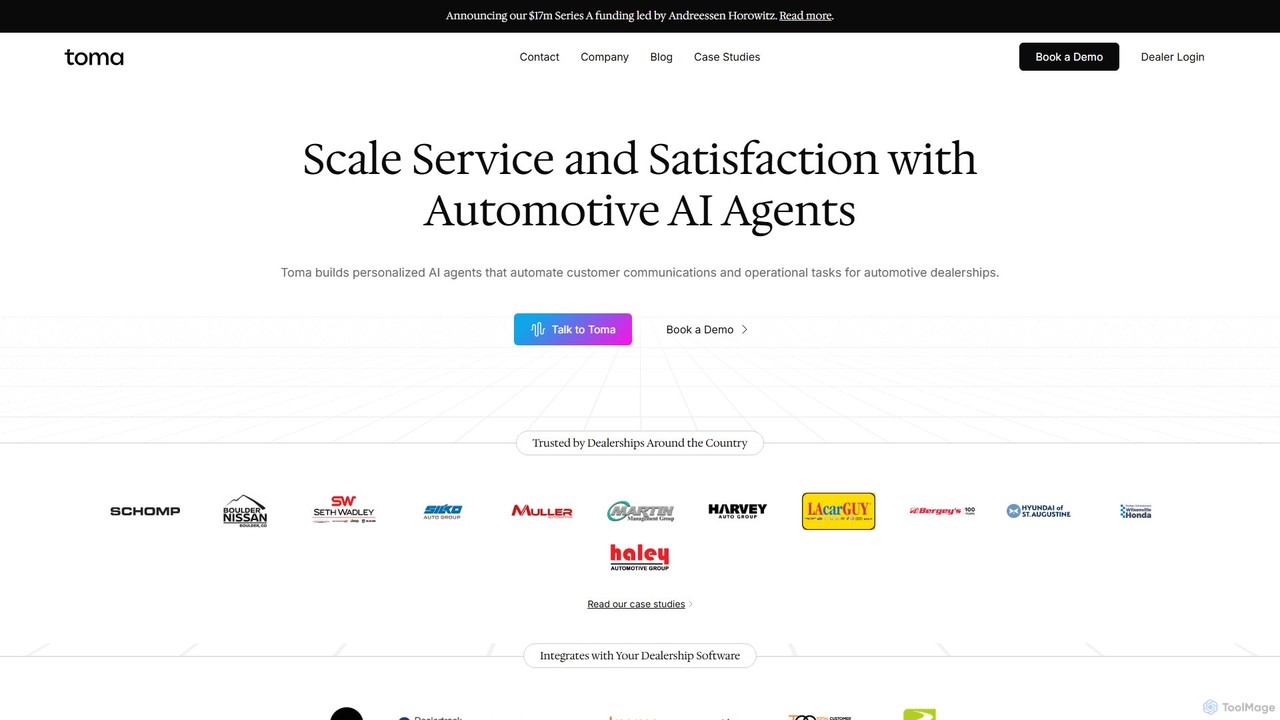
Toma provides advanced AI agents specifically designed for automotive dealerships. It automates customer interactions across voice and SMS, …
Toma provides advanced AI agents specifically designed for automotive dealerships. It automates customer interactions across voice and SMS, handling tasks like service appointment booking, recall notifications, parts orders, and appointment reminders. By acting as a virtual team member, Toma helps dealerships increase service revenue, reduce operational costs, and improve customer satisfaction without adding headcount. Its proprietary AI ensures natural, low-latency conversations and seamless integration with existing dealership software.
About Verticals
Vertical AI tools are specialized artificial intelligence solutions designed and trained for a specific industry or business function. Unlike general-purpose AI, these tools leverage domain-specific datasets, terminology, and workflows to deliver highly accurate and context-aware results. They are engineered to solve niche problems, from analyzing medical images to detecting financial fraud, providing deeper insights than a one-size-fits-all platform. This specialization results in faster implementation and a higher return on investment for businesses operating in complex sectors.
Core Features
- Domain-Specific Knowledge: Pre-trained on industry-specific data, such as legal documents, medical records, or financial market trends, ensuring high relevance.
- Workflow Integration: Designed to seamlessly connect with existing industry software like EMRs, ERPs, or case management systems.
- Regulatory Compliance: Often built with industry regulations (e.g., HIPAA, GDPR, FINRA) in mind to ensure data security and legal adherence.
- Specialized Functionality: Offers unique features tailored to a profession, such as automated medical coding, legal e-discovery, or predictive maintenance alerts.
Use Cases
Vertical AI is critical in sectors with unique data and complex regulations. In healthcare, it assists in diagnostic imaging and personalized treatment plans. The financial industry uses it for algorithmic trading, credit scoring, and fraud detection. Legal professionals leverage it for contract analysis and case research, while manufacturing applies it for supply chain optimization and quality control.
How to Choose
When selecting a Vertical AI tool, first verify its industry fit and the depth of its domain-specific knowledge. Assess its integration capabilities with your current systems to ensure a smooth workflow. Scrutinize its compliance with relevant industry regulations and data security standards. Finally, evaluate the vendor's expertise and support within your specific sector to ensure long-term success.
VerticalsUse Cases
AI-Powered Medical Imaging Analysis
A radiologist uses a vertical AI tool to analyze hundreds of MRI scans for potential tumors. The AI, trained on millions of medical images, highlights suspicious regions with a high degree of accuracy, providing a probability score for malignancy. This allows the radiologist to prioritize cases, focus their expertise on complex scans, and reduce the time spent on routine screenings. The result is a faster diagnostic workflow, a potential reduction in human error, and earlier detection for patients.
Automated Legal Contract Review
A corporate legal team needs to review a batch of 50 supplier contracts for non-standard clauses and potential risks. Instead of manual review, which could take days, they use a legal AI tool. The tool automatically scans each document, identifies key clauses like liability limits and termination rights, and flags any deviations from the company's standard templates. It generates a summary report highlighting risks for each contract, allowing lawyers to focus their attention on negotiation and strategic advice rather than tedious document checking.
Financial Fraud Detection in Real-Time
A financial institution uses a vertical AI system to monitor millions of credit card transactions per second. The AI model, trained on historical fraud patterns, analyzes variables like transaction amount, location, time, and merchant type. When a transaction deviates significantly from a user's normal spending behavior, the system flags it as potentially fraudulent in real-time. This triggers an immediate alert to the customer and can automatically block the card to prevent further losses, significantly reducing the financial impact of fraud.
Predictive Maintenance in Manufacturing
A factory manager uses a vertical AI platform connected to sensors on their production line machinery. The AI continuously analyzes data streams like vibration, temperature, and pressure. By recognizing subtle patterns that precede equipment failure, the system predicts when a specific component is likely to fail. It then automatically schedules maintenance before the breakdown occurs, providing a detailed report to the engineering team. This proactive approach minimizes costly unplanned downtime and extends the lifespan of the machinery.
AI-Driven Retail Demand Forecasting
A retail chain's supply manager uses a vertical AI tool to optimize inventory. The system analyzes historical sales data, seasonality, promotional events, and even external factors like weather forecasts and social media trends. It generates highly accurate demand forecasts for thousands of products across hundreds of stores. Based on these predictions, the system recommends optimal stock levels and automated reordering schedules, helping the retailer avoid both stockouts of popular items and overstocking of slow-moving goods.
Automated Property Valuation in Real Estate
A real estate investment firm uses a vertical AI tool to quickly assess the value of potential properties. The appraiser inputs a property address, and the AI instantly analyzes vast datasets including recent comparable sales, local market trends, property tax records, school district ratings, and zoning regulations. It generates an Automated Valuation Model (AVM) report within seconds, providing a reliable estimate of the property's current market value. This allows the firm to make faster, data-driven investment decisions and screen hundreds of properties efficiently.