ToolMage
Sign in

AI TOOL COMPARISON

apiversion.dev vs Release

What is the difference, and which fits your workflow? Compare features, usage, pricing models and traffic side by side.

Jump to key differences

Product overview

apiversion.dev Product overview

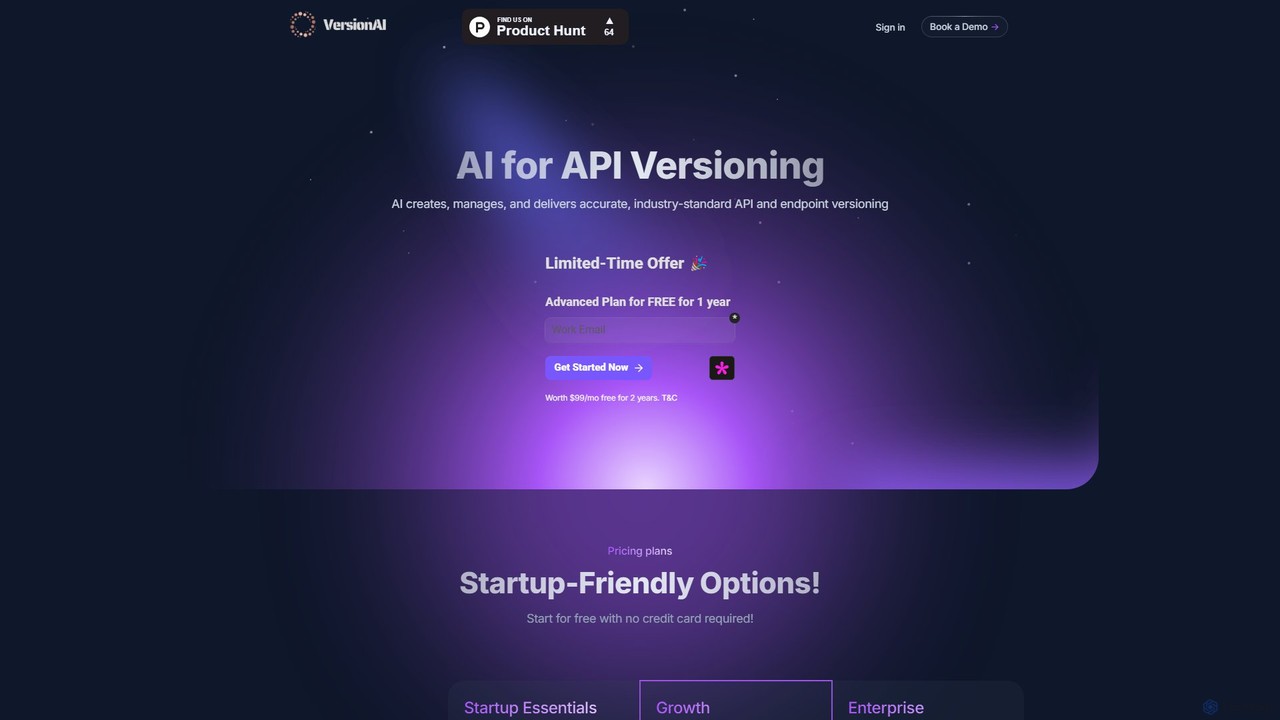
apiversion.dev is an AI-powered platform that automates API and endpoint versioning. It helps development teams create, manage, and deliver accurate, industry-standard versions using Semantic or Calendar Versioning. By integrating with CI/CD pipelines, it reduces manual errors, improves communication, and accelerates development cycles, ensuring seamless updates for both internal teams and external customers.

Preview

Release Product overview

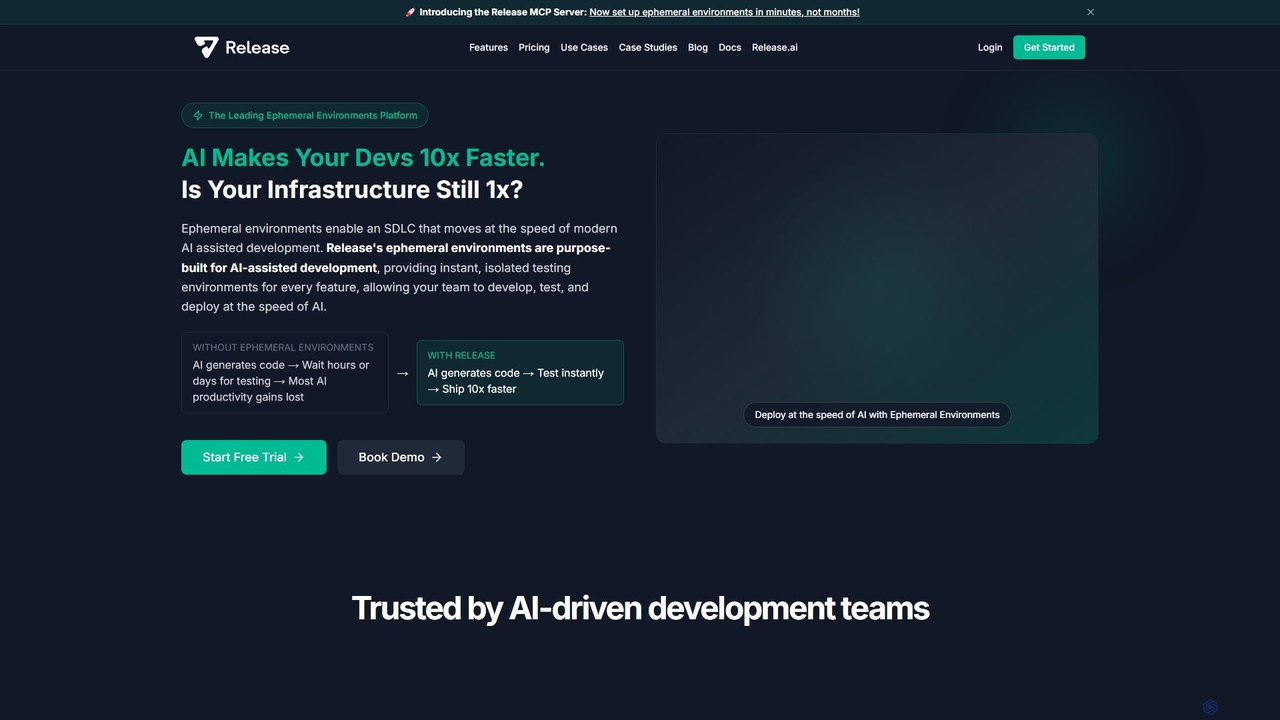
Release is an AI-powered ephemeral environments platform that accelerates software development. It provides instant, isolated testing environments for every feature or pull request, eliminating infrastructure bottlenecks. By integrating with AI development tools and IDEs, Release enables teams to test and deploy code up to 10x faster.

Preview

Quick facts

Compare product focus, pricing models and audiences. Highlighted rows indicate different listed information; unknown pricing does not mean free.

apiversion.dev VS Release — Quick facts
Quick factsapiversion.devRelease
Pricing modelFreemiumFreemium
Product typeWebWeb
Primary focusApi ManagementDevops
Audience and rolesNo data availableNo data available
CategoriesApi Management · Devops · AutomationDevops · Testing · Infrastructure
AddedAug 13, 2025Aug 12, 2025
UpdatedNov 19, 2026Nov 19, 2026

Features, usage and use cases

Explore the listed product descriptions, features and workflows. Taxonomy labels alone are not feature evaluations.

apiversion.dev

apiversion.dev is a sophisticated AI-driven platform designed to tackle one of the most critical and often complex aspects of software development: API versioning. It streamlines the entire versioning lifecycle, from creation and management to communication, ensuring that API changes are handled consistently, accurately, and in line with industry best practices. By automating this process, apiversion.dev frees up developers from tedious manual tasks, minimizes the risk of human error, and fosters better collaboration across teams.

The platform acts as a central nervous system for your API's evolution. It intelligently analyzes changes in your API specifications and automatically suggests or applies the correct version number, whether you prefer Semantic Versioning (SemVer), Calendar Versioning (CalVer), or simple incremental numbers. This ensures that every change, whether a major breaking update, a minor feature addition, or a simple patch, is correctly documented and versioned.

How to use apiversion.dev

Using apiversion.dev is designed to be a seamless integration into your existing development workflow. Here's a typical process:

  1. Connect Your Repository: Start by linking your code repositories (e.g., GitHub) to the apiversion.dev platform. This allows the AI to access and monitor your API specification files (like OpenAPI/Swagger).
  2. Configure Versioning Rules: Define your preferred versioning strategy. Choose between Semantic Versioning (e.g., 2.1.0), Calendar Versioning (e.g., 2024.08.01), or incremental versioning. You can set up rules for different APIs or projects.
  3. Integrate with CI/CD: Connect apiversion.dev to your CI/CD pipeline using tools like GitHub Actions. This enables the platform to analyze changes automatically during the pull request process.
  4. Automated Feedback: When a developer submits a pull request with changes to an API, the AI analyzes the modifications and provides instant feedback directly in the PR. It will suggest the appropriate version bump and summarize the changes.
  5. Merge and Publish: Once the pull request is approved and merged, apiversion.dev finalizes the new version. It automatically updates the version number in your specification file, records the change in a comprehensive version history, and can trigger downstream actions like publishing updated documentation or notifying team members via Slack.

Core Features of apiversion.dev

  • Automated Versioning Management: The core of the platform, using AI to create and maintain API and endpoint versions, eliminating manual effort and ensuring consistency.
  • Multiple Versioning Schemes: Full support for industry standards including Semantic Versioning (SemVer), Calendar Versioning (CalVer), and Incremental Versioning to fit any project's needs.
  • Comprehensive Version History: Maintains an immutable and detailed history of all API and endpoint versions, providing a clear audit trail and making it easy to track changes over time.
  • CI/CD Integration: Seamlessly integrates with GitHub Actions and other CI/CD tools to provide versioning feedback before code is merged, preventing last-minute rollbacks.
  • Developer Feedback Loop: Provides developers with precise versioning feedback on API changes directly within their pull requests, improving code quality and development speed.
  • Stakeholder Communication: Automatically keeps project managers, support teams, and customers informed with accurate API versioning information through integrations with Slack and reporting tools.
  • Broad Integration Support: Connects with essential developer tools including GitHub, Confluence, and cloud storage like Dropbox, S3, Google Drive, and OneDrive (Enterprise Plan).
  • Advanced Reporting: Generates detailed reports in HTML and GitHub Markup formats, with customizable cadences (weekly, monthly, etc.) to keep everyone aligned.

Use Cases for apiversion.dev

apiversion.dev is valuable for any organization that builds or relies on APIs:

  • SaaS Companies: For managing public-facing APIs, ensuring that customer integrations don't break unexpectedly and that changes are communicated clearly through predictable versioning.
  • Microservices Architectures: In complex systems with hundreds of internal services, it automates the versioning of inter-service APIs, preventing cascading failures caused by unannounced breaking changes.
  • API-First Companies: For businesses where the API is the primary product (like WristBand, mentioned in the testimonial), it provides the critical infrastructure for managing the API lifecycle professionally.
  • Large Enterprise Teams: Helps enforce a consistent versioning policy across multiple development teams and projects, improving governance and reducing integration chaos.

Advantages of apiversion.dev

The platform offers significant benefits:

  • Increased Developer Productivity: By automating a repetitive task, developers can focus on building features instead of debating version numbers.
  • Reduced Risk of Errors: AI-driven analysis is more reliable than manual checks, minimizing the risk of incorrect versioning that can lead to breaking changes.
  • Enhanced Collaboration: Creates a single source of truth for API changes, aligning developers, product managers, and technical support.
  • Improved Customer Confidence: Consumers of your API can rely on a stable, predictable versioning scheme, which builds trust and simplifies their own development work.
  • Accelerated Time-to-Market: By catching issues early in the development cycle, it prevents costly delays and rollbacks, allowing for faster and more frequent updates.

Pricing and Plans

apiversion.dev offers a freemium model designed to scale with your company's needs:

  • Startup Essentials Plan: $0/month. Ideal for early-stage startups and individual projects. Includes up to 5 APIs, 40 total endpoints, and unlimited users. Provides core features like API/Endpoint Versioning and Snapshot View.
  • Growth Plan: $199/month (or a discounted yearly rate). Designed for growing startups. Increases limits to 10 APIs and 100 total endpoints. Includes all features of the Startup plan plus weekly reports and enhanced support.
  • Enterprise Plan: Custom pricing (Book a Demo). Tailored for large or expanding companies with extensive needs. Includes 20+ APIs, 200+ endpoints, and unlocks all advanced features such as GitHub Actions & CI/CD integration, integrations with Confluence, S3, Google Drive, API Gateway management, and dedicated enterprise support.

Release

Release is a pioneering ephemeral environments platform designed to synchronize infrastructure speed with the rapid pace of AI-assisted development. In modern software development, AI tools can generate code at an unprecedented rate, but traditional staging and testing environments create significant bottlenecks, nullifying these productivity gains. Release addresses this challenge by providing on-demand, isolated, and fully functional testing environments for every feature, branch, and pull request (PR).

The core of the platform is the Release MCP (Model Context Protocol) Server, an innovative AI-powered engine that transforms the complex process of setting up environments. What traditionally took weeks or months of manual configuration can now be accomplished in minutes. The MCP Server analyzes your application's codebase, automatically detects frameworks, dependencies, and database requirements, and then generates an optimized configuration template. This allows development teams to eliminate manual setup and focus on building and shipping high-quality software.

How to use Release

Using Release is designed to be a seamless part of the development workflow:

  1. Onboard Your Application: Start by pointing the Release MCP Server to your code repository. It will run an analysis to understand your stack, including Dockerfiles, package.json, frameworks like React or Next.js, and database configurations.
  2. Generate Configuration: Within minutes, the MCP Server generates a complete and optimized environment configuration. This plan is ready for immediate deployment.
  3. Integrate with Your Workflow: Release integrates directly into your existing tools, most notably your IDE (e.g., Cursor). This allows you to manage environments without ever leaving your development context.
  4. Automated Environment Creation: Once configured, Release automatically spins up a new, isolated ephemeral environment for every pull request or feature branch. This enables parallel testing without any conflicts.
  5. Manage with Natural Language: Interact with your running environments using the conversational AI of the MCP Server. You can ask for deployment statuses, check logs, or debug issues with simple English commands like "what's the status of my feature branch deployments?" or "help me debug 500 errors on the API."
  6. AI-Powered Debugging: Grant AI agents access to your environment logs. The platform can then automatically analyze error patterns, identify root causes (e.g., incorrect environment variables), and suggest fixes, drastically reducing troubleshooting time.
  7. Automatic Cleanup: Ephemeral environments are automatically decommissioned and cleaned up when the corresponding branch is merged or closed, preventing resource waste and eliminating manual maintenance.

Core Features of Release

  • AI-Powered Onboarding (MCP Server): Automatically analyzes codebases and generates optimal environment configurations in minutes.
  • Instant Ephemeral Environments: Creates complete, isolated, full-stack environments for every PR and feature branch on-demand.
  • Conversational Management & Debugging: Use natural language requests within your IDE to manage, monitor, and troubleshoot environments.
  • AI-Powered Log Analysis: AI agents can access runtime logs to proactively identify issues, pinpoint root causes, and suggest solutions.
  • Complete Database Integration: Automatically provisions stateful services like databases for each environment, and can help populate test data and manage schema migrations.
  • IDE Integration: Seamlessly integrates with developer tools like Cursor, keeping environment management within the natural development flow.
  • Stack-Agnostic: Works with any technology stack, from simple applications to complex, multi-service enterprise systems.
  • Automated Lifecycle Management: Fully automates the creation, maintenance, and teardown of environments, freeing up DevOps resources.

Use Cases for Release

Release is ideal for modern development teams looking to maximize their velocity and efficiency:

  • AI Development Teams: Provides the necessary infrastructure to keep pace with AI-assisted code generation, enabling rapid testing and iteration of AI features and models.
  • High-Velocity DevOps: Eliminates deployment queues and staging bottlenecks, allowing teams to confidently push multiple releases per day.
  • Parallel Feature Branch Testing: Enables developers and AI agents to test new features in fully isolated environments, preventing conflicts and ensuring code quality.
  • ML/AI Workload Validation: Allows for testing and validation of machine learning models in production-like environments that are optimized for AI/ML workloads.
  • Replacing Traditional Staging: Modernizes the SDLC by replacing slow, monolithic, and costly staging environments with fast, on-demand ephemeral environments.

Advantages of Release

The primary advantage of Release is the massive acceleration of the development lifecycle. By removing infrastructure as a bottleneck, teams can ship features up to 10x faster. This preserves the return on investment in AI development tools. It enables true parallel development, improves developer happiness by removing tedious infrastructure tasks, and reduces the hidden costs associated with maintaining persistent staging servers. The automated, AI-optimized nature of the platform ensures that infrastructure scales seamlessly with development velocity.

Pricing and Plans

Release operates on a freemium model. There is a free trial available for teams to get started and experience the platform's benefits. For larger teams and enterprise use cases with specific needs, Release offers tailored plans. Detailed pricing information is available upon booking a personalized demo with their engineering team through the official website.

Positioning

Their taxonomy shows where the products overlap and where each one has a more distinct focus. Unknown fields are shown explicitly and are never filled with assumptions.

Categories

Shared
Devops
Only apiversion.dev
Api ManagementAutomation
Only Release
TestingInfrastructure

Tags

Shared
CI/CDdeveloper toolsdevopssoftware development
Only apiversion.dev
APIapi managementautomationopenapisemantic versioningversioning
Only Release
AI developmentEphemeral Environmentsinfrastructurekubernetesstaging environmenttesting

Audience and roles

Shared
No listed items
Only apiversion.dev
No listed items
Only Release
No listed items

Traffic comparison

Traffic is shown on the same scale so differences in market visibility are not visually understated.

How to interpret the traffic data

Both charts share the same months and vertical scale. Each tool identifies its latest reporting month; missing months are left blank, not counted as zero. Regional and source visit counts are estimates calculated from the reported shares.

apiversion.dev

No data available

Release monthly traffic:

Latest traffic · 2026-05

Monthly visits
17.4K
Avg. visit duration
0:10
Pages per visit
1.59
Bounce rate
42.93%
Data updated 2026-06-15

Monthly traffic trend

  • 2025-09: 20.9K
  • 2026-01: 24.8K
  • 2026-02: 21.2K
  • 2026-03: 17.3K
  • 2026-04: 13.3K
  • 2026-05: 17.4K

Top regions

Top 5 countries/regions
Country/regionPercentageEstimated visits
🇺🇸United States48.38%8.4K
🇻🇳Vietnam17.5%3.1K
🇮🇳India13.8%2.4K
🇫🇷France10.76%1.9K
🇹🇭Thailand9.56%1.7K

Search keywords

does launchdarkly integrate with flxbl ci/cd toolenvironment presetreleasereleases.com operationa statuswhat happen to release.com

Community signals

Ratings, comments, favorites, and likes are community signals—not a substitute for product fit.

apiversion.dev

Rating
No data available
Comments
0
Favorites
149
Likes
159

Release

Rating
No data available
Comments
0
Favorites
144
Likes
155

apiversion.dev vs Release · Comparison FAQ

What do apiversion.dev and Release have in common?
Both tools are listed under Devops. These categories indicate overlapping use cases; compare their detailed descriptions for workflows, capabilities and limitations.
Are apiversion.dev and Release free?
Listed pricing models: apiversion.dev — Freemium; Release — Freemium. Missing pricing is not proof of a free plan, and freemium does not mean every feature is free. Check official sites for current plans, limits and trials.
How should I choose between apiversion.dev and Release?
The primary listed category is Api Management for apiversion.dev, and Devops for Release. Compare features, steps and use cases, then verify pricing, data permissions and deployment needs. This page does not include hands-on testing and does not declare a winner from traffic or tags.

Sources and comparison methodology

This page is assembled from ToolMage product listings, taxonomy, traffic statistics and on-site user feedback. It is not a hands-on test or an independent review.
  • Feature and plan descriptions reflect information in the listings, not real-time guarantees. Verify pricing, quotas, availability and privacy terms on the official sites.
  • Traffic uses the reporting months shown. Missing statistics do not mean zero visits, and different periods do not establish growth or superiority. Regional and source visit counts are estimates based on shares.
  • Different tags indicate differences in the listings, not proof that the other product lacks a capability. Ratings, favorites and visits are not used to declare a winner.

Related comparisons