Bugster
Code Quality
AI TOOL COMPARISON
What is the difference, and which fits your workflow? Compare features, usage, pricing models and traffic side by side.
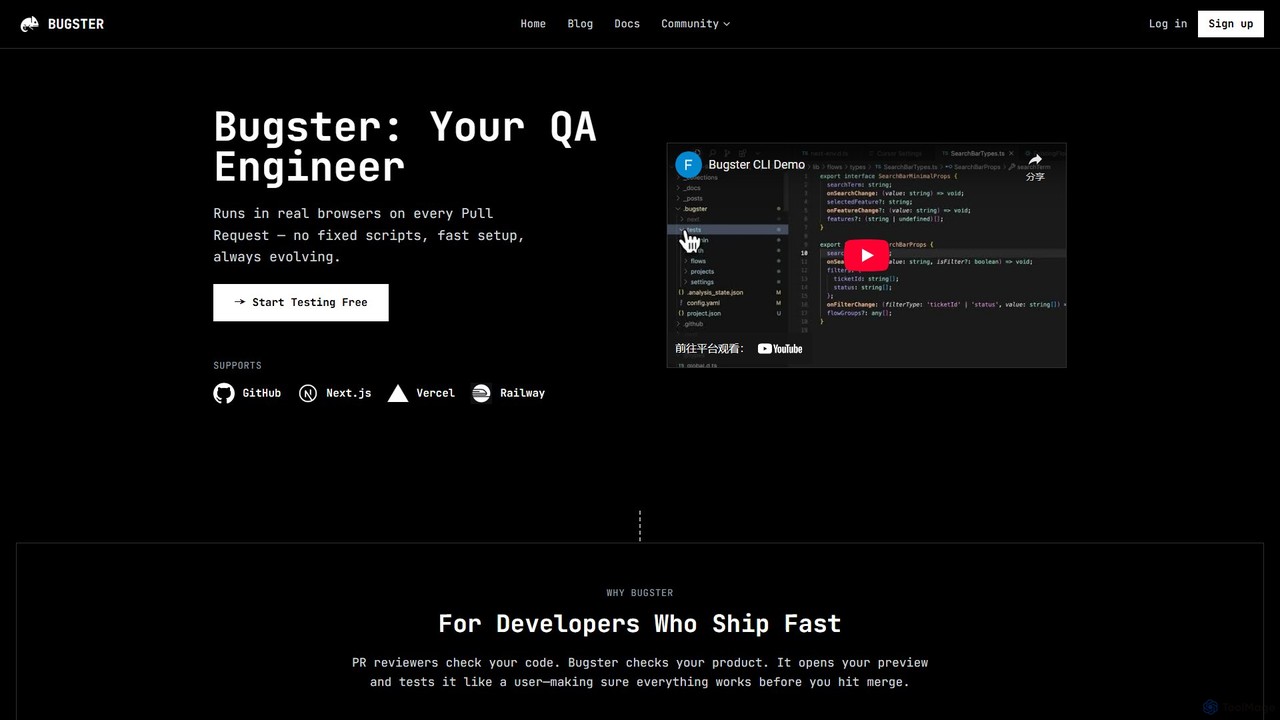
Bugster is an AI-powered QA engineer for developers that automates end-to-end testing. It runs on every pull request, simulating user interactions in real browsers to find bugs before they hit production. It offers automatic test generation, zero-effort maintenance, and seamless integration with GitHub and Vercel.
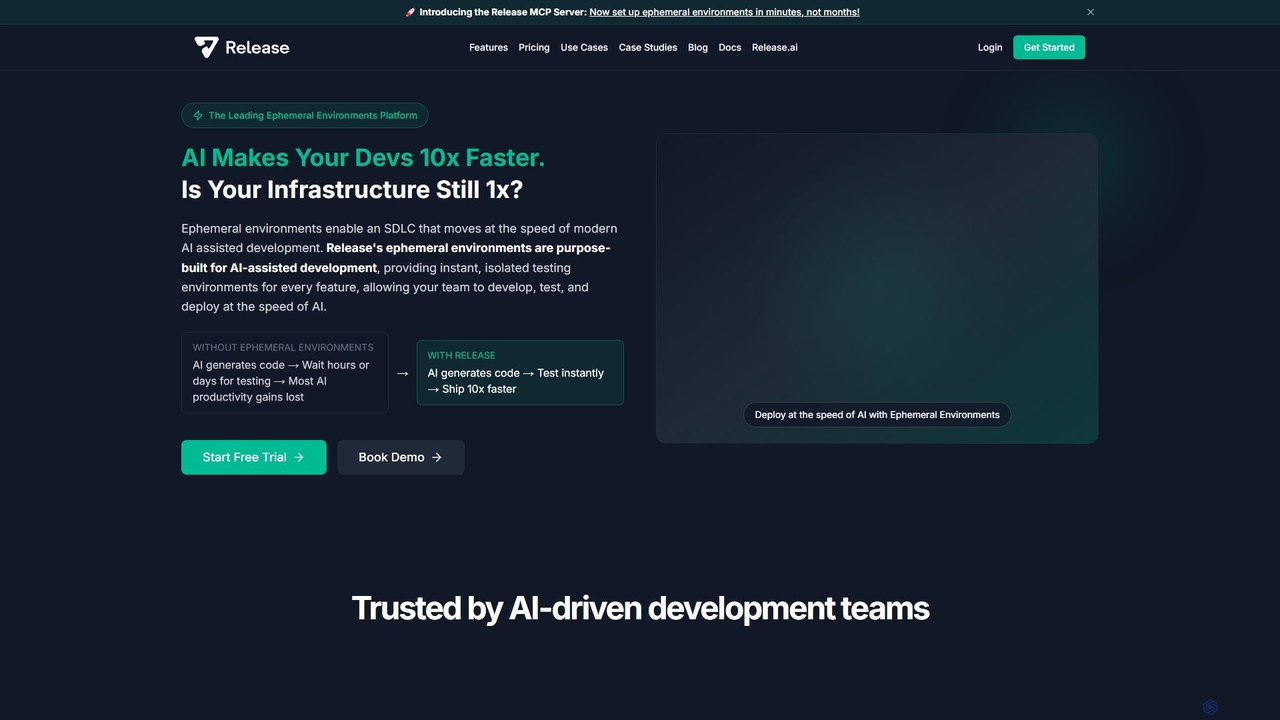
Release is an AI-powered ephemeral environments platform that accelerates software development. It provides instant, isolated testing environments for every feature or pull request, eliminating infrastructure bottlenecks. By integrating with AI development tools and IDEs, Release enables teams to test and deploy code up to 10x faster.
Compare product focus, pricing models and audiences. Highlighted rows indicate different listed information; unknown pricing does not mean free.
| Quick facts | Bugster | Release |
|---|---|---|
| Pricing model | Freemium | Freemium |
| Product type | Web | Web |
| Primary focus | Code Quality | Devops |
| Audience and roles | No data available | No data available |
| Categories | Code Quality · Testing · Automation | Devops · Testing · Infrastructure |
| Added | Aug 11, 2025 | Aug 12, 2025 |
| Updated | Nov 19, 2026 | Nov 19, 2026 |
Explore the listed product descriptions, features and workflows. Taxonomy labels alone are not feature evaluations.
Bugster is a revolutionary AI-powered testing tool designed for modern development teams who prioritize speed and quality. It acts as an autonomous QA engineer that integrates directly into your development workflow, specifically within your pull requests (PRs). Instead of relying on brittle, manually-written test scripts, Bugster uses AI to automatically generate, maintain, and execute realistic end-to-end (E2E) tests. It checks your product by interacting with it like a real user in a live browser environment, ensuring that every change works perfectly before it gets merged into the main branch.
The core philosophy of Bugster is to make sophisticated testing effortless and invisible. It runs automatically as part of your CI/CD pipeline, evaluating your application in various environments, including GitHub PRs, Vercel previews, localhost, and staging servers. This ensures that tests are conducted exactly where they matter most, providing immediate and relevant feedback to developers.
Getting started with Bugster is designed to be quick and intuitive, taking only a few minutes. You can choose between two main setup methods:
1. Automatic Setup (GitHub App): This is the easiest way to get started. Simply connect the Bugster GitHub App to your repository. Bugster will then automatically sync with your project and begin running tests on new pull requests without any manual configuration.
2. Manual Setup (CLI-based): For developers who want more control or wish to test locally first, the CLI provides a powerful alternative.
- Install the Bugster CLI: Run a simple curl command provided in the documentation to install the command-line interface.
- Initialize your project: Navigate to your project directory and run `bugster init`. This sets up the necessary configuration files.
- Generate a test suite: Use the `bugster generate` command. The AI will analyze your application and create a suite of tests defined in human-readable YML format, which are then stored in your repository.
- Run tests locally: You can execute the generated tests on your local machine using `bugster run` to validate them before pushing.
- Connect to GitHub: Once you're ready, connect the GitHub App to enable automated testing on every PR.
After setup, on every pull request, Bugster automatically detects the relevant test cases, deploys its 'Destructive Agent' to stress-test your changes, runs the full suite in a real browser, and comments on the PR only if it finds a bug, complete with logs, visuals, and reproduction steps.
Bugster is ideal for various development scenarios:
- Agile and DevOps Teams: For teams practicing CI/CD, Bugster automates the QA process, allowing them to ship features faster and with greater confidence.
- Frontend-Heavy Applications: Projects built with frameworks like Next.js, Vercel, and React benefit immensely from automated UI and user-flow testing.
- Reducing QA Bottlenecks: Development teams can take ownership of quality without being burdened by test creation and maintenance, freeing up dedicated QA resources for more complex exploratory testing.
- Preventing Regressions: Automatically catch visual, functional, and interactive regressions before they are merged and deployed to production.
The primary advantage of Bugster is its ability to provide robust E2E testing without the traditional overhead. It combines speed, intelligence, and simplicity. Developers can focus on building features, knowing that a reliable AI QA engineer is constantly monitoring their work. The self-maintaining nature of the tests ensures the system doesn't become a technical debt liability. Furthermore, by only reporting on actual issues, it maintains a high signal-to-noise ratio, ensuring that developers pay attention when it matters.
Bugster operates on a freemium model. There is a generous Free Plan available that allows individual developers and small teams to start testing their projects immediately. This plan typically includes a certain number of test runs and basic features. For larger teams, enterprises, or projects with more demanding testing needs, Bugster offers Paid Plans that provide higher usage limits, advanced features like concurrent testing, priority support, and more. For the most up-to-date and detailed pricing information, please visit the official Bugster website.
Release is a pioneering ephemeral environments platform designed to synchronize infrastructure speed with the rapid pace of AI-assisted development. In modern software development, AI tools can generate code at an unprecedented rate, but traditional staging and testing environments create significant bottlenecks, nullifying these productivity gains. Release addresses this challenge by providing on-demand, isolated, and fully functional testing environments for every feature, branch, and pull request (PR).
The core of the platform is the Release MCP (Model Context Protocol) Server, an innovative AI-powered engine that transforms the complex process of setting up environments. What traditionally took weeks or months of manual configuration can now be accomplished in minutes. The MCP Server analyzes your application's codebase, automatically detects frameworks, dependencies, and database requirements, and then generates an optimized configuration template. This allows development teams to eliminate manual setup and focus on building and shipping high-quality software.
Using Release is designed to be a seamless part of the development workflow:
Release is ideal for modern development teams looking to maximize their velocity and efficiency:
The primary advantage of Release is the massive acceleration of the development lifecycle. By removing infrastructure as a bottleneck, teams can ship features up to 10x faster. This preserves the return on investment in AI development tools. It enables true parallel development, improves developer happiness by removing tedious infrastructure tasks, and reduces the hidden costs associated with maintaining persistent staging servers. The automated, AI-optimized nature of the platform ensures that infrastructure scales seamlessly with development velocity.
Release operates on a freemium model. There is a free trial available for teams to get started and experience the platform's benefits. For larger teams and enterprise use cases with specific needs, Release offers tailored plans. Detailed pricing information is available upon booking a personalized demo with their engineering team through the official website.
Their taxonomy shows where the products overlap and where each one has a more distinct focus. Unknown fields are shown explicitly and are never filled with assumptions.
Traffic is shown on the same scale so differences in market visibility are not visually understated.
Both charts share the same months and vertical scale. Each tool identifies its latest reporting month; missing months are left blank, not counted as zero. Regional and source visit counts are estimates calculated from the reported shares.
| Country/region | Percentage | Estimated visits |
|---|---|---|
| 🇺🇸United States | 43.02% | 1.3K |
| 🇨🇱Chile | 22.04% | 652 |
| 🇵🇭Philippines | 15% | 444 |
| 🇻🇳Vietnam | 12.98% | 384 |
| 🇯🇵Japan | 6.96% | 206 |
| Country/region | Percentage | Estimated visits |
|---|---|---|
| 🇺🇸United States | 48.38% | 8.4K |
| 🇻🇳Vietnam | 17.5% | 3.1K |
| 🇮🇳India | 13.8% | 2.4K |
| 🇫🇷France | 10.76% | 1.9K |
| 🇹🇭Thailand | 9.56% | 1.7K |
Ratings, comments, favorites, and likes are community signals—not a substitute for product fit.
This page is assembled from ToolMage product listings, taxonomy, traffic statistics and on-site user feedback. It is not a hands-on test or an independent review.