Baseten
Deployment
AI TOOL COMPARISON
What is the difference, and which fits your workflow? Compare features, usage, pricing models and traffic side by side.
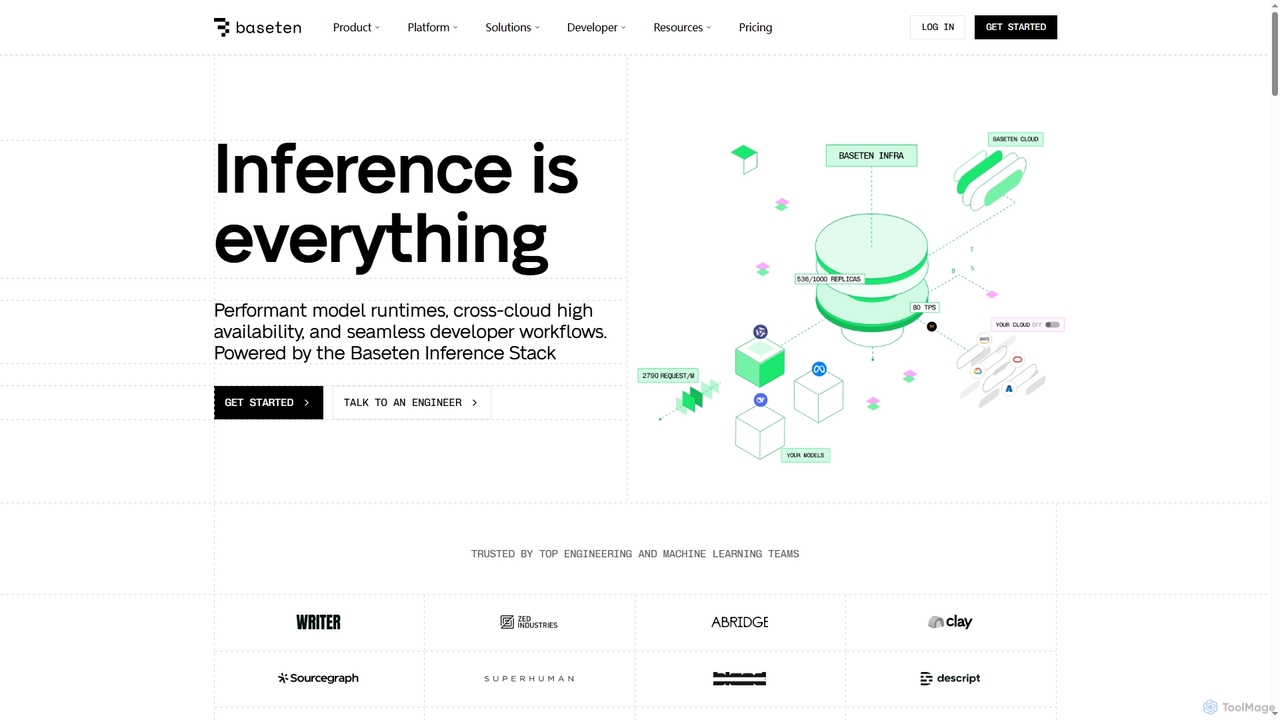
Baseten is a production-grade inference platform for deploying, scaling, and managing AI models. It offers high-performance runtimes, seamless developer workflows, and flexible deployment options (cloud, self-hosted, hybrid). Ideal for engineering and ML teams building mission-critical AI applications.
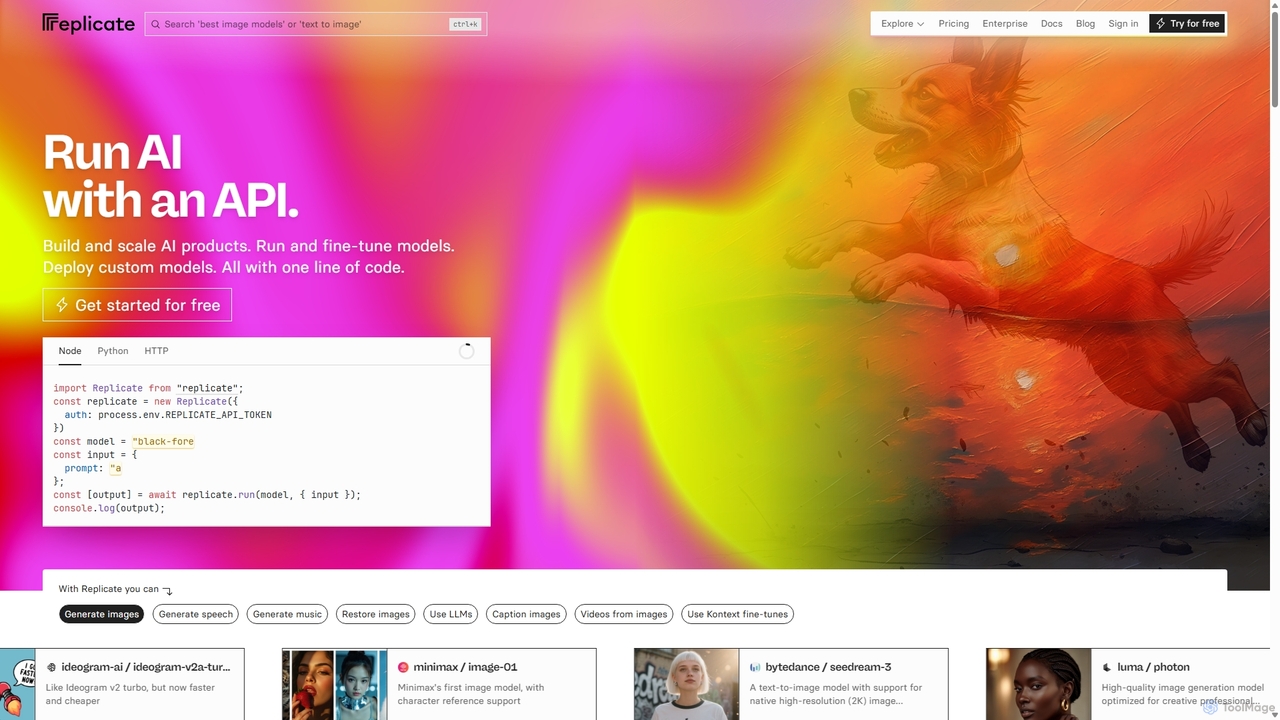
Replicate is a cloud platform for developers to run, fine-tune, and deploy AI models via a simple API. It eliminates the need for managing complex infrastructure, offering access to thousands of models with pay-per-use pricing and automatic scaling.
Compare product focus, pricing models and audiences. Highlighted rows indicate different listed information; unknown pricing does not mean free.
| Quick facts | Baseten | Replicate |
|---|---|---|
| Pricing model | Freemium | Paid |
| Product type | Web | Web |
| Primary focus | Deployment | Machine Learning |
| Audience and roles | AI Researcher · CTO · Data Scientist · Machine Learning Engineer · Product Manager · Software Developer | AI Researcher · Data Scientist · DevOps Engineer · Machine Learning Engineer · Product Manager · Software Developer · Startup Founder |
| Categories | Deployment · Machine Learning · Cloud Computing | Machine Learning · Platform As A Service · Api |
| Added | Nov 1, 2025 | Sep 8, 2025 |
| Updated | Nov 19, 2026 | Nov 19, 2026 |
Explore the listed product descriptions, features and workflows. Taxonomy labels alone are not feature evaluations.
Baseten is a comprehensive platform designed to deploy, serve, and scale AI models in production environments. It provides the necessary infrastructure, tooling, and expertise to bring AI products to market quickly and efficiently. Powered by the Baseten Inference Stack, it delivers performant model runtimes, cross-cloud high availability, and a developer-centric experience for mission-critical inference workloads.
1. Choose your deployment method: Utilize the Model APIs for instant access to pre-optimized models for prototyping, or create a Dedicated Deployment for custom, fine-tuned, or open-source models.
2. Package your model using Truss, Baseten's open-source standard, which supports any machine learning framework.
3. Deploy your model to your preferred environment: Baseten's fully-managed cloud, your own VPC for self-hosting, or a hybrid setup that combines both.
4. Scale your application automatically based on traffic, benefiting from features like fast cold starts and 99.99% uptime.
5. Optionally, leverage Baseten's inference-optimized infrastructure to train your models for the best possible production performance.
Baseten is ideal for building demanding, real-time AI applications. Use cases include powering low-latency AI phone agents, developing generative AI products for image and text creation, serving high-throughput embedding models for search and retrieval, and deploying custom-built LLMs for specialized industries like finance and healthcare.
The primary advantages of Baseten are its exceptional performance, cost-efficiency, and scalability. By optimizing the entire inference stack, it significantly reduces latency and increases throughput, as demonstrated by helping clients like Bland AI achieve sub-400ms response times. Its pay-for-what-you-use model eliminates costs for idle time, while traffic-based autoscaling ensures reliability during rapid growth. The platform is also SOC 2 Type II certified and HIPAA compliant, ensuring enterprise-grade security.
Baseten offers a tiered pricing structure designed for growth:
- Basic: A pay-as-you-go plan starting at $0 per month. It includes access to Dedicated Deployments, Model APIs, fast cold starts, and is SOC 2 Type II and HIPAA compliant.
- Pro: A custom-quoted plan that adds priority access to high-demand GPUs, dedicated compute, higher rate limits, and hands-on support via Slack and Zoom.
- Enterprise: A custom-quoted plan for full control, offering self-hosting in your VPC, custom SLAs, advanced security, and the ability to use existing cloud commitments.
Usage is billed based on two models:
- Model APIs: Priced per 1 million input and output tokens. For example, Kimi K2 costs $0.60/1M input tokens and $2.50/1M output tokens.
- Dedicated Deployments: Billed per minute of compute time. For instance, an A10G GPU instance is priced at $0.02012 per minute, and an H100 GPU is $0.10833 per minute.
Replicate is a cloud platform designed to democratize access to artificial intelligence, making it simple for any software developer to run, fine-tune, and deploy machine learning models. Its core mission is to remove the immense complexity traditionally associated with ML infrastructure management. Instead of wrestling with API servers, CUDA drivers, GPU provisioning, and dependency management, developers can leverage Replicate's powerful API to integrate cutting-edge AI models into their applications with just a few lines of code. The platform hosts thousands of open-source models from the community, covering a vast range of applications from image and video generation to text analysis and audio processing.
Getting started with Replicate is designed to be straightforward, catering to different levels of complexity.
1. Run Existing Models: The simplest way to use Replicate is by running one of the thousands of pre-existing models available in its public library. This can be achieved with a single API call. For example, in Python, you can generate an image with a model like FLUX Dev:import Replicate
output = Replicate.run(
"black-forest-labs/flux-dev",
input={
"prompt": "An astronaut riding a rainbow unicorn, cinematic, dramatic"
}
)
print(output)
This abstracts away all the backend complexity, allowing developers to focus on their application logic.
2. Fine-Tune Models: For more specific tasks, you can fine-tune existing models with your own data. This is particularly useful for creating models that recognize a specific person, object, or artistic style. The process involves creating a training job via the API, providing your dataset (e.g., a zip file of images) and a trigger word. Replicate handles the training process and creates a new, custom model version for you to use.
3. Deploy Custom Models: If you have your own machine learning model, you can deploy it on Replicate's infrastructure. This is done using Cog, Replicate's open-source tool for packaging ML models into standard, reproducible containers. You define your model's environment in a cog.yaml file (specifying Python version, packages, GPU requirements) and its prediction interface in a predict.py file. After testing locally with cog predict, you can push the container to Replicate with cog push, and it instantly becomes available via the same simple API as public models.
Cog tool to package and deploy your own models, giving you full control and flexibility.Replicate's versatility makes it suitable for a wide array of applications:
The primary advantage of Replicate is its radical simplification of MLOps. It abstracts away the difficult parts of deploying machine learning models at scale.
Cog tool.Replicate operates on a transparent, pay-as-you-go pricing model. You only pay for the compute resources you use, billed by the second.
Their taxonomy shows where the products overlap and where each one has a more distinct focus. Unknown fields are shown explicitly and are never filled with assumptions.
Traffic is shown on the same scale so differences in market visibility are not visually understated.
Both charts share the same months and vertical scale. Each tool identifies its latest reporting month; missing months are left blank, not counted as zero. Regional and source visit counts are estimates calculated from the reported shares.
| Country/region | Percentage | Estimated visits |
|---|---|---|
| 🇺🇸United States | 70.97% | 188.5K |
| 🇨🇦Canada | 8.11% | 21.5K |
| 🇻🇳Vietnam | 7.87% | 20.9K |
| 🇮🇳India | 7% | 18.6K |
| 🇩🇪Germany | 6.05% | 16.1K |
| Source type | Percentage | Estimated visits |
|---|---|---|
| Direct | 85.63% | 227.4K |
| Referral | 10.77% | 28.6K |
| 3.6% | 9.6K |
| Country/region | Percentage | Estimated visits |
|---|---|---|
| 🇺🇸United States | 37.37% | 469.1K |
| 🇮🇳India | 27.74% | 348.3K |
| 🇨🇳China | 13.53% | 169.9K |
| 🇬🇧United Kingdom | 11.64% | 146.1K |
| 🇩🇪Germany | 9.72% | 122K |
| Source type | Percentage | Estimated visits |
|---|---|---|
| Direct | 92.92% | 1.2M |
| Referral | 5.48% | 68.8K |
| 1.6% | 20.1K |
Ratings, comments, favorites, and likes are community signals—not a substitute for product fit.
You can deploy both open-source and custom models on Baseten. The platform supports any model built in any framework through Truss, its open-source standard for packaging and serving models. You can also start with off-the-shelf models from the Baseten model library.
You have control over which GPUs your models use. Baseten provides a full list of currently available GPUs in its instance type reference. If you need a specific GPU type that is not listed, you can reach out to their team to request it.
No, you do not pay for idle time. You only pay for the time your model is actively using compute on Baseten, which includes when it is deploying, scaling up or down, or making predictions. You have full control over your model's scaling behavior.
Yes, Baseten is SOC 2 Type II certified and HIPAA compliant, ensuring it meets high standards for security and data protection suitable for enterprise and healthcare applications.
Yes, with the Enterprise plan, you can self-host Baseten in your own VPCs. This allows you to maintain full control over security, data residency, and use your existing cloud commitments.
This page is assembled from ToolMage product listings, taxonomy, traffic statistics and on-site user feedback. It is not a hands-on test or an independent review.