ToolMage
Sign in

AI TOOL COMPARISON

BrowserStack vs Kusho

What is the difference, and which fits your workflow? Compare features, usage, pricing models and traffic side by side.

Jump to key differences

Product overview

BrowserStack Product overview

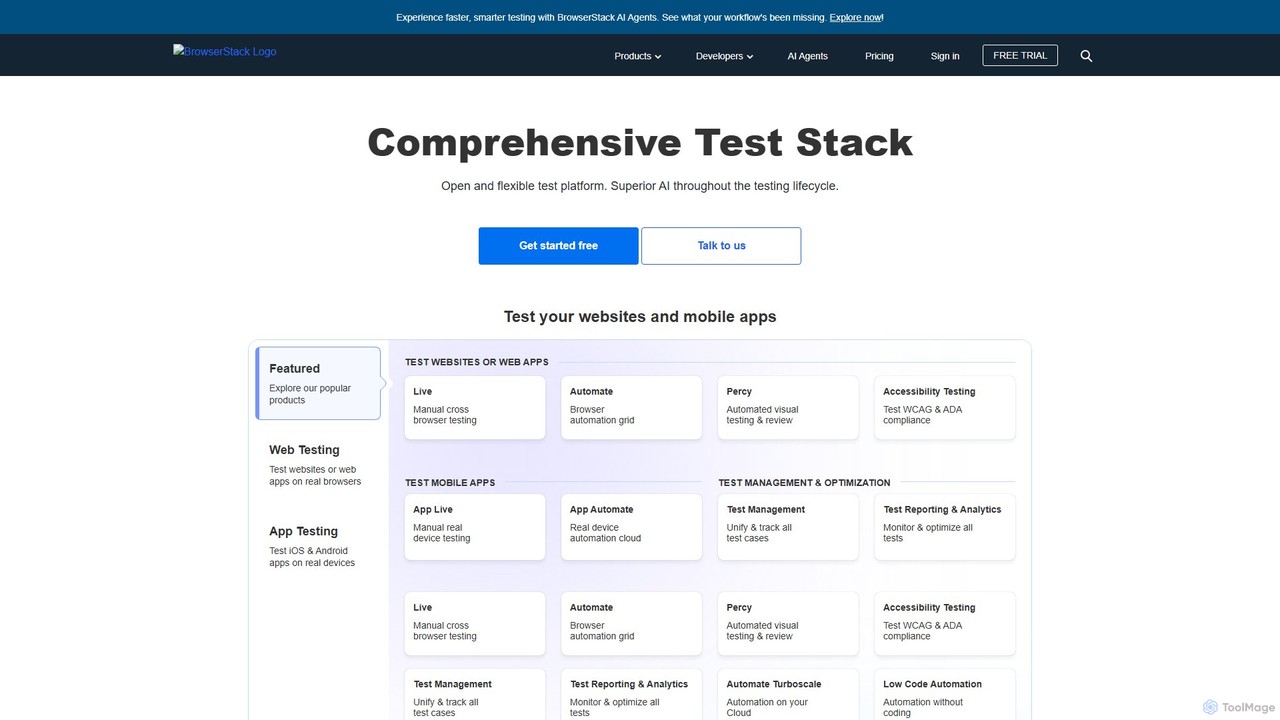
BrowserStack is a leading AI-powered cloud platform for comprehensive app and cross-browser testing. It provides instant access to over 30,000 real mobile devices and desktop browsers, enabling developers and QA teams to test their websites and mobile apps in real-world conditions. With features like automated testing, visual testing, and accessibility checks, BrowserStack accelerates release cycles and ensures a flawless user experience across all platforms.

Preview

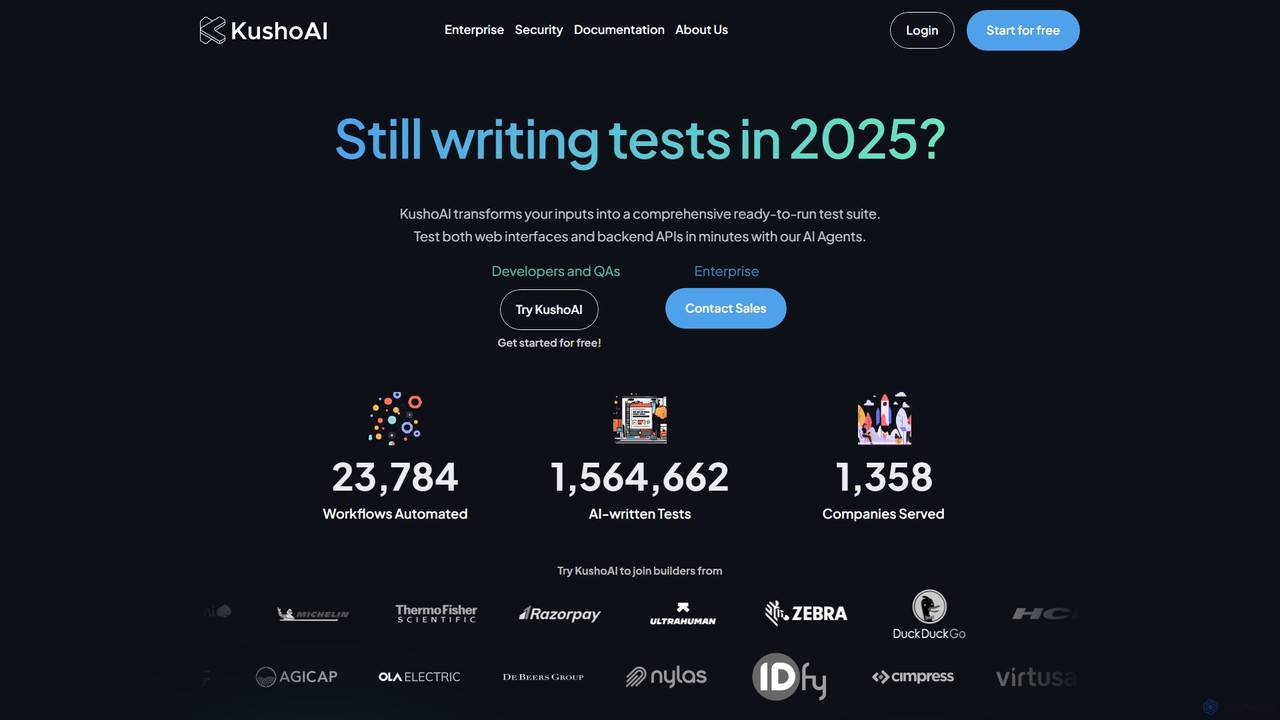
Kusho Product overview

Kusho is an AI-powered platform that automates software testing for developers and enterprises. It uses autonomous AI agents to transform inputs into comprehensive, ready-to-run test suites for both web UIs and backend APIs. By automatically generating and maintaining tests, Kusho helps teams achieve over 90% test coverage, accelerate deployment cycles, and ship bug-free code with confidence.

Preview

Quick facts

Compare product focus, pricing models and audiences. Highlighted rows indicate different listed information; unknown pricing does not mean free.

BrowserStack VS Kusho — Quick facts
Quick factsBrowserStackKusho
Pricing modelFreemiumFreemium
Product typeWebWeb
Primary focusMobile DevelopmentCode Assistant
Audience and rolesNo data availableNo data available
CategoriesMobile Development · Testing · AutomationCode Assistant · Testing · Automation
AddedAug 8, 2025Aug 14, 2025
UpdatedNov 19, 2026Nov 19, 2026

Features, usage and use cases

Explore the listed product descriptions, features and workflows. Taxonomy labels alone are not feature evaluations.

BrowserStack

BrowserStack is an industry-leading, AI-enhanced cloud web and mobile testing platform, trusted by over 50,000 customers globally, including major companies like Optimizely, GoodRx, and OLX. It empowers development and QA teams to build and release high-quality software with speed and confidence. The platform provides a comprehensive test stack, offering instant access to a vast real device cloud of over 30,000 real iOS and Android devices and desktop browser combinations. This eliminates the need for expensive in-house device labs and allows for testing in real-world user conditions.

Recently, BrowserStack has integrated superior AI capabilities across the entire testing lifecycle. These AI agents enhance productivity, enabling faster, smarter testing and providing actionable insights to optimize workflows. From manual interactive testing to large-scale automation, BrowserStack covers every aspect of the testing process, including functional, visual, and accessibility testing.

How to use BrowserStack

Using BrowserStack is designed to be intuitive and seamlessly integrate into your existing development workflow:

  1. Sign Up & Choose a Product: Start with a free trial or select a plan. Choose from a suite of products like Live (manual testing), Automate (automated testing), or Percy (visual testing).
  2. Manual Testing (Live & App Live): For interactive testing, simply select your desired operating system, browser version, or real mobile device from the dashboard. An interactive session will launch instantly, giving you access to developer tools for real-time debugging.
  3. Automated Testing (Automate & App Automate): Configure your existing automation scripts (using frameworks like Selenium, Cypress, Playwright, Appium) to run on BrowserStack's cloud grid. This involves a minor change in the configuration file to point to the BrowserStack hub URL.
  4. Integrate with CI/CD: Connect BrowserStack to your CI/CD pipeline (e.g., Jenkins, GitLab, Travis CI). This allows you to run your test suite automatically on every code commit, catching bugs early in the development cycle.
  5. Debug and Report: Utilize comprehensive logs, video recordings, and screenshots for every test run to quickly identify and debug issues. Report bugs directly to integrated tools like Jira or Trello with a single click.
  6. Leverage Advanced Features: Test for specific conditions by using features like IP Geolocation, network simulation, biometric authentication, and accessibility scanning.

Core Features of BrowserStack

  • Real Device Cloud: Instant access to over 30,000 real desktop browsers (Windows, macOS) and mobile devices (iOS, Android) for accurate testing.
  • Comprehensive Test Automation: High-speed, parallel testing on a scalable grid for frameworks like Selenium, Cypress, Playwright, and Appium.
  • AI-Powered Testing: AI agents are integrated throughout the testing lifecycle to boost productivity, provide smarter insights, and accelerate test cycles.
  • Visual Testing with Percy: Automate visual testing and reviews to catch visual bugs and ensure UI consistency with every release.
  • Accessibility Testing: Scan and test for WCAG and ADA compliance to ensure your applications are accessible to all users.
  • Advanced Device Features: Simulate real-world conditions with features like GPS and IP geolocation, network throttling, biometric authentication (Face ID, Fingerprint), physical SIM testing, and camera/microphone injection.
  • Seamless Integrations: Works with all major CI/CD tools, project management software, and automation frameworks, including Jira, Slack, GitHub, Jenkins, and more.
  • Test Management & Analytics: Unify, track, and manage all test cases in one place. Gain deep insights from test reporting and analytics to monitor and optimize test performance.

Use Cases for BrowserStack

BrowserStack is versatile and caters to various testing needs:

  • Cross-Browser Compatibility: Ensure your website functions and appears correctly across all major browsers and their versions on both desktop and mobile.
  • Mobile App Testing: Test native and hybrid iOS and Android apps on a wide range of real devices to check for performance, functionality, and UI issues.
  • Regression Testing: Automate your regression suite to run on every build, preventing new code changes from breaking existing functionality.
  • Localization and Geolocation Testing: Verify that your application works as expected for users in different geographical locations by simulating IP addresses and GPS coordinates from over 100 countries.
  • End-to-End User Flow Testing: Test complex user journeys that involve multiple steps, such as user registration, in-app purchases, and OTP authentication.
  • Performance Under Poor Network Conditions: Simulate various network profiles (e.g., slow 3G, unstable Wi-Fi) to see how your app or website performs for users with poor connectivity.

Advantages of BrowserStack

Using BrowserStack offers significant advantages:

  • Improved Test Coverage: Drastically increase your test coverage by testing on a massive range of real devices and browsers without the overhead of maintaining them.
  • Accelerated Release Cycles: By running tests in parallel on a high-speed cloud grid, teams can reduce testing time from hours to minutes, enabling faster releases. GoodRx, for example, cut testing time by 90%.
  • Reduced Costs: Eliminates the high cost associated with purchasing, maintaining, and updating an in-house lab of physical devices.
  • Enhanced Collaboration: Centralized dashboards, shareable test sessions, and integrations with tools like Slack and Jira improve collaboration between developers and QA engineers.
  • Higher Quality Software: Catching bugs earlier and testing in real-world conditions leads to a more stable, reliable, and user-friendly final product.

Pricing and Plans

BrowserStack offers a flexible pricing structure to suit individuals, teams, and enterprises.

  • Free Trial: A free trial is available to explore the platform's features.
  • Open Source Plan: Free, unlimited access for qualifying open-source projects.
  • Freelancer Plan: Starts at $12.50/month (billed annually) for individual users with limited testing minutes.
  • Live Plans: For manual testing, plans start at $29/month (billed annually) for Desktop testing and $39/month for Desktop & Mobile.
  • Team Plans: Designed for collaboration, starting at $150/month (billed annually) for 5 users.
  • Enterprise Plan: Custom pricing for large organizations, offering advanced features like Single Sign-On (SSO), IP whitelisting, dedicated support, and higher security compliance.
  • Other Products: Products like Automate, Percy, and Test Management are priced separately with their own plans. Payments can be made via credit card, and invoices are available for annual plans.

Kusho

Kusho is a revolutionary platform that introduces a new era of software engineering through autonomous AI agents. It is designed to eliminate the tedious and time-consuming tasks of manual software testing, allowing developers and QA teams to focus on building innovative products. Kusho specializes in automating the testing process for both the building blocks of modern software: backend APIs and web user interfaces. By leveraging proprietary models combined with powerful foundational LLMs, Kusho can intelligently understand complex application workflows and generate comprehensive, executable test suites in a matter of minutes. This AI-led transformation helps organizations accelerate their deployment velocity, significantly improve code quality, and achieve unprecedented levels of test coverage, ultimately leading to more stable and reliable software releases.

How to use Kusho

Getting started with Kusho is designed to be a seamless and intuitive process.
1. Provide Your Inputs: Users begin by providing Kusho with inputs related to the application they want to test. This can include API specifications (like OpenAPI/Swagger files), Postman collections, or descriptions of user journeys and workflows for web interfaces.
2. AI-Powered Test Generation: The Kusho AI agent analyzes these inputs, understands the logic, potential edge cases, and complex interactions within the application. Within minutes, it automatically generates a complete, ready-to-run test suite, including various test scenarios and the necessary test code.
3. Execute and Analyze: The generated tests can be executed instantly on the Kusho platform or integrated directly into your existing CI/CD pipeline (e.g., Jenkins, GitHub Actions, CircleCI).
4. Receive Actionable Reports: After execution, Kusho provides tailored reports that highlight any bugs, performance issues, or failures. These reports offer actionable insights, making it easy for developers to identify and fix problems quickly.
5. Autonomous Maintenance: As your codebase evolves, Kusho continuously monitors changes and automatically updates the test suites in real-time, ensuring that your tests remain relevant and effective without any manual intervention.

Core Features of Kusho

  • Autonomous AI Testing Agent: An intelligent agent that understands application logic to generate and maintain tests for APIs and web UIs.
  • Rapid Test Suite Generation: Transforms various inputs into comprehensive, executable test suites in under two minutes.
  • Real-time Test Synchronization: Automatically updates tests in sync with codebase changes, maintaining 100% test relevance and eliminating test flakiness.
  • High Test Coverage: Enables teams to achieve over 95% test automation coverage by default, identifying bugs that manual testing might miss.
  • Seamless CI/CD Integration: Works effortlessly with popular CI platforms to augment your team's workflow with autonomous testing from day one.
  • Intelligent Scenario Generation: The AI thinks of thousands of possible test combinations for complex user journeys, ensuring thorough validation.
  • Enterprise-Grade Security: SOC 2 Type II and ISO 27001 compliant, with options for on-premises deployment for highly regulated industries like finance and healthcare.
  • Actionable Reporting: Delivers detailed reports with clear insights to accelerate bug fixing and improve code quality.

Use Cases for Kusho

Development and QA Teams: To automate the creation of unit, integration, and end-to-end tests, saving hundreds of engineering hours and freeing up teams to focus on feature development.
Enterprises with Large Codebases: To manage and maintain an effective testing strategy for hundreds or thousands of APIs, ensuring tests are always up-to-date with the evolving code.
Complex Application Testing: For applications with intricate user journeys and numerous potential interaction paths, Kusho can autonomously generate tests for all combinations.
Accelerating Release Cycles: Organizations looking to increase their deployment velocity can use Kusho to shrink testing timelines from weeks to hours, enabling quicker and more frequent releases.
Improving Software Quality: To achieve near-perfect test coverage, find bugs before they reach production, and deliver a more stable and reliable product to users.

Advantages of Kusho

Massive Time Savings: Automates what would typically be hours or days of manual test writing into a process that takes just minutes.
Increased Deployment Velocity: By drastically reducing the testing bottleneck, teams can ship code to production faster and with greater confidence.
Unprecedented Test Coverage: The AI agent explores scenarios and edge cases that humans might overlook, pushing test coverage to levels beyond 90%.
Stress-Free Releases: Comprehensive and constantly updated testing means fewer bugs slip into production, leading to smoother, more reliable deployments.
Zero-Maintenance Tests: The self-updating nature of the tests eliminates the significant engineering effort typically required to maintain a test suite.
Scalability: Effortlessly scales testing efforts as the application grows in complexity, without needing to proportionally increase the size of the QA team.

Pricing and Plans

Kusho operates on a freemium model. There is a Free Plan available to get started and experience the core features of the platform. For teams and organizations with more advanced needs, Kusho offers an Enterprise Plan. The Enterprise plan includes additional features such as on-premises deployment, enhanced security controls, and dedicated support. For detailed pricing information and to discuss the Enterprise plan, prospective customers are encouraged to Contact Sales through the official website.

Positioning

Their taxonomy shows where the products overlap and where each one has a more distinct focus. Unknown fields are shown explicitly and are never filled with assumptions.

Categories

Shared
TestingAutomation
Only BrowserStack
Mobile Development
Only Kusho
Code Assistant

Tags

Shared
developer toolstest automation
Only BrowserStack
accessibility testingai testingcross-browser testingcypress testingmobile app testingQA toolsreal device cloudselenium gridvisual testing
Only Kusho
AI agentAPI testingCI/CDno-code testingquality assurancesoftware testingUI testing

Audience and roles

Shared
No listed items
Only BrowserStack
No listed items
Only Kusho
No listed items

Traffic comparison

Traffic is shown on the same scale so differences in market visibility are not visually understated.

How to interpret the traffic data

Both charts share the same months and vertical scale. Each tool identifies its latest reporting month; missing months are left blank, not counted as zero. Regional and source visit counts are estimates calculated from the reported shares.

BrowserStack monthly traffic:

Latest traffic · 2026-05

Monthly visits
1.3M
Avg. visit duration
5:05
Pages per visit
7.49
Bounce rate
40.23%
Data updated 2026-06-15

Monthly traffic trend

  • 2025-09: 2.5M
  • 2026-01: 2.4M
  • 2026-02: 1.9M
  • 2026-03: 1.9M
  • 2026-04: 1.6M
  • 2026-05: 1.3M

Top regions

Top 5 countries/regions
Country/regionPercentageEstimated visits
🇮🇳India53.23%713.3K
🇺🇸United States26.38%353.5K
🇩🇪Germany8.8%117.9K
🇬🇧United Kingdom6.52%87.4K
🇪🇹Ethiopia5.07%67.9K

Traffic sources

Source typePercentageEstimated visits
Direct84.8%1.1M
Referral9.71%130.1K
Email5.49%73.6K

Search keywords

apkbrowser stackbrowserstackbrowserstack careersrandom address generator

Kusho monthly traffic:

Latest traffic · 2026-05

Monthly visits
10.3K
Avg. visit duration
0:28
Pages per visit
2.19
Bounce rate
39.88%
Data updated 2026-06-15

Monthly traffic trend

  • 2025-09: 18.8K
  • 2026-01: 14.3K
  • 2026-02: 12.1K
  • 2026-03: 6.6K
  • 2026-04: 6.2K
  • 2026-05: 10.3K

Top regions

Top 5 countries/regions
Country/regionPercentageEstimated visits
🇮🇳India63.86%6.6K
🇻🇳Vietnam14.12%1.5K
🇺🇸United States11.35%1.2K
🇵🇰Pakistan5.99%619
🇹🇷Turkey4.68%483

Traffic sources

Source typePercentageEstimated visits
Direct54.1%5.6K
Referral23.05%2.4K
Email22.85%2.4K

Search keywords

__e2e_test__kushokusho aikushoailibrechat

Community signals

Ratings, comments, favorites, and likes are community signals—not a substitute for product fit.

BrowserStack

Rating
No data available
Comments
0
Favorites
175
Likes
181

Kusho

Rating
No data available
Comments
0
Favorites
170
Likes
177

BrowserStack vs Kusho · Comparison FAQ

What do BrowserStack and Kusho have in common?
Both tools are listed under Testing、Automation. These categories indicate overlapping use cases; compare their detailed descriptions for workflows, capabilities and limitations.
Are BrowserStack and Kusho free?
Listed pricing models: BrowserStack — Freemium; Kusho — Freemium. Missing pricing is not proof of a free plan, and freemium does not mean every feature is free. Check official sites for current plans, limits and trials.
How should I choose between BrowserStack and Kusho?
The primary listed category is Mobile Development for BrowserStack, and Code Assistant for Kusho. Compare features, steps and use cases, then verify pricing, data permissions and deployment needs. This page does not include hands-on testing and does not declare a winner from traffic or tags.

Sources and comparison methodology

This page is assembled from ToolMage product listings, taxonomy, traffic statistics and on-site user feedback. It is not a hands-on test or an independent review.

  • Feature and plan descriptions reflect information in the listings, not real-time guarantees. Verify pricing, quotas, availability and privacy terms on the official sites.
  • Traffic uses the reporting months shown. Missing statistics do not mean zero visits, and different periods do not establish growth or superiority. Regional and source visit counts are estimates based on shares.
  • Different tags indicate differences in the listings, not proof that the other product lacks a capability. Ratings, favorites and visits are not used to declare a winner.

Related comparisons