CodeMaker AI
Code Assistant
AI TOOL COMPARISON
What is the difference, and which fits your workflow? Compare features, usage, pricing models and traffic side by side.
Code Assistant
Code Assistant
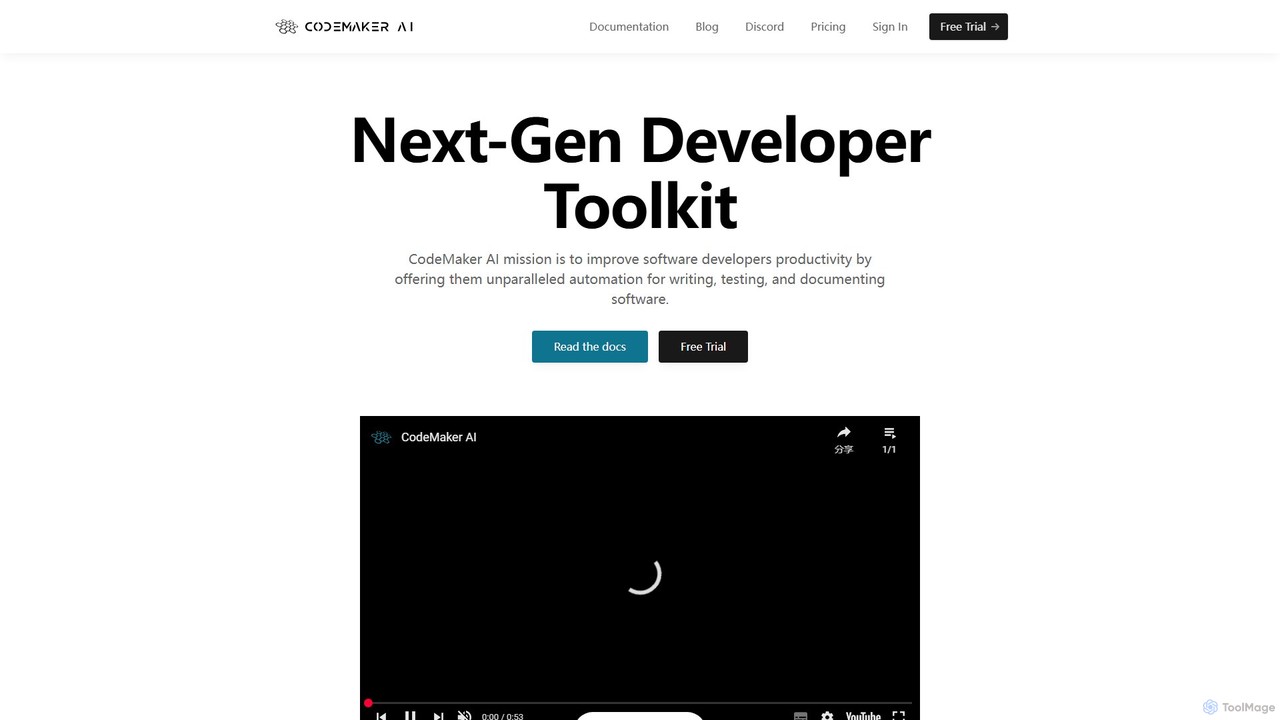
CodeMaker AI is a next-generation developer toolkit designed to boost productivity by automating software writing, testing, and documentation. It integrates seamlessly into your workflow via IDEs, GitHub, and CLI, offering context-aware code generation and a powerful AI assistant.
Devgen is an AI-powered coding assistant designed to accelerate the software development lifecycle. It helps developers write better code faster by providing intelligent code generation, completion, refactoring, and automated testing, directly within their IDE.
Compare product focus, pricing models and audiences. Highlighted rows indicate different listed information; unknown pricing does not mean free.
| Quick facts | CodeMaker AI | Devgen |
|---|---|---|
| Pricing model | Freemium | Freemium |
| Product type | Web | Web |
| Primary focus | Code Assistant | Code Assistant |
| Audience and roles | No data available | Data Scientist · DevOps Engineer · Product Manager · Software Developer · Software Engineer · Student · Web Developer |
| Categories | Code Assistant · Testing · Automation | Code Assistant · Testing · Automation |
| Added | Aug 15, 2025 | Sep 7, 2025 |
| Updated | Nov 19, 2026 | Nov 19, 2026 |
Explore the listed product descriptions, features and workflows. Taxonomy labels alone are not feature evaluations.
CodeMaker AI is a comprehensive developer toolkit engineered to enhance the productivity of software developers through advanced automation. Founded in 2023, its mission is to streamline the entire software development lifecycle, from initial coding to testing and documentation. The platform provides a unified experience across multiple environments, ensuring developers have access to powerful AI-driven tools wherever they work.
At its core, CodeMaker AI leverages context-aware intelligence. Unlike basic code completion tools, it analyzes the entire source file—including imports, existing functions, and comments—to generate highly accurate and relevant code. This deep understanding allows it to perform complex tasks such as implementing entire functions, generating class structures, and even recreating large codebases with high similarity, as demonstrated in its experiments with Spring Boot and Mockito.
Getting started with CodeMaker AI is straightforward. First, sign up on the official website to create an account and start a free trial. Then, integrate the tool into your preferred development environment:
Once set up, you can use natural language prompts (e.g., in a comment) to generate code, ask the AI assistant to explain or refactor a block of code, or trigger batch operations to document your entire project.
Rapid Prototyping and Development: Generate boilerplate code, entire functions, and class implementations from simple descriptions, drastically speeding up the initial development phase.
Legacy Code Modernization: Use batch processing to automatically migrate an entire legacy codebase to a modern version of a language (e.g., older Java to a newer syntax).
Improving Code Quality and Consistency: Employ the AI assistant to refactor complex methods, fix syntax errors across the project, and ensure consistent coding styles.
Automating Code Reviews: Integrate the GitHub App to automatically review pull requests, explain changes, and apply feedback from comments, reducing the manual workload on the development team.
Enhancing Test Coverage: Automatically generate unit tests for existing methods and functions, helping to quickly increase test coverage and ensure code reliability before refactoring or shipping new features.
Holistic Lifecycle Support: It's not just a code completion tool; it's a toolkit that assists across the entire development lifecycle, including writing, documenting, testing, and reviewing code.
Deep Contextual Understanding: Its ability to analyze the full context of a file and even an entire project (with source graph generation) leads to superior code quality compared to tools with limited context windows.
Scalability for Enterprise: Designed to handle large, complex, enterprise-grade projects with features like batch processing and the ability to process large files.
Customization and Precision: The option to fine-tune models on a private codebase provides a level of customization and accuracy that generic models cannot match.
Unified Developer Experience: Provides a consistent and powerful set of features across different platforms (IDE, SCM, CLI), allowing developers to work efficiently in their preferred environment.
CodeMaker AI offers a freemium model with a free trial and several paid tiers.
An Enterprise offer is also available for teams with specific needs, which can be arranged by contacting sales directly.
Devgen is a state-of-the-art AI-powered tool designed to be the ultimate pair programmer for software developers, engineers, and data scientists. It integrates seamlessly into your development workflow, aiming to significantly boost productivity, improve code quality, and reduce the time spent on repetitive tasks. By leveraging advanced large language models trained on vast codebases, Devgen understands context, suggests relevant code, and helps solve complex programming challenges in real-time.
Using Devgen is straightforward and designed for a frictionless experience. First, sign up on the Devgen website and choose a plan that suits your needs. Then, install the Devgen extension for your favorite Integrated Development Environment (IDE), such as VS Code, JetBrains (IntelliJ, PyCharm), or others. Once installed, log in with your credentials. You can start using Devgen immediately by either writing a comment describing the function you need, and Devgen will generate the code, or by starting to type and letting its intelligent autocompletion suggest the rest. For refactoring or documentation, simply highlight a block of code, right-click, and select the desired action from the Devgen context menu.
Devgen is versatile and can be applied in various scenarios. For rapid prototyping, developers can quickly scaffold an entire application by describing the core features. In enterprise environments, it helps maintain high code quality and consistency across large teams. Data scientists can use it to generate complex data manipulation scripts and visualization code in Python or R. Students and junior developers can leverage the code explanation feature as a learning tool to understand professional-grade code. DevOps engineers can automate the creation of infrastructure-as-code scripts and CI/CD pipeline configurations.
The primary advantage of Devgen is the massive productivity boost it offers. By automating mundane coding tasks, it allows developers to focus on high-level problem-solving and application logic. It also acts as a quality gatekeeper, reducing bugs and vulnerabilities by suggesting best practices and generating robust tests. Unlike some competitors, Devgen's contextual awareness is fine-tuned to understand your specific project's architecture, leading to more relevant and accurate suggestions. Its seamless IDE integration ensures that it enhances, rather than disrupts, the natural coding workflow.
Devgen offers a flexible pricing structure to cater to individuals and teams of all sizes.
Free Plan: Perfect for students and hobbyists, offering a limited number of code completions and generations per month.
Pro Plan: Aimed at professional developers, this plan includes unlimited code generation, advanced features like whole-project context analysis, and priority support.
Enterprise Plan: Designed for organizations, this plan provides everything in Pro, plus features like on-premise deployment, advanced security controls, centralized billing, and dedicated team support.
Their taxonomy shows where the products overlap and where each one has a more distinct focus. Unknown fields are shown explicitly and are never filled with assumptions.
Traffic is shown on the same scale so differences in market visibility are not visually understated.
Both charts share the same months and vertical scale. Each tool identifies its latest reporting month; missing months are left blank, not counted as zero. Regional and source visit counts are estimates calculated from the reported shares.
No data available
No data available
Ratings, comments, favorites, and likes are community signals—not a substitute for product fit.
This page is assembled from ToolMage product listings, taxonomy, traffic statistics and on-site user feedback. It is not a hands-on test or an independent review.