ToolMage
Sign in

AI TOOL COMPARISON

Codespell vs Kodezi

What is the difference, and which fits your workflow? Compare features, usage, pricing models and traffic side by side.

Jump to key differences

Product overview

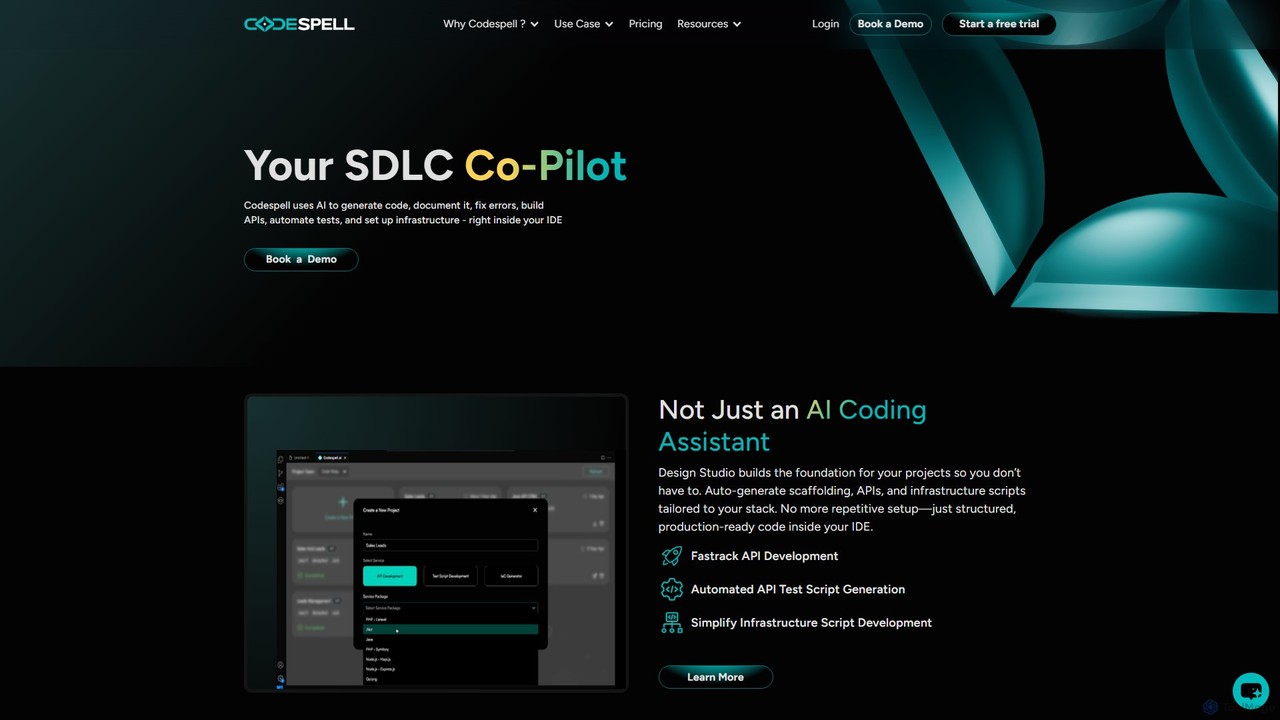
Codespell Product overview

Codespell is an AI-powered SDLC co-pilot that integrates into your IDE to accelerate software development. It goes beyond code completion, helping generate code, create APIs, automate tests, document logic, and fix errors, streamlining the entire development lifecycle.

Preview

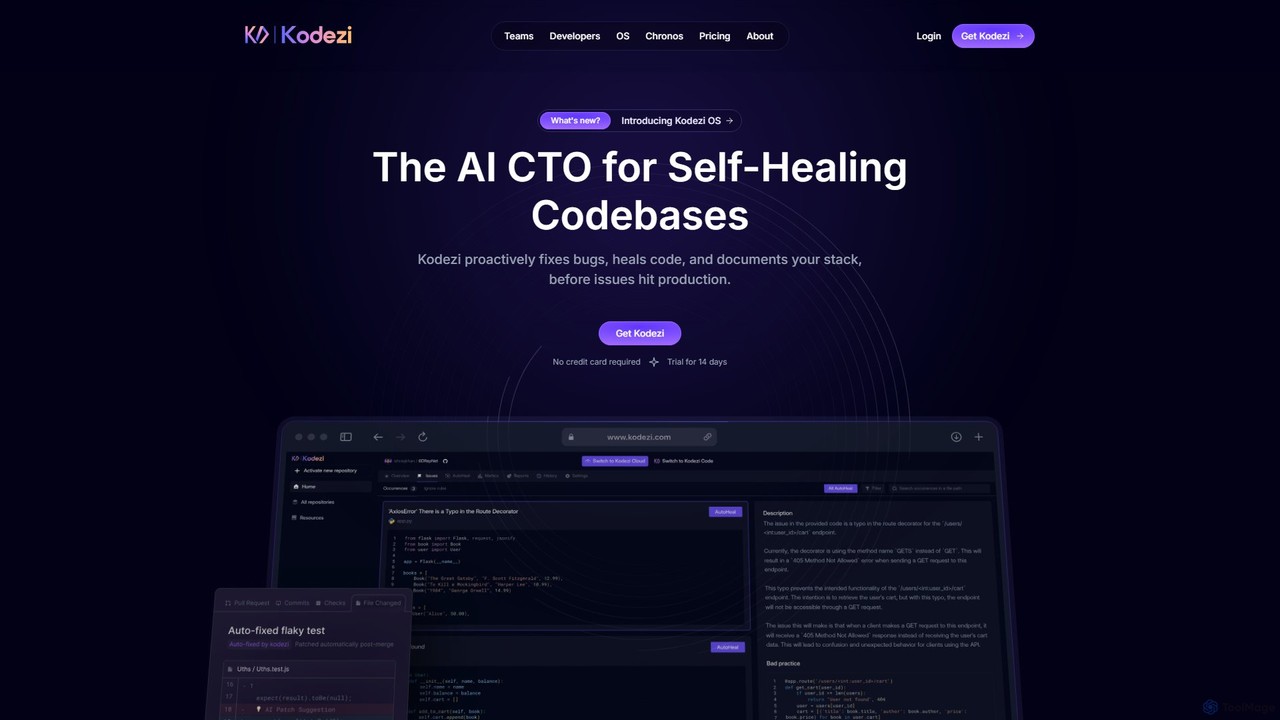
Kodezi Product overview

Kodezi is an AI-powered developer platform that acts as an AI CTO for your codebase. It autonomously fixes bugs, refines code, detects vulnerabilities, and automates documentation, integrating seamlessly into your development workflow to enhance productivity and code quality.

Preview

Quick facts

Compare product focus, pricing models and audiences. Highlighted rows indicate different listed information; unknown pricing does not mean free.

Codespell VS Kodezi — Quick facts
Quick factsCodespellKodezi
Pricing modelFreemiumFreemium
Product typeExtensionsWeb
Primary focusCode AssistantCode Assistant
Audience and rolesNo data availableNo data available
CategoriesCode Assistant · Low Code No Code · Testing · AutomationCode Assistant · Debugging · Testing · Automation
AddedAug 16, 2025Aug 10, 2025
UpdatedNov 19, 2026Nov 19, 2026

Features, usage and use cases

Explore the listed product descriptions, features and workflows. Taxonomy labels alone are not feature evaluations.

Codespell

Codespell presents itself as a comprehensive AI Co-Pilot for the Software Development Life Cycle (SDLC), designed to significantly accelerate the journey from concept to deployment. Unlike standard AI coding assistants that focus solely on code completion, Codespell offers a holistic suite of tools that integrate directly into your development environment. It aims to reduce manual coding effort by 30-50% by automating repetitive and complex tasks across the development spectrum.

The platform is built on two core pillars: the Design Studio and the AI Coding Sidekick. The Design Studio acts as a foundational tool, automatically generating project scaffolding, APIs, and infrastructure scripts tailored to your specific technology stack. This eliminates the tedious setup phase, allowing developers to start with structured, production-ready code. The AI Coding Sidekick assists with day-to-day coding tasks through simple commands called "spells." These spells enable developers to instantly generate documentation, explain complex logic, refactor code for optimization, create unit tests, and clean up errors, all without leaving the IDE.

How to use Codespell

Using Codespell is designed to be a seamless part of a developer's existing workflow. First, you install the Codespell extension into your preferred IDE, such as VS Code, JetBrains, or Eclipse. Once integrated, you can interact with the AI in several ways:

  1. Inline Code Suggestions: As you type, Codespell provides intelligent, context-aware code completions to speed up writing.
  2. AI Chat & Spells: You can open a chat interface within the IDE to ask questions or use specific commands (spells). For example, highlighting a block of code and typing /doc will generate comprehensive documentation for it. Using /unit will create corresponding unit tests, and /optimize will suggest structural improvements.
  3. Design Studio: For new projects, you can use the Design Studio to define your requirements and technology stack. Codespell then generates the initial project structure, API endpoints, and infrastructure scripts, providing a solid foundation to build upon.
  4. Team Collaboration: Teams can save and share effective prompts and designs, ensuring consistency and leveraging collective knowledge across projects.

Core Features of Codespell

  • Design to Code (Design Studio): Automatically generates project scaffolding, APIs, and infrastructure scripts from design inputs, tailored to your tech stack.
  • AI Coding Sidekick: An in-IDE assistant that uses simple commands (spells) like /explain, /doc, /unit, /optimize, and /clear to perform complex tasks.
  • Automated Test Generation: Simplifies the creation of API test scripts and unit tests, improving code quality and coverage.
  • Intelligent Code Documentation: Automatically generates clear and concise documentation for your code, making it easier to maintain and understand.
  • Seamless IDE Integration: Works directly within popular IDEs including VS Code, JetBrains IDEs (like IntelliJ IDEA, PyCharm), and Eclipse.
  • Broad Tech Stack Support: Compatible with major languages and frameworks such as Java, .NET, Node.js, and PHP.
  • Team-Oriented Features: Includes a user management console, usage tracking reports, and the ability to share prompts and designs across teams.
  • Task Completions & Spell Credits: A system for handling complex generation tasks and design-to-code actions, with usage shared across team licenses.

Use Cases for Codespell

Codespell is valuable for individual developers, small teams, and large enterprises looking to boost productivity. Key use cases include:

  • Rapid Prototyping: Quickly scaffold new applications and APIs using the Design Studio to validate ideas faster.
  • Legacy Code Modernization: Use the /explain and /doc spells to understand and document old codebases before refactoring.
  • Improving Code Quality: Consistently apply best practices by using /optimize for code structure and /unit for test coverage.
  • Accelerating API Development: Automate the creation of API boilerplate code and corresponding test scripts.
  • Onboarding New Developers: Help new team members get up to speed faster by using Codespell to explain existing code logic and structures.

Advantages of Codespell

The primary advantage of Codespell is its focus on the entire SDLC, not just coding. By automating setup, documentation, and testing, it frees up developers to focus on building core features. Its deep integration into the IDE means less context-switching, leading to higher efficiency. The collaborative features make it a powerful tool for teams, ensuring consistency and shared standards. Finally, the promise of reducing manual coding effort by up to 50% presents a significant return on investment by accelerating delivery times and reducing development costs.

Pricing and Plans

Codespell offers a freemium model with a 1-month free trial to get started.

  • Starter Plan: Priced at $12 per user/month (billed annually). This plan includes unlimited inline AI code suggestions, chat & spells usage, local chat history, 10 Task Completions (coming soon), and the ability to save up to 10 prompts.
  • Growth Plan: Priced at $20 per user/month (billed annually). It includes everything in the Starter plan, plus an increased limit of 20 Task Completions, 5 Design Studio uses, saving up to 20 prompts, and team collaboration features for sharing designs.
  • Enterprise Plan: Custom pricing is available for large organizations requiring advanced security, support, and management features. Interested parties can book a demo for more details.

Usage counts for features like Task Completions and Design Studios are pooled and shared across the entire team for multi-license purchases.

Kodezi

Kodezi positions itself as the world's first autonomous operating system for code, designed to maintain, evolve, and optimize software in real time. It goes beyond traditional AI copilots by providing a comprehensive suite of tools that proactively manage the health of your codebase. Kodezi's mission is to solve the software survivability problem, addressing the immense time and cost associated with debugging, refactoring, and managing technical debt. By automating these tedious processes, Kodezi allows development teams to focus on building innovative features rather than on maintenance.

How to use Kodezi

Kodezi offers a flexible, multi-faceted platform that integrates into various stages of the development lifecycle:

  1. Kodezi Create (Web IDE): For quick projects and exploration, you can use the web-based IDE. Simply log in, start a new project, and leverage Kodezi's AI to write, debug, and refine code directly in your browser.
  2. Kodezi CLI: For local development, the Command-Line Interface (CLI) is the most powerful tool. Install it in your terminal to scan your local codebase, identify issues, and receive pull-request-ready fixes with explanations. It can also be used to auto-generate API documentation.
  3. CI/CD Integration: Integrate the Kodezi CLI into your existing CI/CD pipelines (e.g., GitHub Actions, GitLab, Bitbucket). This allows you to automatically validate, debug, format, and secure every push or pull request before it gets merged, ensuring a consistently clean and production-ready codebase.
  4. VS Code Extension: For a seamless in-editor experience, Kodezi provides a VS Code extension, bringing its powerful code analysis and correction features directly into your preferred development environment.

Core Features of Kodezi

  • Autonomous Bug Fixing: Automatically detects issues and applies intelligent, context-aware fixes, keeping your codebase clean without manual intervention.
  • Real-Time Code Refinement: Streamlines code by removing bloat, eliminating redundancies, and optimizing for performance and maintainability.
  • Vulnerability Detection & Healing: Proactively scans for security risks like XSS vulnerabilities and automatically applies patches to secure your code before it reaches production.
  • Automated Best Practices Enforcement: Aligns your code with industry standards for performance, security, and clarity, ensuring consistency across the entire team.
  • API Documentation Automation: Reads your backend routes and automatically generates and maintains OpenAPI 3.0 (Swagger) specifications, eliminating outdated documentation.
  • Long-Term Project Memory: Kodezi learns from your project's history and coding patterns to provide smarter, more relevant suggestions and fixes over time.
  • Multi-Language Support: Natively supports a wide range of popular programming languages, including JavaScript, TypeScript, Python, and Java.

Use Cases for Kodezi

For Individual Developers: Accelerate personal projects by instantly debugging code, learning best practices, and automating repetitive tasks like documentation.

For Development Teams: Maintain a high standard of code quality across the team. Use Kodezi in CI/CD pipelines to catch bugs and security issues early, reduce time spent on code reviews, and streamline collaboration.

For Enterprises: Manage large, complex, and legacy codebases by systematically reducing technical debt, patching security vulnerabilities, and ensuring all code adheres to company-wide standards. This leads to fewer failed deploys and a more stable production environment.

Advantages of Kodezi

Kodezi offers a significant advantage by shifting from reactive assistance (like copilots) to proactive, autonomous maintenance. It acts like a senior engineer on every repository, constantly working to improve the codebase. This leads to faster development cycles, significantly reduced technical debt, improved application security, and higher overall developer productivity and satisfaction. Its ability to learn from a project makes it an evolving partner in software development.

Pricing and Plans

Kodezi offers a tiered pricing structure to suit different needs:

  • Kodezi Code (Free): $0/month. Includes access to the web-based IDE, 50 credits per month, and basic AI models. Ideal for individuals and students exploring the platform.
  • Kodezi Pro: $9.99/month. Unlocks higher usage limits with 250 credits per month, access to the Pro Web IDE, and advanced AI models. Suited for serious individual builders.
  • Kodezi CLI + OS: $59.99/month per user. This is the most comprehensive plan for teams, offering full access to the Kodezi CLI, Kodezi OS for autonomous infrastructure, dev stack integration, smart PRs, auto-healing, and unlimited usage.

An annual subscription option is available with a 20% discount.

Positioning

Their taxonomy shows where the products overlap and where each one has a more distinct focus. Unknown fields are shown explicitly and are never filled with assumptions.

Categories

Shared
Code AssistantTestingAutomation
Only Codespell
Low Code No Code
Only Kodezi
Debugging

Tags

Shared
code assistantcode optimizationjava
Only Codespell
api generationcode documentationcode generationdeveloper productivityIDE plugin.NETnode.jsphpsldcsoftware developmentunit testing
Only Kodezi
AI programmerautomated testingCI/CDdebuggingdeveloper toolsdocumentationjavascriptpythonsecurity scannertypescript

Audience and roles

Shared
No listed items
Only Codespell
No listed items
Only Kodezi
No listed items

Traffic comparison

Traffic is shown on the same scale so differences in market visibility are not visually understated.

How to interpret the traffic data

Both charts share the same months and vertical scale. Each tool identifies its latest reporting month; missing months are left blank, not counted as zero. Regional and source visit counts are estimates calculated from the reported shares.

Codespell

No data available

Kodezi monthly traffic:

Latest traffic · 2026-05

Monthly visits
12.4K
Avg. visit duration
0:10
Pages per visit
1.52
Bounce rate
41.91%
Data updated 2026-06-15

Monthly traffic trend

  • 2025-09: 31.8K
  • 2026-01: 10.6K
  • 2026-02: 8.4K
  • 2026-03: 25K
  • 2026-04: 13.2K
  • 2026-05: 12.4K

Top regions

Top 5 countries/regions
Country/regionPercentageEstimated visits
🇺🇸United States41.18%5.1K
🇷🇺Russia20.72%2.6K
🇮🇳India17.9%2.2K
🇧🇷Brazil11.73%1.5K
🇬🇭Ghana8.47%1.1K

Search keywords

codexzhinstal lsp-tools commandkodezikodezi aikodzi

Community signals

Ratings, comments, favorites, and likes are community signals—not a substitute for product fit.

Codespell

Rating
No data available
Comments
0
Favorites
190
Likes
205

Kodezi

Rating
No data available
Comments
0
Favorites
143
Likes
179

Codespell vs Kodezi · Comparison FAQ

What do Codespell and Kodezi have in common?
Both tools are listed under Code Assistant、Testing、Automation. These categories indicate overlapping use cases; compare their detailed descriptions for workflows, capabilities and limitations.
Are Codespell and Kodezi free?
Listed pricing models: Codespell — Freemium; Kodezi — Freemium. Missing pricing is not proof of a free plan, and freemium does not mean every feature is free. Check official sites for current plans, limits and trials.
How should I choose between Codespell and Kodezi?
The primary listed category is Code Assistant for Codespell, and Code Assistant for Kodezi. Compare features, steps and use cases, then verify pricing, data permissions and deployment needs. This page does not include hands-on testing and does not declare a winner from traffic or tags.

Sources and comparison methodology

This page is assembled from ToolMage product listings, taxonomy, traffic statistics and on-site user feedback. It is not a hands-on test or an independent review.

  • Feature and plan descriptions reflect information in the listings, not real-time guarantees. Verify pricing, quotas, availability and privacy terms on the official sites.
  • Traffic uses the reporting months shown. Missing statistics do not mean zero visits, and different periods do not establish growth or superiority. Regional and source visit counts are estimates based on shares.
  • Different tags indicate differences in the listings, not proof that the other product lacks a capability. Ratings, favorites and visits are not used to declare a winner.

Related comparisons