ToolMage
Sign in

AI TOOL COMPARISON

DhiWise vs React

What is the difference, and which fits your workflow? Compare features, usage, pricing models and traffic side by side.

Jump to key differences

Product overview

DhiWise Product overview

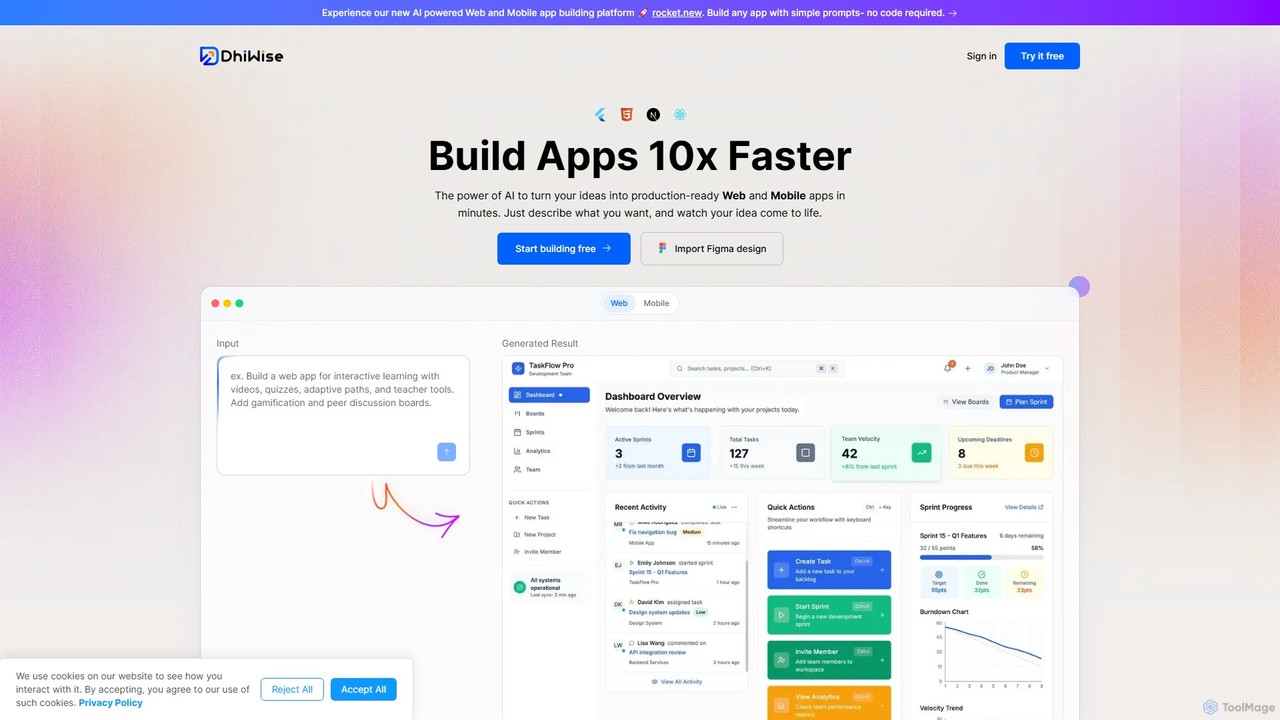
DhiWise is an AI-powered development platform that accelerates the creation of web and mobile applications. It transforms your ideas, natural language prompts, or Figma designs into high-quality, production-ready code in minutes. Supporting frameworks like Flutter and modern web technologies, DhiWise automates boilerplate tasks, enabling developers to build and deploy apps 10x faster.

Preview

React Product overview

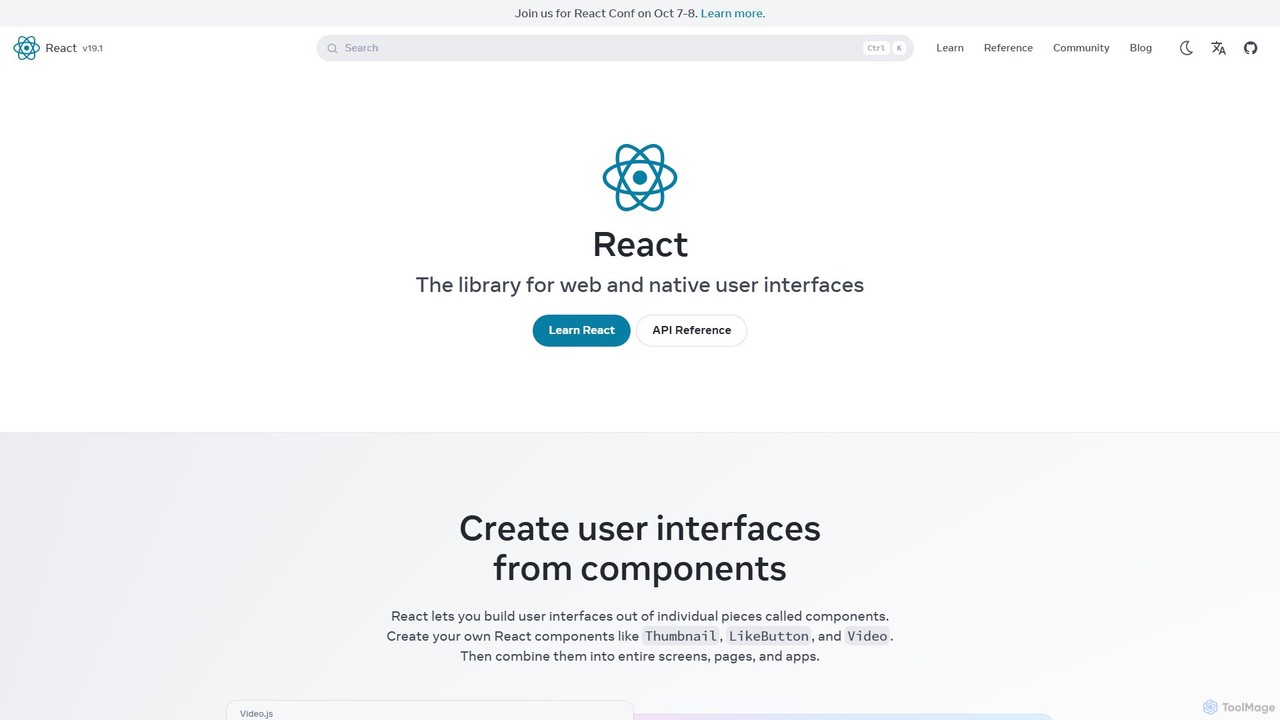
React is a free and open-source JavaScript library for building user interfaces based on components. Developed by Meta, it enables developers to create large-scale web and native applications with complex, interactive UIs efficiently. It uses a declarative approach and a component-based architecture to build encapsulated components that manage their own state.

Preview

Quick facts

Compare product focus, pricing models and audiences. Highlighted rows indicate different listed information; unknown pricing does not mean free.

DhiWise VS React — Quick facts
Quick factsDhiWiseReact
Pricing modelFreemiumFree
Product typeWebWeb
Primary focusDesign To CodeFrameworks & Libraries
Audience and rolesNo data availableNo data available
CategoriesDesign To Code · Low Code No Code · Mobile Development · Web DevelopmentFrameworks & Libraries · Mobile Development · Web Development
AddedAug 14, 2025Aug 7, 2025
UpdatedNov 19, 2026Nov 19, 2026

Features, usage and use cases

Explore the listed product descriptions, features and workflows. Taxonomy labels alone are not feature evaluations.

DhiWise

DhiWise is a revolutionary AI-powered development platform designed to drastically reduce the time and effort required to build professional-grade web and mobile applications. It serves as a co-pilot for developers, product teams, and entrepreneurs, enabling them to turn concepts into functional, production-ready software at unprecedented speed. By leveraging advanced AI, DhiWise bridges the gap between idea and execution, automating the most tedious parts of the development lifecycle.

The platform offers a dual-pronged approach to app creation. Users can either describe their desired application using natural language prompts through its powerful 'Rocket.new' engine, or they can directly import existing designs from Figma. In both scenarios, DhiWise intelligently interprets the requirements and generates clean, scalable, and maintainable source code. This eliminates the need for manual coding of UI components, screen layouts, and other boilerplate elements, allowing teams to focus on core business logic and innovation.

How to use DhiWise

The workflow in DhiWise is streamlined for maximum efficiency and flexibility:

  1. Provide Input: Start by either describing your app requirements in plain English (e.g., "build a timeline management system for home services") or by uploading your completed Figma design file.
  2. AI-Powered Generation: DhiWise's AI engine analyzes your input and instantly generates a complete, production-ready codebase. This includes a well-structured project, pixel-perfect and responsive UI, and clean code that adheres to industry best practices.
  3. Iterate and Customize: Once the initial app is generated, you can easily make changes. Use natural language to request modifications (e.g., "change the primary color to blue") or use the integrated console to make direct code adjustments. This iterative process is fast and intuitive.
  4. Deploy or Export: With a single click, you can deploy your web application directly to services like Netlify. Alternatively, you have full control and ownership of your code. You can download the entire source code or sync it with your GitHub repository to continue development in your preferred local environment.

Core Features of DhiWise

  • AI Prompt-to-App Generation: Build full-fledged applications simply by describing your idea in natural language.
  • Figma to Code Conversion: Instantly transform your Figma designs into clean, responsive, and production-ready code for both web and mobile (Flutter) applications.
  • High-Quality Code Output: Generates modern, semantic, and maintainable code with a clean architecture and proper component structure.
  • Multi-Framework Support: Specializes in modern frameworks, with strong support for Flutter (including state management options like BLoC, Riverpod, Provider, GetX) and popular web technologies.
  • Iterative Development: Refine and customize your application using natural language prompts or a built-in code editor.
  • One-Click Deployment: Seamlessly deploy your web apps to hosting platforms like Netlify directly from the DhiWise dashboard.
  • Full Code Ownership: Download the complete source code or push it to GitHub/GitLab, ensuring no vendor lock-in and complete control over your project.
  • Enterprise-Grade Security: Security is built-in by default for all users, ensuring your application and data are protected.

Use Cases for DhiWise

DhiWise is versatile and caters to a wide range of development needs:

  • Rapid Prototyping: Entrepreneurs and product managers can build interactive prototypes in minutes to validate ideas with stakeholders and users.
  • MVP Development: Startups can launch their Minimum Viable Product (MVP) significantly faster and with fewer resources, accelerating their time-to-market.
  • Frontend Development Acceleration: Development teams can automate the creation of UI from Figma designs, freeing up frontend developers to focus on complex state management and API integrations.
  • Building Internal Tools: Companies can quickly create custom internal applications, such as dashboards, admin panels, and management systems, without dedicating extensive development cycles.
  • Learning and Education: Developers new to a framework like Flutter can use DhiWise to generate best-practice code and learn its structure and patterns.

Advantages of DhiWise

Using DhiWise provides a significant competitive edge:

  • 10x Development Speed: Drastically cuts down development time from weeks or months to just hours or days.
  • Reduced Costs: Saves significant resources by automating manual coding tasks and reducing the need for large development teams for initial builds.
  • Improved Code Quality: Ensures consistency and adherence to best practices, resulting in a more stable and maintainable final product.
  • Enhanced Productivity: Eliminates roadblocks like design-to-code gaps and boilerplate frustrations, allowing developers to be more productive and focused.
  • Empowerment: Lowers the technical barrier for creating software, enabling a wider range of creators to bring their ideas to life.

Pricing and Plans

DhiWise operates on a freemium model. It offers a generous free plan that allows users to start building applications and explore the core features of the platform. For teams, enterprises, and users requiring more advanced capabilities, higher build limits, or dedicated support, DhiWise provides various paid subscription plans tailored to different needs. This model makes it accessible for individual creators while providing the scale and security required by professional organizations.

React

React is a declarative, efficient, and flexible JavaScript library for building user interfaces. It lets you compose complex UIs from small and isolated pieces of code called “components”. Developed and maintained by Meta, React has become one of the most popular tools for frontend web development and also extends to mobile development through React Native.

The core philosophy of React is its component-based architecture. Developers build encapsulated components that manage their own state, then compose them to make complex UIs. Since component logic is written in JavaScript instead of templates, you can easily pass rich data through your app and keep state out of the DOM. React uses a declarative paradigm, meaning you describe what your UI should look like for any given state, and React will efficiently update and render just the right components when your data changes. This is made possible by the Virtual DOM, which minimizes direct manipulation of the actual DOM, leading to significant performance gains.

How to use React

To start using React, developers typically set up a development environment. While previously `Create React App` was the standard, the official recommendation is now to use a full-stack React framework like Next.js or Remix. These frameworks provide a robust setup out-of-the-box, including routing, data fetching, and code splitting.

1. Setup a Project: Use a framework's CLI to create a new project, e.g., `npx create-next-app@latest`.

2. Create Components: React components are JavaScript functions that return markup. This markup is written in JSX (JavaScript XML), a syntax extension that allows you to write HTML-like code inside JavaScript. For example: `function Welcome(props) { return

Hello, {props.name}

; }`

3. Manage State and Interactivity: Use React Hooks to add state and interactivity. The `useState` hook allows a component to remember information, while `useEffect` lets you perform side effects, like fetching data. For example, `const [count, setCount] = useState(0);` creates a state variable.

4. Compose Components: Build complex UIs by combining smaller, reusable components. You can pass data from parent to child components via “props”.

5. Handle Data and Routing: In a framework like Next.js, you can define pages as components and use built-in data fetching functions to load data on the server or client, which is then passed to your page components.

Core Features of React

  • Component-Based Architecture: Build encapsulated components that manage their own state, making your code more reusable and easier to maintain.
  • Declarative UI: Simply describe what your UI should look like, and React will handle the rendering and updates when the underlying data changes.
  • JSX (JavaScript XML): A syntax extension that allows you to write HTML-like structures directly within your JavaScript code, making component creation intuitive.
  • React Hooks: Functions like `useState`, `useEffect`, and `useContext` that let you use state and other React features without writing a class.
  • React Native: A framework that extends React's principles to build truly native mobile applications for iOS and Android from a single codebase.
  • React Compiler: An upcoming optimizing compiler that automatically memoizes code to improve performance, reducing the need for manual optimizations like `useMemo` and `useCallback`.
  • Concurrent Features and Server Components: Advanced capabilities that enable better performance and user experience through features like streaming server-side rendering and prioritizing updates.
  • Vibrant Ecosystem: A massive community and a rich ecosystem of libraries and tools for state management (Redux, Zustand), routing (React Router), and more.

Use Cases for React

React's flexibility makes it suitable for a wide range of applications:

  • Single-Page Applications (SPAs): Ideal for building dynamic, interactive web applications like social media platforms, project management tools, and online editors.
  • Full-Stack Applications: When used with frameworks like Next.js or Remix, it's perfect for building server-rendered websites, e-commerce platforms, and content-heavy sites with great SEO and performance.
  • Cross-Platform Mobile Apps: Through React Native, developers can build high-quality mobile apps for both iOS and Android, sharing a significant portion of the codebase.
  • Interactive UI for Existing Websites: React can be gradually introduced into an existing non-React website to add interactive components like a search bar or a shopping cart.
  • Large-Scale Enterprise Applications: Its component model, scalability, and strong typing support (with TypeScript) make it a reliable choice for complex enterprise-level software.

Advantages of React

React offers numerous advantages that contribute to its popularity:

  • Improved Performance: The use of a Virtual DOM allows React to minimize costly DOM operations, resulting in faster UI updates.
  • Reusable Components: The component-based approach promotes code reuse, which speeds up the development process and ensures UI consistency.
  • Strong Community Support: A vast and active global community means abundant resources, tutorials, third-party libraries, and quick help.
  • Flexibility and Scalability: As a library, React focuses on the view layer, giving developers the freedom to choose other libraries for routing or state management. It scales from small widgets to large, complex applications.
  • Enhanced Developer Experience: Tools like the React DevTools, Hot Module Replacement (HMR), and a strong ecosystem make the development workflow efficient and enjoyable.
  • SEO-Friendly: With the help of server-side rendering (SSR) frameworks like Next.js, React applications can be fully indexed by search engines, which is crucial for many businesses.

Pricing and Plans

React is a free and open-source library licensed under the MIT License. There are no costs associated with using React in your projects, whether they are personal or commercial. The development and maintenance are sponsored by Meta and a large community of individual developers and companies.

Positioning

Their taxonomy shows where the products overlap and where each one has a more distinct focus. Unknown fields are shown explicitly and are never filled with assumptions.

Categories

Shared
Mobile DevelopmentWeb Development
Only DhiWise
Design To CodeLow Code No Code
Only React
Frameworks & Libraries

Tags

Shared
mobile developmentweb development
Only DhiWise
AI developerapp buildercode generationfigma to codeflutterlow-codeMVPno-coderapid prototypingreact
Only React
component-basedfrontendjavascriptNextJSopen sourcereact nativeUI

Audience and roles

Shared
No listed items
Only DhiWise
No listed items
Only React
No listed items

Traffic comparison

Traffic is shown on the same scale so differences in market visibility are not visually understated.

How to interpret the traffic data

Both charts share the same months and vertical scale. Each tool identifies its latest reporting month; missing months are left blank, not counted as zero. Regional and source visit counts are estimates calculated from the reported shares.

DhiWise monthly traffic:

Latest traffic · 2026-05

Monthly visits
204.4K
Avg. visit duration
0:30
Pages per visit
1.88
Bounce rate
42.7%
Data updated 2026-06-15

Monthly traffic trend

  • 2025-09: 444.9K
  • 2026-01: 328.9K
  • 2026-02: 276.3K
  • 2026-03: 289.7K
  • 2026-04: 219.5K
  • 2026-05: 204.4K

Top regions

Top 5 countries/regions
Country/regionPercentageEstimated visits
🇮🇳India26.42%54K
🇺🇸United States23.87%48.8K
🇸🇳Senegal21.52%44K
🇲🇳Mongolia15.75%32.2K
🇻🇳Vietnam12.44%25.4K

Traffic sources

Source typePercentageEstimated visits
Direct58.42%119.4K
Referral26.8%54.8K
Email14.78%30.2K

Search keywords

dhiwisedisplay apostrophe on websitesfigma to flutterflutter what is a mobile ui padding ios topkotlin group items in value ranges

React monthly traffic:

Latest traffic · 2026-05

Monthly visits
2M
Avg. visit duration
2:09
Pages per visit
2.6
Bounce rate
55.24%
Data updated 2026-06-15

Monthly traffic trend

  • 2025-09: 2.9M
  • 2026-01: 2.8M
  • 2026-02: 2.2M
  • 2026-03: 2.2M
  • 2026-04: 2.1M
  • 2026-05: 2M

Top regions

Top 5 countries/regions
Country/regionPercentageEstimated visits
🇮🇳India35.3%689.8K
🇺🇸United States30.62%598.3K
🇨🇳China16.19%316.4K
🇩🇪Germany9.15%178.8K
🇬🇧United Kingdom8.74%170.8K

Traffic sources

Source typePercentageEstimated visits
Direct80.22%1.6M
Referral19.26%376.4K
Email0.52%10.2K

Search keywords

reactreact docsreact documentationreact jsreactjs

Community signals

Ratings, comments, favorites, and likes are community signals—not a substitute for product fit.

DhiWise

Rating
No data available
Comments
0
Favorites
179
Likes
187

React

Rating
No data available
Comments
0
Favorites
190
Likes
184

DhiWise vs React · Comparison FAQ

What do DhiWise and React have in common?
Both tools are listed under Mobile Development、Web Development. These categories indicate overlapping use cases; compare their detailed descriptions for workflows, capabilities and limitations.
Are DhiWise and React free?
Listed pricing models: DhiWise — Freemium; React — Free. Missing pricing is not proof of a free plan, and freemium does not mean every feature is free. Check official sites for current plans, limits and trials.
How should I choose between DhiWise and React?
The primary listed category is Design To Code for DhiWise, and Frameworks & Libraries for React. Compare features, steps and use cases, then verify pricing, data permissions and deployment needs. This page does not include hands-on testing and does not declare a winner from traffic or tags.

Sources and comparison methodology

This page is assembled from ToolMage product listings, taxonomy, traffic statistics and on-site user feedback. It is not a hands-on test or an independent review.

  • Feature and plan descriptions reflect information in the listings, not real-time guarantees. Verify pricing, quotas, availability and privacy terms on the official sites.
  • Traffic uses the reporting months shown. Missing statistics do not mean zero visits, and different periods do not establish growth or superiority. Regional and source visit counts are estimates based on shares.
  • Different tags indicate differences in the listings, not proof that the other product lacks a capability. Ratings, favorites and visits are not used to declare a winner.

Related comparisons