Angular
Framework
AI TOOL COMPARISON
What is the difference, and which fits your workflow? Compare features, usage, pricing models and traffic side by side.
Angular is a powerful, open-source web application framework led by the Angular Team at Google. It empowers developers to build scalable, high-performance single-page applications (SPAs) using TypeScript and a component-based architecture. With a comprehensive ecosystem including a powerful CLI, built-in state management, and advanced tooling, Angular is ideal for creating complex enterprise-grade applications.
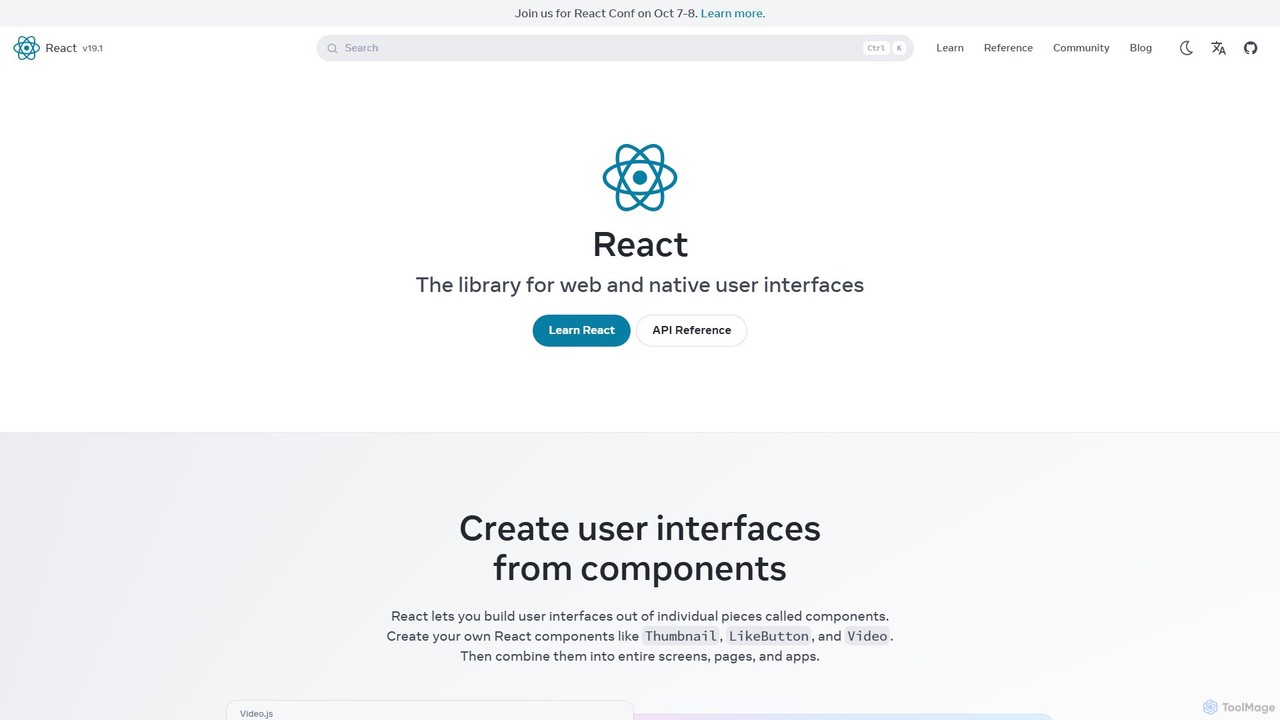
React is a free and open-source JavaScript library for building user interfaces based on components. Developed by Meta, it enables developers to create large-scale web and native applications with complex, interactive UIs efficiently. It uses a declarative approach and a component-based architecture to build encapsulated components that manage their own state.
Compare product focus, pricing models and audiences. Highlighted rows indicate different listed information; unknown pricing does not mean free.
| Quick facts | Angular | React |
|---|---|---|
| Pricing model | Free | Free |
| Product type | Web | Web |
| Primary focus | Framework | Frameworks & Libraries |
| Audience and roles | No data available | No data available |
| Categories | Framework · Web Development | Frameworks & Libraries · Mobile Development · Web Development |
| Added | Aug 1, 2025 | Aug 7, 2025 |
| Updated | Nov 19, 2026 | Nov 19, 2026 |
Explore the listed product descriptions, features and workflows. Taxonomy labels alone are not feature evaluations.
Angular is a development platform and framework for building efficient and sophisticated single-page applications. Maintained by a dedicated team at Google and a vibrant open-source community, Angular provides a structured, opinionated approach to web development that ensures scalability and maintainability. It leverages TypeScript, a superset of JavaScript, to provide robust typing and tooling, which helps in building large-scale applications with fewer errors.
The framework is built on a component-based architecture, where applications are composed of encapsulated, reusable components. This modular approach simplifies development, testing, and maintenance. Angular's latest versions have introduced significant performance improvements, including a new fine-grained reactivity model with Signals, which simplifies state management and boosts rendering speed. It also offers advanced features like server-side rendering (SSR), static site generation (SSG), and declarative lazy loading with `@defer` blocks, enabling developers to build exceptionally fast and SEO-friendly websites.
Getting started with Angular is streamlined thanks to the Angular CLI (Command Line Interface). First, ensure you have Node.js and npm installed. Then, install the Angular CLI globally by running npm install -g @angular/cli in your terminal. Once installed, you can create a new project with ng new my-app, which sets up a complete starter project with all the necessary configurations. Navigate into your new project directory (cd my-app) and run ng serve to start a local development server with live reloading. From there, you can start building your application by creating new components (ng generate component my-component), services, and routes. The official website, angular.dev, offers comprehensive tutorials and in-depth documentation to guide you through every feature, from basic concepts to advanced topics like dependency injection, routing, and animations.
Angular's robust and scalable nature makes it an excellent choice for a wide range of applications. It is particularly well-suited for large-scale, complex enterprise applications, such as internal dashboards, customer relationship management (CRM) systems, and data analytics platforms. Many of Google's own large products, like Google Cloud and Google Fonts, are built with Angular. It is also a great choice for building sophisticated Single-Page Applications (SPAs) that require rich interactivity and complex state management. Furthermore, with its support for Progressive Web Apps (PWAs), developers can use Angular to create reliable, fast, and engaging web experiences that work offline and can be installed on a user's device.
The primary advantage of Angular is its comprehensive and opinionated nature. It provides a complete solution out-of-the-box, reducing the need to piece together multiple third-party libraries for routing, state management, or data fetching. This leads to a more consistent and stable development experience, especially in large teams. Being backed by Google ensures long-term support (LTS), predictable release schedules, and thorough testing against Google's massive codebase. The use of TypeScript enhances code quality and maintainability. The powerful CLI and integrated tools significantly boost developer productivity, while features like SSR and fine-grained reactivity ensure top-tier application performance.
Angular is a completely free and open-source framework, distributed under the MIT license. There are no fees, subscriptions, or hidden costs associated with using the framework itself. You can freely use it for personal, commercial, or enterprise projects. The entire ecosystem, including the Angular CLI, documentation, and first-party libraries, is available at no cost.
React is a declarative, efficient, and flexible JavaScript library for building user interfaces. It lets you compose complex UIs from small and isolated pieces of code called “components”. Developed and maintained by Meta, React has become one of the most popular tools for frontend web development and also extends to mobile development through React Native.
The core philosophy of React is its component-based architecture. Developers build encapsulated components that manage their own state, then compose them to make complex UIs. Since component logic is written in JavaScript instead of templates, you can easily pass rich data through your app and keep state out of the DOM. React uses a declarative paradigm, meaning you describe what your UI should look like for any given state, and React will efficiently update and render just the right components when your data changes. This is made possible by the Virtual DOM, which minimizes direct manipulation of the actual DOM, leading to significant performance gains.
To start using React, developers typically set up a development environment. While previously `Create React App` was the standard, the official recommendation is now to use a full-stack React framework like Next.js or Remix. These frameworks provide a robust setup out-of-the-box, including routing, data fetching, and code splitting.
1. Setup a Project: Use a framework's CLI to create a new project, e.g., `npx create-next-app@latest`.
2. Create Components: React components are JavaScript functions that return markup. This markup is written in JSX (JavaScript XML), a syntax extension that allows you to write HTML-like code inside JavaScript. For example: `function Welcome(props) { return
3. Manage State and Interactivity: Use React Hooks to add state and interactivity. The `useState` hook allows a component to remember information, while `useEffect` lets you perform side effects, like fetching data. For example, `const [count, setCount] = useState(0);` creates a state variable.
4. Compose Components: Build complex UIs by combining smaller, reusable components. You can pass data from parent to child components via “props”.
5. Handle Data and Routing: In a framework like Next.js, you can define pages as components and use built-in data fetching functions to load data on the server or client, which is then passed to your page components.
React's flexibility makes it suitable for a wide range of applications:
React offers numerous advantages that contribute to its popularity:
React is a free and open-source library licensed under the MIT License. There are no costs associated with using React in your projects, whether they are personal or commercial. The development and maintenance are sponsored by Meta and a large community of individual developers and companies.
Their taxonomy shows where the products overlap and where each one has a more distinct focus. Unknown fields are shown explicitly and are never filled with assumptions.
Traffic is shown on the same scale so differences in market visibility are not visually understated.
Both charts share the same months and vertical scale. Each tool identifies its latest reporting month; missing months are left blank, not counted as zero. Regional and source visit counts are estimates calculated from the reported shares.
| Country/region | Percentage | Estimated visits |
|---|---|---|
| 🇺🇸United States | 31.49% | 335.3K |
| 🇮🇳India | 29.05% | 309.4K |
| 🇩🇪Germany | 17.84% | 190K |
| 🇵🇱Poland | 10.89% | 116K |
| 🇷🇺Russia | 10.73% | 114.3K |
| Source type | Percentage | Estimated visits |
|---|---|---|
| Direct | 72.47% | 771.7K |
| Referral | 25.98% | 276.7K |
| 1.55% | 16.5K |
| Country/region | Percentage | Estimated visits |
|---|---|---|
| 🇮🇳India | 35.3% | 689.8K |
| 🇺🇸United States | 30.62% | 598.3K |
| 🇨🇳China | 16.19% | 316.4K |
| 🇩🇪Germany | 9.15% | 178.8K |
| 🇬🇧United Kingdom | 8.74% | 170.8K |
| Source type | Percentage | Estimated visits |
|---|---|---|
| Direct | 80.22% | 1.6M |
| Referral | 19.26% | 376.4K |
| 0.52% | 10.2K |
Ratings, comments, favorites, and likes are community signals—not a substitute for product fit.
This page is assembled from ToolMage product listings, taxonomy, traffic statistics and on-site user feedback. It is not a hands-on test or an independent review.