ToolMage
Sign in

AI TOOL COMPARISON

Diffbot vs SingleAPI

What is the difference, and which fits your workflow? Compare features, usage, pricing models and traffic side by side.

Jump to key differences

Product overview

Diffbot Product overview

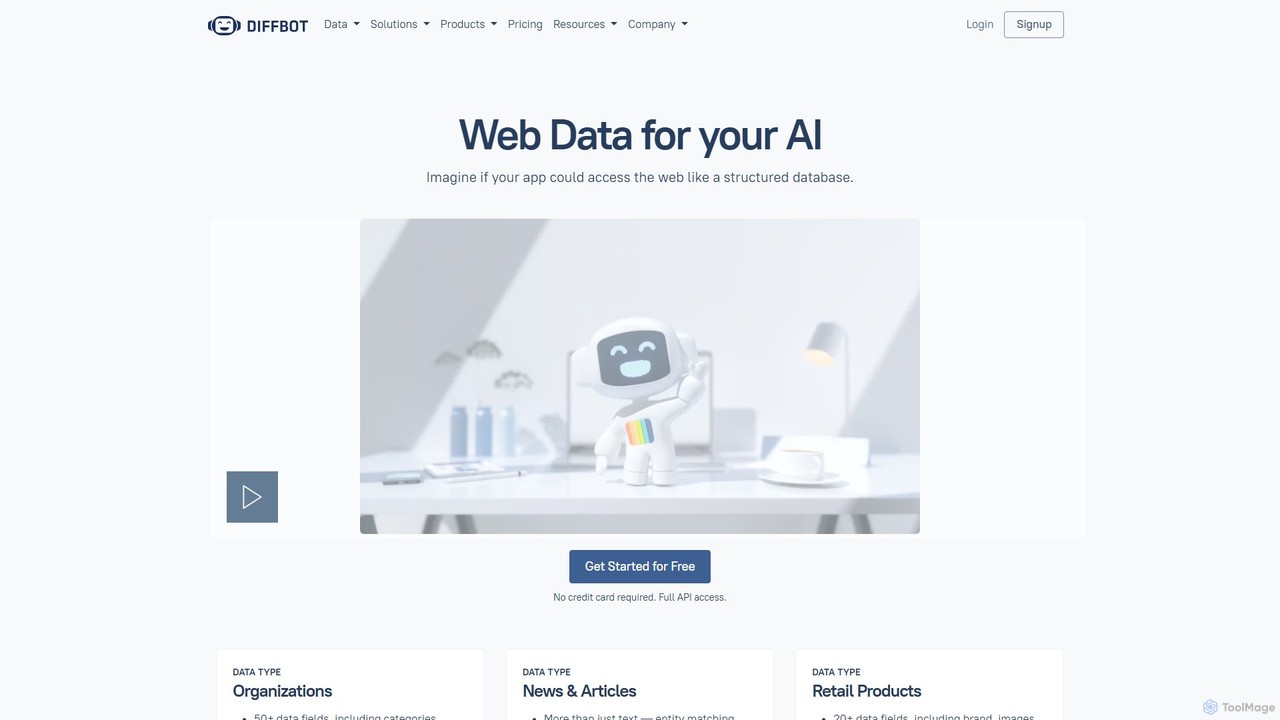
Diffbot is an AI-powered platform that transforms the unstructured web into a massive, structured Knowledge Graph. It offers APIs for web data extraction, crawling, and natural language processing, enabling businesses to access clean, organized data on organizations, news, products, and more for applications in finance, market intelligence, and risk management.

Preview

SingleAPI Product overview

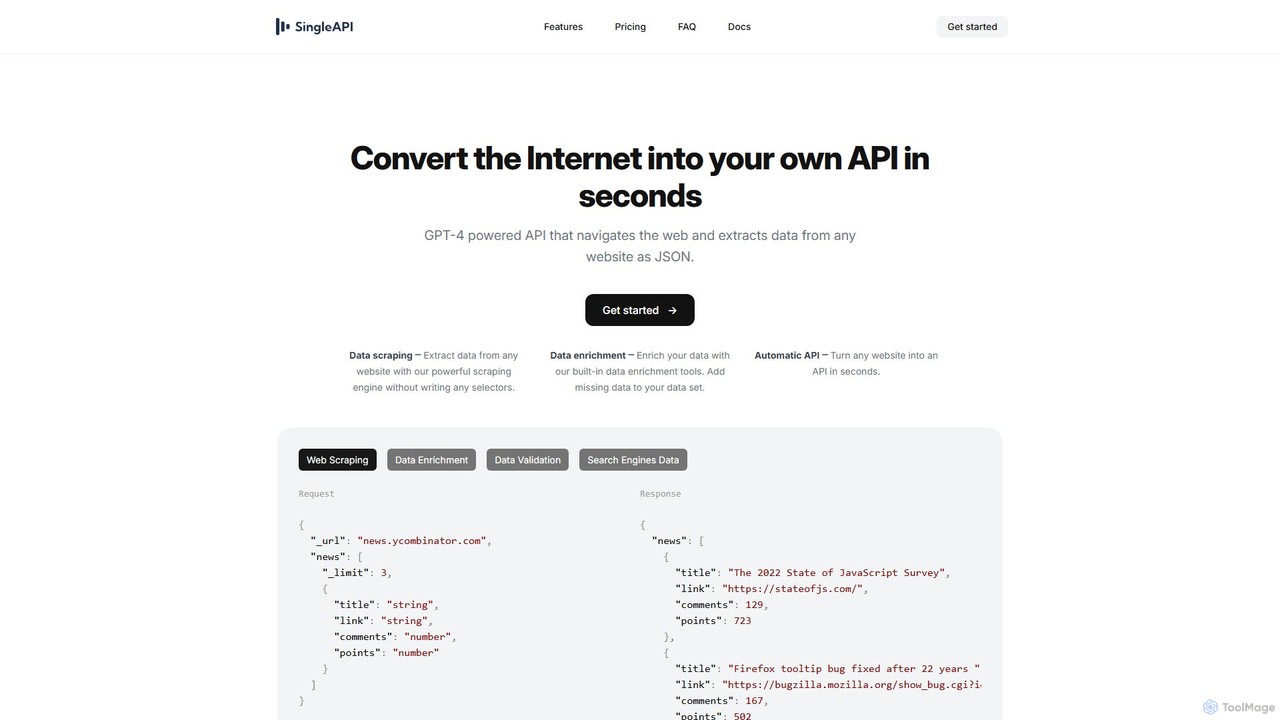
SingleAPI is a GPT-4 powered tool that instantly converts any website into a structured JSON API. It simplifies web scraping, data extraction, and data enrichment without writing any code or selectors, allowing users to effortlessly access web data for various applications.

Preview

Quick facts

Compare product focus, pricing models and audiences. Highlighted rows indicate different listed information; unknown pricing does not mean free.

Diffbot VS SingleAPI — Quick facts
Quick factsDiffbotSingleAPI
Pricing modelFreemiumFreemium
Product typeWebWeb
Primary focusMarket IntelligenceWeb Scraping
Audience and rolesNo data availableNo data available
CategoriesMarket Intelligence · Web Scraping · Api · AutomationWeb Scraping · Api · Data Extraction · Automation
AddedAug 9, 2025Aug 10, 2025
UpdatedNov 19, 2026Nov 19, 2026

Features, usage and use cases

Explore the listed product descriptions, features and workflows. Taxonomy labels alone are not feature evaluations.

Diffbot

Diffbot provides a suite of AI-powered tools designed to understand and structure the content of the public web, effectively turning it into the world's largest, most comprehensive database. At its core is the Diffbot Knowledge Graph, a massive, interconnected repository of data about organizations, people, articles, products, and more. Unlike traditional web scrapers that require manual rules for each website, Diffbot uses computer vision and natural language processing to automatically interpret web pages like a human, extracting structured data without site-specific configurations.

This technology allows developers and businesses to stop wrestling with the noisy, chaotic nature of web data and instead access it as if it were a clean, structured database. Whether you need to monitor news, enrich customer profiles, conduct market research, or power a machine learning model, Diffbot provides the clean, reliable data feeds required to build intelligent applications.

How to use Diffbot

Getting started with Diffbot is designed to be straightforward for developers and data teams. The primary interaction is through its powerful APIs.

  1. Sign Up: Begin by creating an account. Diffbot offers a free plan with 10,000 credits and full API access, allowing you to test the platform's capabilities without a credit card.
  2. Get Your API Token: Once registered, you'll receive an API token from your dashboard. This token is used to authenticate all your requests to the Diffbot APIs.
  3. Choose the Right API: Diffbot offers several distinct APIs for different tasks:
    • Extract API: Point it at any URL (like an article, product page, or forum discussion), and it will automatically return structured JSON data. No rules needed.
    • Crawl API: Provide a starting URL, and Diffbot will systematically crawl the entire site, using the Extract API to turn every relevant page into structured data. This is ideal for building a database from a specific website.
    • Knowledge Graph Search API: Query the pre-built Knowledge Graph to find information on over 246 million organizations, 1.6 billion articles, and more. You can search for entities and build precise data feeds.
    • Knowledge Graph Enhance API: Provide your own data (e.g., a company name), and Diffbot will enrich it with comprehensive data from the Knowledge Graph, such as revenue, employee count, social profiles, and recent news.
    • Natural Language API: Submit raw text to infer entities, relationships between them, and perform sentiment analysis.
  4. Integrate and Build: Use the API responses (in JSON format) to power your applications, populate your databases, or feed your analytics dashboards. For real-time needs, you can set up webhooks for instant notifications, such as new articles mentioning a specific company.

Core Features of Diffbot

  • Knowledge Graph: A massive, pre-crawled, and continuously updated graph of the web, containing structured information on organizations, people, products, articles, and their relationships.
  • Automatic Extraction: AI-driven technology that automatically identifies and extracts key information from various page types (articles, products, discussions, etc.) without requiring manual setup or rules.
  • Crawlbot: An intelligent web crawler that can turn an entire website into a structured database, automatically identifying and extracting content from relevant pages.
  • Natural Language Processing (NLP): Advanced NLP capabilities to understand text in over 20 languages, perform entity recognition (distinguishing 'Apple' the company from 'apple' the fruit), and conduct sentiment analysis at the topic level.
  • Data Enrichment (Enhance API): The ability to take a minimal piece of information, like a company name or email, and enrich it with dozens of data points from the Knowledge Graph.
  • Real-time Monitoring: Build custom, noise-free feeds for news and brand mentions with real-time alerts via email or webhooks.

Use Cases for Diffbot

Diffbot's structured data is valuable across numerous industries and functions:

  • Market Intelligence: Track competitors, monitor industry trends, and analyze market movements by tapping into global news, company filings, and product data.
  • Risk & Compliance: Perform due diligence on companies and individuals, monitor supply chains for risk signals, and stay ahead of regulatory changes.
  • Sales & Marketing: Enrich lead data in CRMs, identify new prospects based on specific criteria (e.g., companies in a certain industry that just received funding), and personalize outreach.
  • News & Media Monitoring: Create highly specific, real-time news feeds that track mentions of brands, people, or topics with precise entity matching and sentiment analysis.
  • Recruiting: Build databases of potential candidates, identify talent, and enrich professional profiles with data from across the web.
  • Machine Learning: Use the Knowledge Graph as a source of high-quality, structured training data for various AI and machine learning models.

Advantages of Diffbot

The primary advantage of Diffbot is its ability to treat the entire web as a single, queryable database. It abstracts away the complexity of web scraping and data cleaning. Key benefits include accuracy, scale, and efficiency. Instead of building and maintaining fragile, site-specific scrapers, users can rely on a single, robust API. The entity-aware NLP ensures data quality and relevance, while the pre-built Knowledge Graph provides immediate access to a vast dataset that would take years to build in-house.

Pricing and Plans

Diffbot offers a tiered pricing structure to accommodate different levels of usage, from hobby projects to large enterprises.

  • Free Plan: $0/month. Includes 10,000 credits, full API access, and is free forever. Ideal for testing and small projects.
  • Startup Plan: $299/month. Includes 250,000 credits and is designed for small teams needing plug-and-play scraping and Knowledge Graph access.
  • Plus Plan: $899/month. Includes 1,000,000 credits, access to the Crawl product, and higher API call rates. Suitable for growing businesses with more significant data needs.
  • Enterprise Plan: Custom pricing. Offers bespoke plans with custom credit allotments, the highest API call rates, premium SLA support, and managed solutions for large-scale data operations.

Credits are consumed based on the type and complexity of the API call. A detailed breakdown is available on their website.

SingleAPI

SingleAPI is a revolutionary tool designed to transform the entire internet into a developer-friendly, structured data source. Powered by GPT-4, it provides an intelligent API that can navigate any website, understand its structure, and extract the desired information into a clean JSON format, all within seconds. This eliminates the tedious and complex process of traditional web scraping, where developers would need to write and maintain fragile selectors (like CSS selectors or XPaths) to target specific data points. With SingleAPI, you simply describe the data you need, and the AI handles the rest.

The platform is built for simplicity and power, catering to a wide range of users from individual hobbyists to large enterprises. Whether you need to monitor competitor pricing, aggregate news, generate leads, or enrich your existing datasets, SingleAPI provides a robust and reliable solution that saves significant time and resources.

How to use SingleAPI

Using SingleAPI is remarkably straightforward. The process involves sending a simple HTTP request with a JSON body that specifies the target website and the data schema you want to extract. The AI engine then visits the URL, interprets your request, finds the relevant data on the page, and returns it in a perfectly structured JSON response.

For example, to extract the top 3 articles from Hacker News, your request would look like this:

Request:
{
  "_url": "news.ycombinator.com",
  "news": [
    {
      "_limit": 3,
      "title": "string",
      "link": "string",
      "comments": "number",
      "points": "number"
    }
  ]
}

SingleAPI's AI understands this structure, navigates to Hacker News, identifies the list of articles, and extracts the title, link, comment count, and points for the first three entries, returning a clean JSON object.

Core Features of SingleAPI

  • AI-Powered Web Scraping: Leverages GPT-4 to understand web page layouts and extract data without requiring users to write or manage any selectors.
  • Automatic API Creation: Instantly turns any public website into a functional, queryable API.
  • Data Enrichment: Automatically enhances your extracted data. For example, it can find social media profiles from a list of company names or add other relevant information to your dataset.
  • Flexible Data Delivery: Delivers data in multiple formats, including JSON, CSV, XML, and Excel, to fit various workflows.
  • Real-time Data with Webhooks: Configure webhooks to receive data instantly as it's scraped, enabling real-time applications.
  • Managed Proxy Rotation: Automatically handles proxy management to prevent IP blocks and ensure successful data retrieval, with options for dedicated proxy pools.
  • Search Engine Scraping: Capable of scraping data directly from search engine results pages, such as Google, for SEO analysis or market research.
  • 24/7 Monitoring: Provides constant monitoring of crawlers and a user dashboard to track usage and ensure service uptime and reliability.

Use Cases for SingleAPI

SingleAPI's versatility makes it suitable for a wide array of applications:

  • Market Research: Track competitor pricing, product details, and customer reviews from e-commerce sites.
  • Lead Generation: Extract contact information, company details, and job listings from corporate websites and professional networks.
  • Content Aggregation: Build custom news feeds, blog aggregators, or social media monitors.
  • Financial Analysis: Scrape stock prices, market data, and financial news for analysis and modeling.
  • AI Model Training: Gather large, structured datasets from across the web to train machine learning models.

Advantages of SingleAPI

The primary advantage of SingleAPI is its simplicity and efficiency. It abstracts away the complexities of web scraping, such as handling dynamic JavaScript-heavy sites, managing proxies, and parsing HTML. This allows developers and non-developers alike to focus on using the data rather than acquiring it. The AI-driven approach makes it more resilient to website layout changes compared to traditional scrapers. Its flexibility in data formats and real-time delivery via webhooks makes it a powerful tool for modern data-driven businesses.

Pricing and Plans

SingleAPI offers a tiered pricing structure to suit different needs:

  • Hobby Plan: $0/month. Includes 100 requests, 3 API endpoints, and 24-hour data retention. Ideal for individuals and testing purposes.
  • Professional Plan: $75/month. Includes 5,000 requests, with additional requests at $10 per 1,000. Offers unlimited API endpoints, 30-day data retention, priority support, and Zapier integration. Designed for businesses.
  • Enterprise Plan: Custom pricing. Tailored for large companies with high-volume needs. Includes custom API diagnostics, a 99.99% uptime SLA, premium 24/7 chat support, and SAML-based SSO.

Positioning

Their taxonomy shows where the products overlap and where each one has a more distinct focus. Unknown fields are shown explicitly and are never filled with assumptions.

Categories

Shared
Web ScrapingApiAutomation
Only Diffbot
Market Intelligence
Only SingleAPI
Data Extraction

Tags

Shared
APIdata enrichmentdata extractiondeveloper toolsweb scraping
Only Diffbot
business intelligenceknowledge graphmarket intelligencenatural language processingnews monitoringweb crawling
Only SingleAPI
automationdata scrapinggpt-4JSONno-code

Audience and roles

Shared
No listed items
Only Diffbot
No listed items
Only SingleAPI
No listed items

Traffic comparison

Traffic is shown on the same scale so differences in market visibility are not visually understated.

How to interpret the traffic data

Both charts share the same months and vertical scale. Each tool identifies its latest reporting month; missing months are left blank, not counted as zero. Regional and source visit counts are estimates calculated from the reported shares.

Diffbot monthly traffic:

Latest traffic · 2026-05

Monthly visits
47.2K
Avg. visit duration
0:36
Pages per visit
2.02
Bounce rate
38.73%
Data updated 2026-06-15

Monthly traffic trend

  • 2025-09: 65.5K
  • 2026-01: 49.6K
  • 2026-02: 69.2K
  • 2026-03: 61.7K
  • 2026-04: 44.6K
  • 2026-05: 47.2K

Top regions

Top 5 countries/regions
Country/regionPercentageEstimated visits
🇺🇸United States31.36%14.8K
🇳🇬Nigeria28.45%13.4K
🇮🇳India20.17%9.5K
🇬🇧United Kingdom11.29%5.3K
🇵🇰Pakistan8.73%4.1K

Traffic sources

Source typePercentageEstimated visits
Direct89.5%42.2K
Referral8.3%3.9K
Email2.2%1K

Search keywords

crawlydifbotdiffbotdiffbot apiwebsite content extractor

SingleAPI monthly traffic:

Latest traffic · 2026-05

Monthly visits
438
Avg. visit duration
0:00
Pages per visit
1.01
Bounce rate
40.53%
Data updated 2026-06-15

Monthly traffic trend

  • 2025-09: 737
  • 2026-01: 0
  • 2026-02: 135
  • 2026-03: 156
  • 2026-04: 0
  • 2026-05: 438

Top regions

Top 5 countries/regions
Country/regionPercentageEstimated visits
🇮🇶Iraq100%438

Search keywords

any site to apiturn website to api

Community signals

Ratings, comments, favorites, and likes are community signals—not a substitute for product fit.

Diffbot

Rating
No data available
Comments
0
Favorites
196
Likes
188

SingleAPI

Rating
No data available
Comments
0
Favorites
208
Likes
202

Diffbot vs SingleAPI · Comparison FAQ

What do Diffbot and SingleAPI have in common?
Both tools are listed under Web Scraping、Api、Automation. These categories indicate overlapping use cases; compare their detailed descriptions for workflows, capabilities and limitations.
Are Diffbot and SingleAPI free?
Listed pricing models: Diffbot — Freemium; SingleAPI — Freemium. Missing pricing is not proof of a free plan, and freemium does not mean every feature is free. Check official sites for current plans, limits and trials.
How should I choose between Diffbot and SingleAPI?
The primary listed category is Market Intelligence for Diffbot, and Web Scraping for SingleAPI. Compare features, steps and use cases, then verify pricing, data permissions and deployment needs. This page does not include hands-on testing and does not declare a winner from traffic or tags.

Sources and comparison methodology

This page is assembled from ToolMage product listings, taxonomy, traffic statistics and on-site user feedback. It is not a hands-on test or an independent review.

  • Feature and plan descriptions reflect information in the listings, not real-time guarantees. Verify pricing, quotas, availability and privacy terms on the official sites.
  • Traffic uses the reporting months shown. Missing statistics do not mean zero visits, and different periods do not establish growth or superiority. Regional and source visit counts are estimates based on shares.
  • Different tags indicate differences in the listings, not proof that the other product lacks a capability. Ratings, favorites and visits are not used to declare a winner.

Related comparisons