Foxscrape
Data Extraction
AI TOOL COMPARISON
What is the difference, and which fits your workflow? Compare features, usage, pricing models and traffic side by side.
Data Extraction
Data Extraction
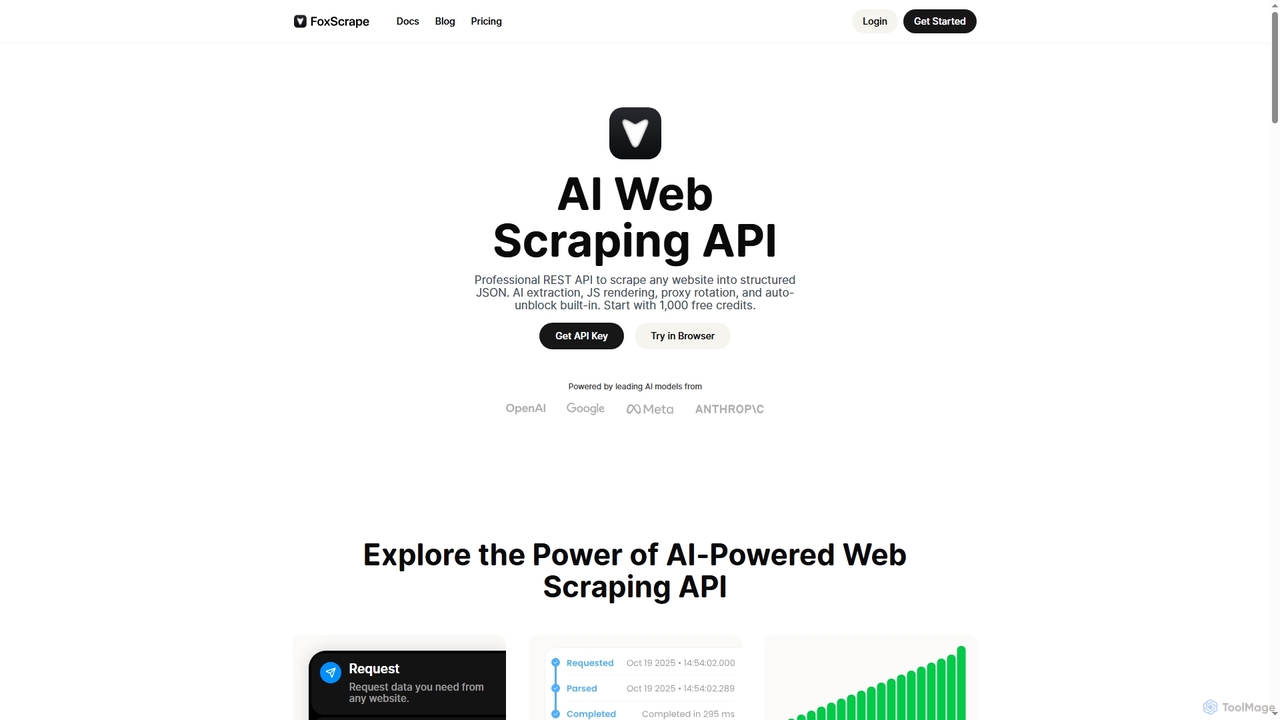
FoxScrape is an AI-powered web scraping REST API for developers. It simplifies data extraction by converting any website into structured JSON data using features like AI-driven parsing from plain English, JavaScript rendering for dynamic sites, and automatic proxy rotation to prevent blocks.
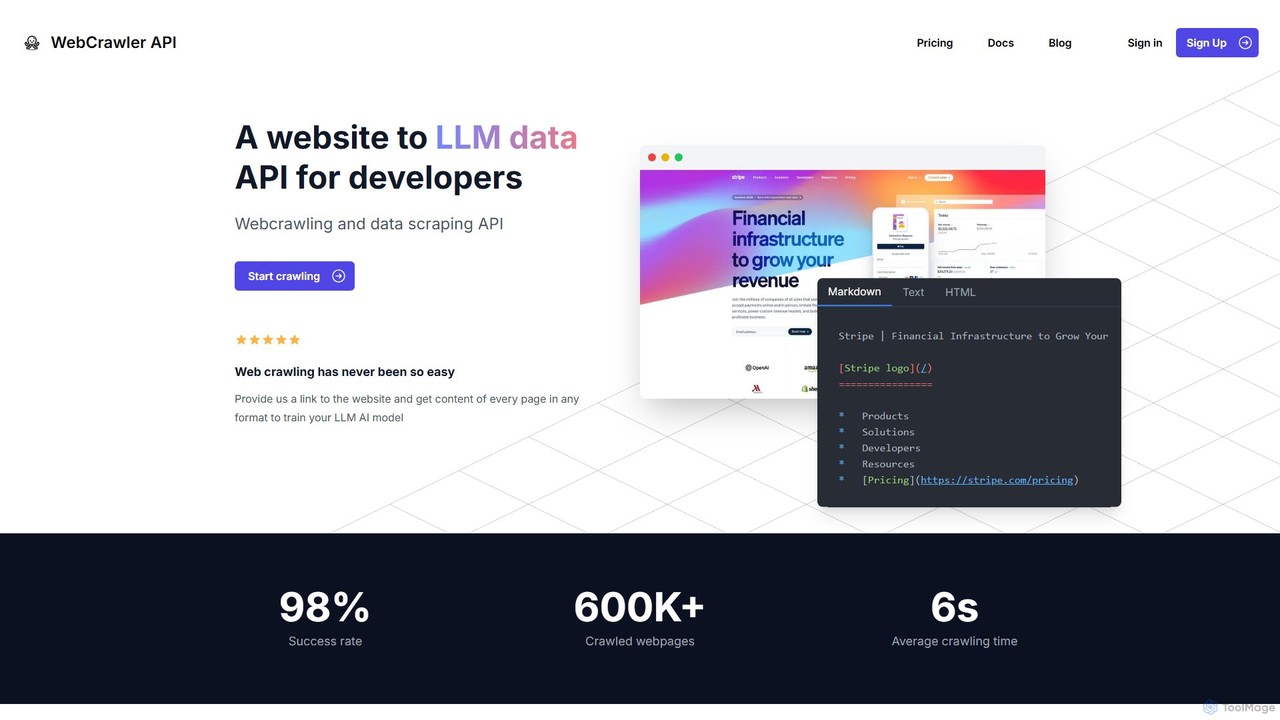
Webcrawlerapi is a powerful API for developers to effortlessly crawl websites and extract clean data. It simplifies web scraping by handling JavaScript rendering, anti-bot measures, and data parsing. Ideal for gathering structured content like Markdown or text to train LLM AI models or for Retrieval-Augmented Generation (RAG) systems, it offers a high success rate and a simple, pay-as-you-go pricing model.
Compare product focus, pricing models and audiences. Highlighted rows indicate different listed information; unknown pricing does not mean free.
| Quick facts | Foxscrape | Webcrawlerapi |
|---|---|---|
| Pricing model | Freemium | Freemium |
| Product type | Web | Web |
| Primary focus | Data Extraction | Data Extraction |
| Audience and roles | Business Analyst · Data Analyst · Data Scientist · Marketing Manager · Product Manager · Software Developer | No data available |
| Categories | Data Extraction · Api · Automation | Data Extraction · Api · Automation |
| Added | Nov 5, 2025 | Aug 2, 2025 |
| Updated | Nov 19, 2026 | Nov 19, 2026 |
Explore the listed product descriptions, features and workflows. Taxonomy labels alone are not feature evaluations.
FoxScrape provides a professional REST API designed to streamline the web scraping process for developers. It enables users to extract structured data from any website and receive it in clean JSON format. The platform is built to be powerful yet easy to use, catering to both beginners and experienced professionals. It leverages thousands of headless Chrome instances to ensure API requests behave like a real user, bypassing common anti-bot measures and reliably extracting data at scale.
To use FoxScrape, developers can start by getting a free API key which includes 1,000 credits. Integration is straightforward: make a REST API call to the FoxScrape endpoint, including your API key in the 'Authorization' header and the target URL as a parameter. For dynamic websites built with frameworks like React or Vue, simply enable the 'render_js' parameter. For intelligent extraction, describe the required data in plain English, and the AI will handle the parsing without needing CSS selectors or XPath.
FoxScrape is ideal for a variety of data extraction tasks. Developers and data analysts can use it for price monitoring on e-commerce sites, gathering real estate listings, aggregating customer reviews, conducting market research by scraping competitor data, and extracting search engine results for SEO analysis. Its ability to handle complex sites also makes it suitable for extracting data from financial portals, social media, and news websites.
The primary advantage of FoxScrape is its intelligence and reliability. The AI-powered extraction eliminates the need for brittle CSS selectors, making scrapers more resilient to website updates. The built-in proxy rotation and browser-level rendering ensure high success rates and prevent blocking. It offers an all-in-one solution that combines a scraper, renderer, and proxy manager into a single, scalable API, saving developers significant time and effort compared to building and maintaining a DIY setup.
FoxScrape offers a transparent pricing model with a free trial. New users receive 1,000 free API credits without needing a credit card.
Webcrawlerapi is a specialized API designed to streamline the process of web crawling and data extraction for developers. In an era where data is crucial for training large language models (LLMs) and powering AI applications, traditional web scraping presents significant challenges. These include handling dynamic JavaScript-rendered content, bypassing sophisticated anti-bot systems, managing proxies, and cleaning messy HTML into usable formats. Webcrawlerapi abstracts away all these complexities, providing a simple yet powerful interface to turn any website into a structured data source.
With a reported 98% success rate and an average crawling time of just 6 seconds, the service is built for efficiency and reliability. It allows developers to focus on their core application logic instead of getting bogged down in the intricacies of building and maintaining a scalable crawling infrastructure. By providing a link, developers can receive clean, ready-to-use content in formats like Markdown, text, or raw HTML, making it perfect for feeding into AI model training pipelines or knowledge bases for RAG systems.
Integrating Webcrawlerapi into your project is designed to be straightforward. The process typically involves just a few lines of code. First, you need to sign up on the Webcrawlerapi website to obtain your unique API access key. Then, you can use one of their provided client libraries for popular programming languages.
For example, in a NodeJS environment, you would start by installing the client library via npm: npm i webcrawlerapi-js. Then, in your code, you import the library, create a new client instance with your API key, and call the `crawl` method. This method takes parameters such as the target `url`, the desired `scrape_type` (e.g., 'markdown'), and optional limits like `items_limit`. The API then handles the entire crawling process in the background and returns a structured JSON response with the extracted data. Similar simple integration patterns are available for Python, PHP, and .NET, making it accessible to a wide range of developers.
Webcrawlerapi is versatile and can be applied to a variety of data-intensive tasks. Its primary use cases revolve around AI and data analysis.
The main advantage of Webcrawlerapi is its simplicity and efficiency. It allows development teams to offload the entire web crawling infrastructure and maintenance burden. This means faster time-to-market for data-driven products. The high success rate (98%) and robust anti-bot features ensure data pipelines are reliable. Furthermore, its transparent, pay-as-you-go pricing model is highly cost-effective, as you only pay for successful requests, eliminating the risk and overhead associated with subscriptions or building an in-house solution.
Webcrawlerapi employs a straightforward and transparent 'pay-for-usage' pricing model, completely avoiding subscriptions and hidden fees. Costs are calculated based on the number of pages you successfully crawl each month. The service includes unlimited crawl jobs, an unlimited and automatically managed proxy network, and email support in its pricing. For a clear cost estimation, the website provides a calculator. As an example, crawling 10,000 pages in a month would cost approximately $20. This model is ideal for projects of all sizes, from small-scale experiments to large-scale data operations, as costs scale directly with usage. The platform also allows users to try the service before making a purchase, likely through a free credit allocation for new accounts.
Their taxonomy shows where the products overlap and where each one has a more distinct focus. Unknown fields are shown explicitly and are never filled with assumptions.
Traffic is shown on the same scale so differences in market visibility are not visually understated.
Both charts share the same months and vertical scale. Each tool identifies its latest reporting month; missing months are left blank, not counted as zero. Regional and source visit counts are estimates calculated from the reported shares.
| Country/region | Percentage | Estimated visits |
|---|---|---|
| 🇧🇷Brazil | 27.03% | 439 |
| 🇨🇭Switzerland | 25.81% | 419 |
| 🇮🇳India | 25.7% | 417 |
| 🇦🇹Austria | 15.65% | 254 |
| 🇺🇸United States | 5.81% | 94 |
| Country/region | Percentage | Estimated visits |
|---|---|---|
| 🇺🇸United States | 49.13% | 2.7K |
| 🇩🇪Germany | 20.9% | 1.1K |
| 🇮🇳India | 14.85% | 809 |
| 🇻🇳Vietnam | 12.23% | 666 |
| 🇦🇺Australia | 2.89% | 157 |
Ratings, comments, favorites, and likes are community signals—not a substitute for product fit.
Yes, Foxscrape is designed to scrape modern websites. By enabling the `render_js` parameter in your API request, the service uses headless Chrome instances to fully render any site built with frameworks like React, Vue, or Angular, allowing you to extract dynamic content.
You can integrate Foxscrape by making HTTP requests to its REST API endpoint. According to the documentation, you need to include your API key in the `Authorization` header as a Bearer token (e.g., `Authorization: Bearer YOUR_API_KEY`). The documentation provides examples for cURL and JavaScript's `fetch` API to get you started quickly.
Foxscrape employs an automatic proxy rotation system that leverages a large, geo-distributed pool of premium proxies. This feature automatically rotates IP addresses for your requests, significantly reducing the chances of encountering rate limits, CAPTCHAs, and IP bans from target websites.
The Foxscrape API uses standard HTTP status codes to indicate the outcome of a request. As per the documentation, a successful request returns a `200` status code. Errors are indicated with codes like `400` for bad requests (missing/invalid parameters), `401` for an invalid API key, or `500` for an internal server error.
Foxscrape offers two main paid plans: the Starter plan at $20/month for 150,000 API credits and 20 concurrent requests, and the Pro plan at $79/month for 1,000,000 API credits and 100 concurrent requests. There is also a free trial that provides 1,000 API credits to new users without requiring a credit card.
This page is assembled from ToolMage product listings, taxonomy, traffic statistics and on-site user feedback. It is not a hands-on test or an independent review.