ToolMage
Sign in

AI TOOL COMPARISON

marimo vs Paperspace

What is the difference, and which fits your workflow? Compare features, usage, pricing models and traffic side by side.

Jump to key differences

Product overview

marimo Product overview

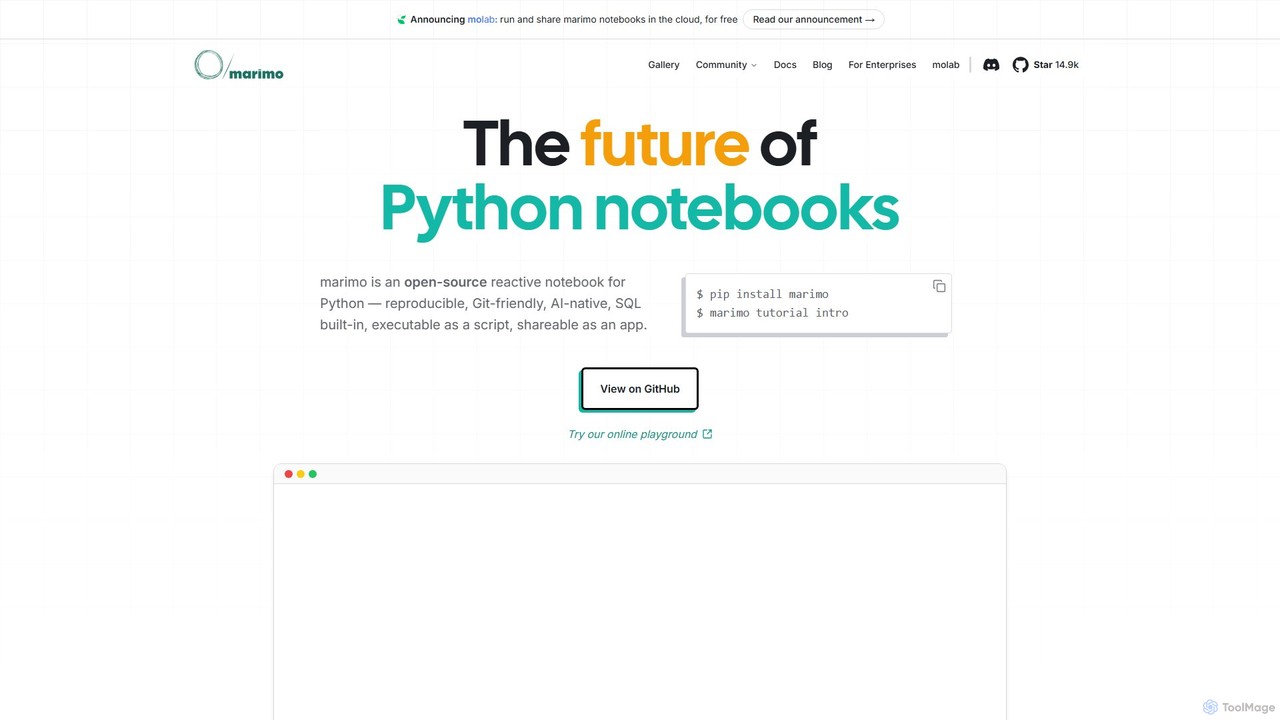
marimo is an open-source reactive Python notebook for modern data science and AI. It offers a reproducible, Git-friendly, and interactive environment where notebooks are pure Python scripts. Features include built-in AI assistance, SQL cells, and the ability to share notebooks as web apps, streamlining the workflow from experiment to production.

Preview

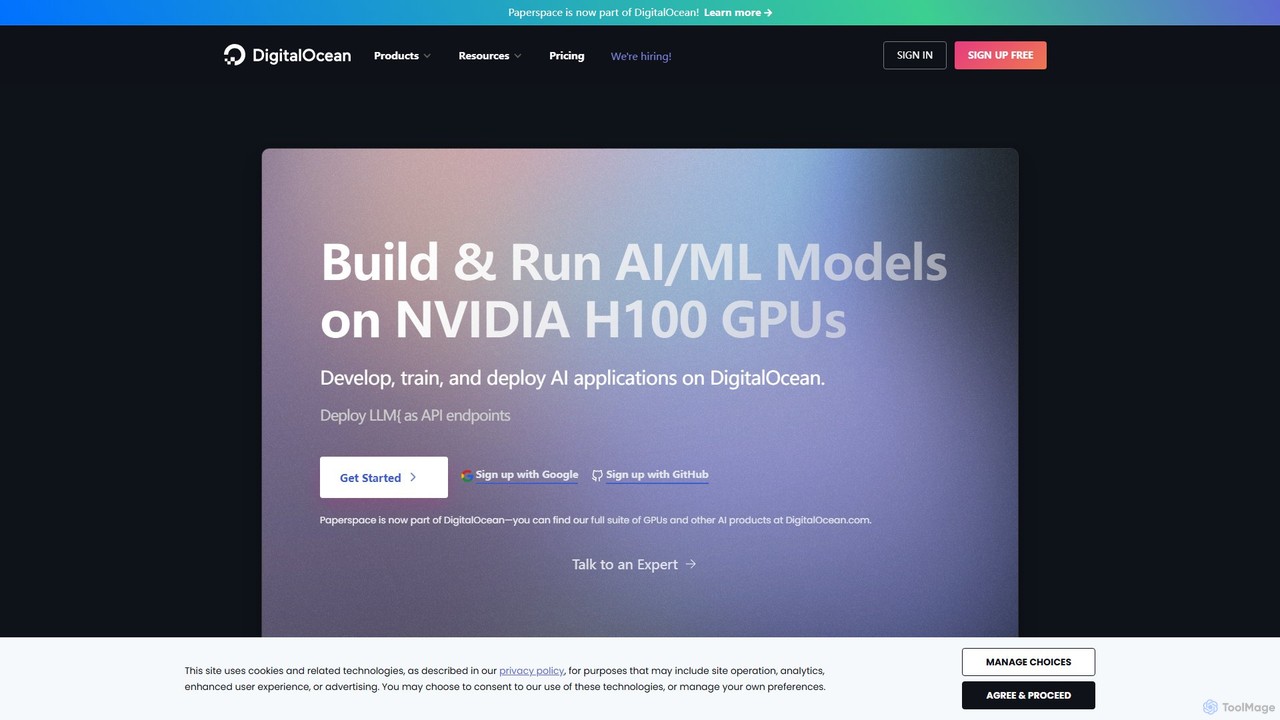
Paperspace Product overview

Paperspace is a high-performance cloud computing platform designed for AI and Machine Learning. It provides effortless access to powerful cloud GPUs, managed Jupyter notebooks, and a complete MLOps platform (Gradient) to build, train, and deploy models. Ideal for developers, data scientists, and enterprises looking to accelerate their AI workflows without the complexity of managing infrastructure.

Preview

Quick facts

Compare product focus, pricing models and audiences. Highlighted rows indicate different listed information; unknown pricing does not mean free.

marimo VS Paperspace — Quick facts
Quick factsmarimoPaperspace
Pricing modelFreemiumFreemium
Product typeWebWeb
Primary focusData VisualizationMachine Learning
Audience and rolesNo data availableNo data available
CategoriesData Visualization · Notebook · DevelopmentMachine Learning · Cloud Computing · Development
AddedAug 2, 2025Aug 1, 2025
UpdatedNov 19, 2026Nov 19, 2026

Features, usage and use cases

Explore the listed product descriptions, features and workflows. Taxonomy labels alone are not feature evaluations.

marimo

marimo is a revolutionary open-source Python notebook that reimagines interactive computing for the modern era of data science and artificial intelligence. Unlike traditional notebooks that store content in error-prone JSON files, marimo notebooks are pure Python scripts (.py files). This fundamental design choice makes them reproducible, Git-friendly, testable, and reusable as standard Python modules. marimo introduces a reactive execution model, where updating a single cell automatically triggers the execution of all dependent cells, eliminating hidden state and the tedious manual task of re-running code to ensure consistency. This creates a fluid, intuitive, and error-resistant development environment.

Developed by a team with extensive experience from Google, Palantir, and the PyData ecosystem, marimo is built to bridge the gap between experimental prototyping and production-ready applications. It empowers developers and data scientists to build complex, interactive web applications directly from their notebooks without writing any frontend code. These notebooks can be seamlessly shared as interactive HTML files powered by WebAssembly or deployed as robust web apps using the marimo command-line interface.

How to use marimo

Getting started with marimo is straightforward and designed for a smooth developer experience. First, install it using pip:

$ pip install marimo

Once installed, you can launch the introductory tutorial to familiarize yourself with its reactive paradigm:

$ marimo tutorial intro

To create or edit a notebook, simply run the marimo command with a Python file:

$ marimo edit my_notebook.py

Inside the web-based editor, you can write Python code in cells, just like in other notebooks. However, marimo's power lies in its special features. You can bind UI elements like sliders and dropdowns directly to Python variables. When a user interacts with a widget, the corresponding variable updates, and all downstream cells that use this variable reactively re-run. You can also write SQL queries directly in dedicated SQL cells to interact with databases like DuckDB, SQLite, Postgres, and more. To share your work, you can either run it as a read-only application or export it to a self-contained HTML file:

# Run as an interactive app
$ marimo run my_notebook.py

# Export to HTML
$ marimo export my_notebook.py --to html

The integrated AI assistant can be used to generate code, explain concepts, and debug issues, supporting models from OpenAI, Anthropic, Google Gemini, and local models via Ollama.

Core Features of marimo

  • Reactive Execution: Code and outputs stay perfectly in sync. Modifying a cell automatically updates all dependent cells, eliminating hidden state and ensuring reproducibility.
  • Git-Friendly Format: Notebooks are saved as standard Python (.py) files, not complex JSON. This results in clean, readable diffs, making version control with Git seamless.
  • AI-Native Editor: Features integrated AI assistance, including GitHub Copilot-style autocomplete, context-aware chat, and inline edits. It supports major AI models to accelerate development.
  • Built-in SQL Cells: Natively query databases and dataframes using SQL. The results can be seamlessly transformed and visualized using the full power of Python.
  • Interactive UI Elements: Build interactive UIs with a rich set of widgets like sliders, dropdowns, and interactive dataframe GUIs without needing any frontend expertise.
  • Seamless Deployment: Effortlessly transition from a prototype notebook to a production-grade tool. Deploy notebooks as read-only web apps, run them as Python scripts in pipelines, or export them as self-contained HTML files.
  • Reproducible Environments: marimo can serialize package requirements within the notebook file and automatically create ephemeral virtual environments, ensuring that notebooks run consistently everywhere.
  • Rich Developer Experience: The editor includes modern features like vim keybindings, code formatting, debugging panels, extensive hotkeys, and a VS Code extension.

Use Cases for marimo

marimo's versatility makes it suitable for a wide range of applications across different domains:

  • AI and Machine Learning Development: Rapidly prototype and test AI models. Build interactive interfaces for LLMs, such as chatbots and generative UI tools. Create custom data labeling and evaluation dashboards to fine-tune and compare models.
  • Data Exploration and Visualization: Explore datasets interactively using reactive plots and dataframe GUIs. Selections made in a plot can automatically update downstream analyses and visualizations, creating a dynamic and exploratory workflow.
  • Scientific Research and Education: Communicate research findings through tangible, interactive applications. Develop engaging educational materials that allow students to experiment with concepts in real-time, such as simulating physical processes or exploring mathematical functions.
  • Internal Tooling and Dashboards: Build and maintain internal tools like financial calculators, NLP model comparison dashboards, or data labeling interfaces using only Python. This eliminates the complexity of managing separate frontend and backend services.

Advantages of marimo

marimo offers significant advantages over traditional notebook environments like Jupyter:

  • Reproducibility by Design: The reactive, acyclic dataflow graph guarantees that notebooks execute in a deterministic order, preventing the common "out-of-order execution" problems that plague other systems.
  • Simplified Version Control: By using a pure Python format, marimo solves the nightmare of resolving merge conflicts in notebook JSON files, enabling true collaboration via Git.
  • From Notebook to App, Instantly: marimo unifies the development and deployment process. What you build in the notebook is the app, drastically reducing the time and effort needed to share your work.
  • Modern and Integrated Toolchain: It combines the best of modern development practices, including built-in AI assistance, first-class SQL support, and powerful interactive components, all within a single, cohesive environment.
  • Open Source and Community-Driven: As a free and open-source tool with a vibrant community on GitHub and Discord, marimo is continuously evolving with contributions and feedback from its users.

Pricing and Plans

marimo is fundamentally a free and open-source project. The core marimo notebook library and its command-line interface are available for anyone to use without charge. You can install and run it on your local machine or your own servers. Additionally, the project offers molab, a cloud-based platform to run and share marimo notebooks, which is also currently available for free. This positions marimo as a highly accessible tool for individuals, students, and professional teams alike.

Paperspace

Paperspace, now part of DigitalOcean, is a leading cloud computing and AI development platform that radically simplifies access to accelerated computing infrastructure. It is engineered to empower individual developers, researchers, and large enterprises to build, train, and deploy machine learning models of any scale and complexity. The platform is built on the Paperspace Stack, which consists of two main products: Core and Gradient, providing a seamless and powerful environment for any AI-driven task.

How to use Paperspace

Getting started with Paperspace is designed to be quick and intuitive, allowing users to go from signup to a running machine in seconds.

  1. Sign Up: Create an account on the Paperspace website. You can start with a Free plan to explore the platform.
  2. Choose a Product: Decide between 'Gradient' for a managed MLOps experience or 'Core' for a fully configurable cloud GPU machine.
  3. For Gradient Notebooks: Select a pre-configured runtime environment with popular frameworks like PyTorch or TensorFlow. Choose an instance type, including free GPU options for smaller tasks, and launch your notebook with a single click. You can then start coding directly in the web-based IDE.
  4. For Core Machines: Select a template, such as the 'ML in a Box' image which comes pre-installed with major ML frameworks, CUDA drivers, and libraries. Choose your desired GPU from the extensive catalog, including powerful options like NVIDIA H100s. Configure storage and networking, and launch your virtual machine. You can then connect to it via SSH with full root access.
  5. Scale and Collaborate: Easily scale your resources up or down as needed. For team projects, invite collaborators, manage permissions, and share resources within a team workspace.

Core Features of Paperspace

  • Extensive GPU Selection: Access one of the largest catalogs of cloud GPUs, including the latest NVIDIA GPUs like the H100 and A100, suitable for any workload from research to production.
  • Gradient MLOps Platform: An end-to-end platform for the entire machine learning lifecycle. It includes 1-click Jupyter notebooks, experiment tracking, workflow automation, and model deployment capabilities.
  • Fully Managed Virtual Machines (Core): Get powerful, dedicated GPU virtual machines with full root access. These machines are pre-configured with everything needed for ML development, eliminating complex setup.
  • Pre-configured Environments: The 'ML in a Box' template and various notebook runtimes come pre-installed with all major ML frameworks (TensorFlow, PyTorch, etc.), CUDA drivers, and common libraries, enabling you to start working immediately.
  • Effortless Scalability & Powerful API: Instantly scale compute resources up or down. A robust API allows for programmatic management of machines, storage, and networks, enabling automation and integration.
  • Team Collaboration: Create teams, invite members, set permissions, and share projects and resources. Fork public projects or create private ones for secure collaboration.
  • High-Speed Networking: Instances are equipped with lightning-fast networking (up to 10 Gbps backend), crucial for distributed training and handling large datasets.
  • Containerized Environments: Notebooks are built on Docker containers, ensuring fast startup times, portability, and reproducibility of environments.

Use Cases for Paperspace

Paperspace is versatile and caters to a wide range of computationally intensive tasks:

  • Machine Learning & Deep Learning: Training complex neural networks for computer vision, natural language processing, and other AI domains.
  • Data Science & Research: Running large-scale data analysis, simulations, and experiments in a powerful, reproducible environment.
  • AI Application Development & Deployment: Building and deploying AI-powered applications with scalable backend infrastructure.
  • High-Performance Computing (HPC): Executing demanding scientific and engineering computations that require significant parallel processing power.
  • Remote Development: Using powerful cloud machines as a full-fledged remote development environment, accessible from anywhere.

Advantages of Paperspace

Paperspace offers significant advantages over traditional cloud providers and on-premise solutions:

  • Cost-Effectiveness: Save up to 70% on compute costs compared to major public clouds. With per-second billing and no long-term commitments, you only pay for what you use.
  • Simplicity and Ease of Use: The platform abstracts away the complexity of infrastructure management, allowing users to focus on their core work instead of DevOps.
  • Speed and Agility: Go from signup to training a model in seconds. Fast instance startup times and pre-configured environments accelerate the entire development lifecycle.
  • Flexibility: A wide range of instance types and a no-commitment model allow you to easily switch configurations to find the perfect balance of cost and performance.

Pricing and Plans

Paperspace offers a flexible, freemium pricing model designed for individuals and teams of all sizes. The core cost is based on compute utilization, supplemented by a monthly subscription for advanced features.

  • Free Plan: $0/month. Ideal for beginners and learners, includes 5GB of storage and access to basic instances, including free GPUs (subject to availability).
  • Pro Plan: $8/month + utilization costs. Designed for individual ML/AI engineers and data scientists. Includes 15GB of storage, private projects, and priority access to faster free GPUs.
  • Growth Plan: $39/month + utilization costs. Suited for teams, research groups, and startups. Offers 50GB of storage, high-end instances, and expert support.
  • Enterprise Plan: Custom pricing. For large organizations that require hosting on their own infrastructure, unlimited usage, and dedicated support.

Compute usage is billed on-demand, often per second, ensuring you pay only for the resources you consume.

Positioning

Their taxonomy shows where the products overlap and where each one has a more distinct focus. Unknown fields are shown explicitly and are never filled with assumptions.

Categories

Shared
Development
Only marimo
Data VisualizationNotebook
Only Paperspace
Machine LearningCloud Computing

Tags

Shared
AI developmentdata sciencemachine learning
Only marimo
data visualizationdeveloper toolsjupyter alternativenotebookopen sourcepythonreactive programmingSQL
Only Paperspace
cloud computingcloud GPUdeep learningjupyter notebookMLOpsNVIDIAvirtual machine

Audience and roles

Shared
No listed items
Only marimo
No listed items
Only Paperspace
No listed items

Traffic comparison

Traffic is shown on the same scale so differences in market visibility are not visually understated.

How to interpret the traffic data

Both charts share the same months and vertical scale. Each tool identifies its latest reporting month; missing months are left blank, not counted as zero. Regional and source visit counts are estimates calculated from the reported shares.

marimo monthly traffic:

Latest traffic · 2026-05

Monthly visits
156.6K
Avg. visit duration
1:26
Pages per visit
4.06
Bounce rate
40.28%
Data updated 2026-06-15

Monthly traffic trend

  • 2025-09: 99.4K
  • 2026-01: 131.5K
  • 2026-02: 141.3K
  • 2026-03: 173.2K
  • 2026-04: 171K
  • 2026-05: 156.6K

Top regions

Top 5 countries/regions
Country/regionPercentageEstimated visits
🇺🇸United States41.19%64.5K
🇩🇪Germany28.12%44K
🇨🇦Canada13.42%21K
🇰🇷Korea, Republic of8.79%13.8K
🇬🇧United Kingdom8.48%13.3K

Traffic sources

Source typePercentageEstimated visits
Direct70.5%110.4K
Referral27.55%43.1K
Email1.95%3.1K

Search keywords

marimomarimo notebookmarimo pairmarimo pythonmolab

Paperspace monthly traffic:

Latest traffic · 2026-05

Monthly visits
282.2K
Avg. visit duration
5:23
Pages per visit
6.45
Bounce rate
31.55%
Data updated 2026-06-15

Monthly traffic trend

  • 2025-09: 265K
  • 2026-01: 263.2K
  • 2026-02: 249.9K
  • 2026-03: 258.1K
  • 2026-04: 281.4K
  • 2026-05: 282.2K

Top regions

Top 5 countries/regions
Country/regionPercentageEstimated visits
🇯🇵Japan48.97%138.2K
🇺🇸United States34.07%96.2K
🇻🇳Vietnam7.57%21.4K
🇲🇽Mexico5.88%16.6K
🇮🇳India3.51%9.9K

Traffic sources

Source typePercentageEstimated visits
Direct92.36%260.7K
Referral5.51%15.6K
Email2.13%6K

Search keywords

gpu cloudpaperspacepaperspace.compaperspace corepaperspace gradient

Community signals

Ratings, comments, favorites, and likes are community signals—not a substitute for product fit.

marimo

Rating
No data available
Comments
0
Favorites
158
Likes
169

Paperspace

Rating
No data available
Comments
0
Favorites
232
Likes
224

marimo vs Paperspace · Comparison FAQ

What do marimo and Paperspace have in common?
Both tools are listed under Development. These categories indicate overlapping use cases; compare their detailed descriptions for workflows, capabilities and limitations.
Are marimo and Paperspace free?
Listed pricing models: marimo — Freemium; Paperspace — Freemium. Missing pricing is not proof of a free plan, and freemium does not mean every feature is free. Check official sites for current plans, limits and trials.
How should I choose between marimo and Paperspace?
The primary listed category is Data Visualization for marimo, and Machine Learning for Paperspace. Compare features, steps and use cases, then verify pricing, data permissions and deployment needs. This page does not include hands-on testing and does not declare a winner from traffic or tags.

Sources and comparison methodology

This page is assembled from ToolMage product listings, taxonomy, traffic statistics and on-site user feedback. It is not a hands-on test or an independent review.

  • Feature and plan descriptions reflect information in the listings, not real-time guarantees. Verify pricing, quotas, availability and privacy terms on the official sites.
  • Traffic uses the reporting months shown. Missing statistics do not mean zero visits, and different periods do not establish growth or superiority. Regional and source visit counts are estimates based on shares.
  • Different tags indicate differences in the listings, not proof that the other product lacks a capability. Ratings, favorites and visits are not used to declare a winner.

Related comparisons