MindsDB
Machine Learning
AI TOOL COMPARISON
What is the difference, and which fits your workflow? Compare features, usage, pricing models and traffic side by side.
Machine Learning
Mlops
MindsDB is an open-source AI layer for databases, enabling developers to build, train, and deploy AI models and agents using standard SQL. It connects to hundreds of data sources, unifies structured and unstructured data into knowledge bases, and allows you to get AI-powered answers directly from your data without complex ETL pipelines.
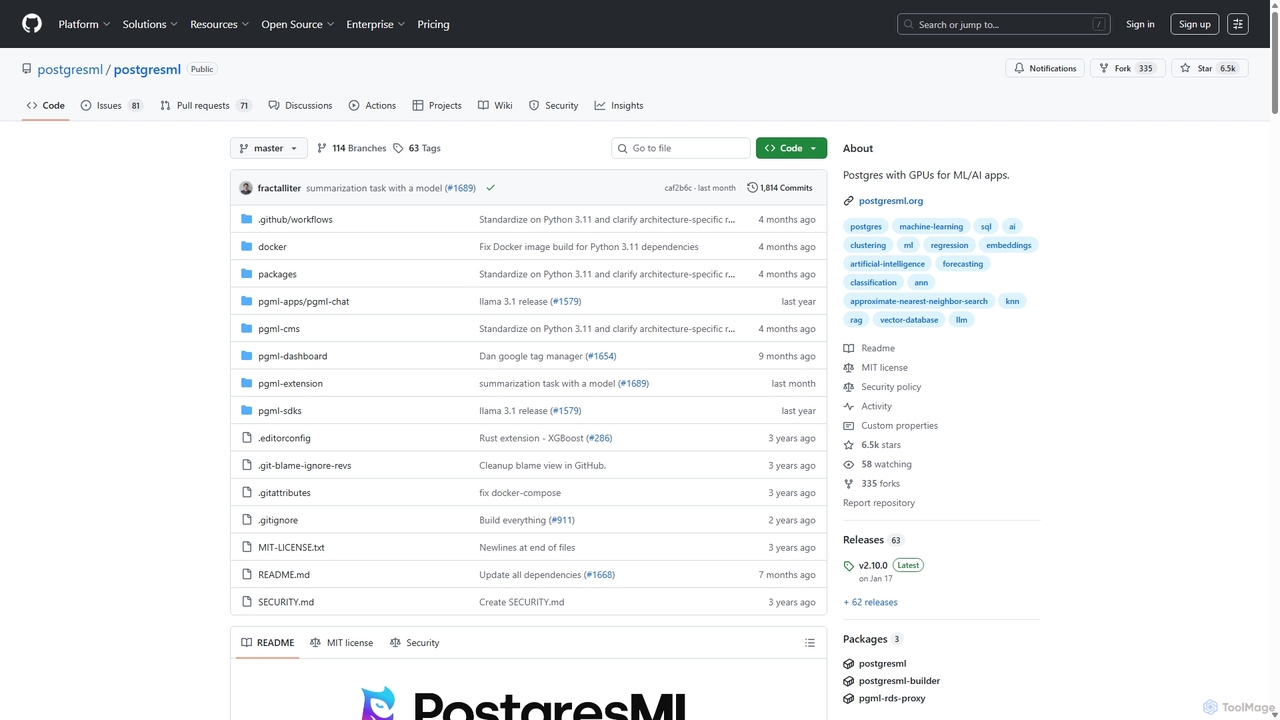
PostgresML is a powerful open-source extension that integrates machine learning and AI directly into your PostgreSQL database. It enables GPU-accelerated inference, vector search, and complete RAG pipelines using simple SQL commands, eliminating data movement and simplifying the MLOps stack for high-performance, scalable AI applications.
Compare product focus, pricing models and audiences. Highlighted rows indicate different listed information; unknown pricing does not mean free.
| Quick facts | MindsDB | PostgresML |
|---|---|---|
| Pricing model | Freemium | Freemium |
| Product type | Web | Web |
| Primary focus | Machine Learning | Mlops |
| Audience and roles | Business Intelligence Developer · Data Analyst · Database Administrator · Data Scientist · Machine Learning Engineer · Product Manager · Software Developer | AI Application Developer · Backend Engineer · Data Analyst · Database Administrator · Data Scientist · Machine Learning Engineer · Product Manager · Software Developer |
| Categories | Machine Learning · Database · Automation | Mlops · Vector Database · Database |
| Added | Sep 19, 2025 | Sep 1, 2025 |
| Updated | Nov 19, 2026 | Nov 19, 2026 |
Explore the listed product descriptions, features and workflows. Taxonomy labels alone are not feature evaluations.
MindsDB is a revolutionary open-source platform that functions as an AI layer on top of existing databases and data sources. It empowers developers, data analysts, and data scientists to bring the power of machine learning and generative AI directly into their data environment using standard SQL commands. The core philosophy of MindsDB revolves around three key capabilities: Connect, Unify, and Respond, creating a seamless workflow from raw data to intelligent, actionable insights without ever moving the data from its source.
Getting started with MindsDB is a straightforward process designed for data professionals:
CREATE DATABASE. You can connect to a vast range of sources, including SQL databases (like MySQL, PostgreSQL, Snowflake), NoSQL databases (MongoDB), applications (Salesforce, Slack, GitHub), and vector stores.CREATE KNOWLEDGE_BASE and then INSERT INTO to populate it with data from your connected sources.CREATE AGENT, you can link a powerful language model (like GPT-4o) to your knowledge bases and tables. Then, you can ask complex questions in natural language using a simple SELECT statement, for example: SELECT * FROM my_agent WHERE question = 'What were our top 5 most profitable products last quarter?';MindsDB is versatile and can be applied to numerous scenarios:
The primary advantage of MindsDB is its ability to bring AI to where the data lives. This approach eliminates complex, costly, and slow ETL processes traditionally required for machine learning projects. By using SQL as the main interface, it significantly lowers the barrier to entry, allowing a much broader audience of developers and analysts to build AI-powered applications. Its open-source nature ensures no vendor lock-in and provides a vibrant community for support and innovation. Furthermore, by keeping data in its original location, MindsDB enhances security and ensures that AI models always operate on the most up-to-date information.
MindsDB operates on a freemium model. The core platform is open-source and completely free to download, self-host, and use without limitations. For users who prefer a managed solution, MindsDB offers a Cloud version with various pricing tiers, including a free tier for getting started and paid plans for more demanding workloads. They also provide custom Enterprise plans for large organizations requiring dedicated support, enhanced security features, and private cloud deployments.
PostgresML is a transformative open-source extension that brings machine learning and AI capabilities directly into the PostgreSQL database. By embedding models and algorithms within the data layer, it fundamentally changes how AI applications are built. The core philosophy is that it's more efficient, manageable, and reliable to move models to the data, rather than constantly moving large, dynamic datasets to the models. This approach eliminates complex data pipelines, reduces latency, and enhances security.
PostgresML turns your existing database into a full-featured AI platform. It supports a wide range of functionalities, from traditional machine learning models like classification and regression to cutting-edge deep learning applications involving Large Language Models (LLMs) and vector search. By leveraging the power of GPUs, it accelerates computations and model inference, making real-time AI feasible for high-throughput systems.
Getting started with PostgresML is designed to be straightforward, with options for both cloud and self-hosted environments.
docker run -it -v postgresml_data:/var/lib/postgresql -p 5433:5432 -p 8000:8000 ghcr.io/postgresml/postgresml:latest.pgml.train()), make predictions (e.g., pgml.predict()), and execute complex AI pipelines. For example, generating text embeddings is as simple as calling the pgml.embed() function on a text column.pgml.chunk for text splitting, pgml.embed for generating vector embeddings, pgml.rank for re-ranking results, and pgml.transform for text generation.PostgresML is ideal for developers and data scientists building a new generation of AI-powered applications.
The primary advantage of PostgresML is its architectural simplicity and efficiency.
PostgresML operates on a freemium model, offering flexibility for different needs.
Their taxonomy shows where the products overlap and where each one has a more distinct focus. Unknown fields are shown explicitly and are never filled with assumptions.
Traffic is shown on the same scale so differences in market visibility are not visually understated.
Both charts share the same months and vertical scale. Each tool identifies its latest reporting month; missing months are left blank, not counted as zero. Regional and source visit counts are estimates calculated from the reported shares.
| Country/region | Percentage | Estimated visits |
|---|---|---|
| 🇮🇳India | 29.21% | 1.2K |
| 🇺🇸United States | 28.84% | 1.2K |
| 🇧🇷Brazil | 20.6% | 856 |
| 🇫🇷France | 15.55% | 646 |
| 🇭🇰Hong Kong | 5.8% | 241 |
No data available
Ratings, comments, favorites, and likes are community signals—not a substitute for product fit.
This page is assembled from ToolMage product listings, taxonomy, traffic statistics and on-site user feedback. It is not a hands-on test or an independent review.