
Actcast
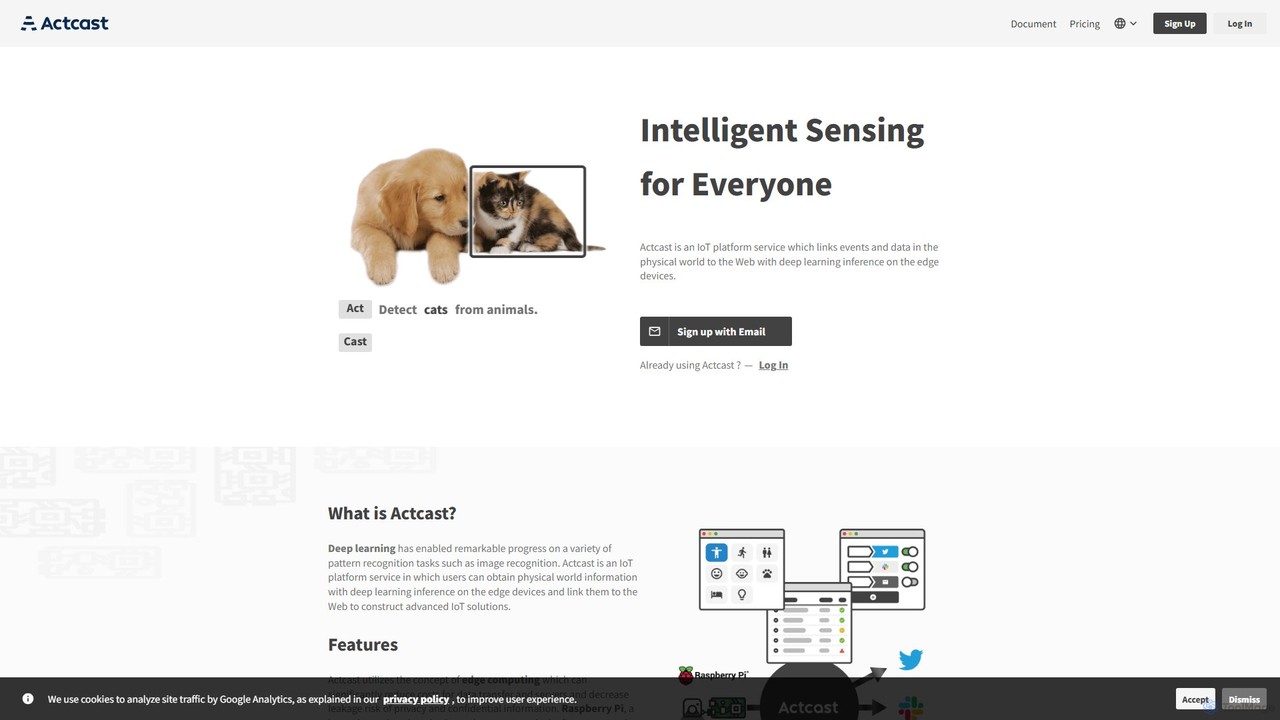
Actcast is an IoT platform service that enables developers to deploy deep learning models on edge devices like …
Actcast is an IoT platform service that enables developers to deploy deep learning models on edge devices like Raspberry Pi. It connects physical world events to web services through on-device AI inference, focusing on edge computing to reduce costs, lower latency, and enhance data privacy.
About Edge Computing
Edge Computing refers to a distributed computing paradigm that brings computation and data storage closer to the sources of data. This approach minimizes latency and bandwidth usage by processing data at the 'edge' of the network, rather than sending it to a centralized cloud or data center. It is crucial for real-time AI applications, enabling faster insights and immediate actions in environments like IoT, autonomous vehicles, and smart factories. As a specialized component within the broader AI Platform ecosystem, Edge Computing significantly enhances the efficiency and responsiveness of AI deployments.
Core Features
- Low Latency Processing: Data is processed near its source, drastically reducing response times for critical applications.
- Enhanced Security: Local data processing minimizes data transmission over networks, reducing exposure to security risks.
- Bandwidth Optimization: Reduces the volume of data sent to the cloud, conserving network resources and costs.
- Real-time Analytics: Supports immediate data analysis and decision-making for time-sensitive AI tasks.
- Offline Capabilities: Edge devices can continue operations and data processing even with intermittent or no cloud connectivity.
Use Cases
Edge Computing is vital for industries requiring instant data processing and decision-making. It is used by manufacturing engineers for real-time anomaly detection in industrial IoT, by automotive developers for autonomous vehicle navigation, and by smart city planners for immediate traffic management and public safety applications.
How to Choose
When selecting Edge Computing solutions, consider hardware compatibility with existing devices, the scalability to manage a growing number of edge nodes, and robust security features for local data protection. Also, evaluate its integration capabilities with your existing cloud AI platforms for seamless data synchronization and model deployment.
Edge ComputingUse Cases
Industrial IoT Anomaly Detection
A Factory Operations Manager needs to monitor machinery for faults in real-time to prevent costly downtime. By deploying AI models on edge devices directly on the factory floor, sensor data is analyzed instantly, identifying anomalies without sending all raw data to the cloud. This enables predictive maintenance and immediate intervention, significantly improving operational efficiency and reducing unexpected stoppages.
Autonomous Vehicle Real-time Decision Making
Automotive Engineers need to enable vehicles to react instantly to changing road conditions for safety. Onboard AI systems, powered by Edge Computing, process camera, radar, and lidar data locally within milliseconds. This allows for split-second decisions regarding navigation, obstacle avoidance, and emergency braking, significantly enhancing the safety and reliability of self-driving cars in dynamic environments.
Smart Retail Customer Experience Optimization
A Retail Store Manager aims to analyze in-store customer behavior and personalize experiences while respecting privacy. AI-powered cameras and sensors at the edge process anonymized customer movement and interaction data locally. This provides real-time insights for dynamic display adjustments or personalized offers, improving customer engagement and sales conversion without transmitting sensitive data to the cloud.
Remote Healthcare Monitoring & Alerting
Healthcare Providers need to continuously monitor vital signs of patients in remote or home settings. Wearable devices or local gateways with AI capabilities, leveraging Edge Computing, process patient data at the source. They detect critical changes and send immediate alerts to caregivers, even with limited internet connectivity, enabling proactive intervention and reducing hospital readmissions by providing timely care.
Smart City Traffic Management
Urban Planners and Traffic Engineers aim to optimize traffic flow and respond to incidents in real-time. AI cameras and sensors at intersections, powered by Edge Computing, process traffic data locally. This allows for dynamic adjustment of signal timings or immediate identification of accidents, reducing congestion and improving response times for emergency services, thereby enhancing urban mobility and public safety.
Agricultural Precision Farming
Farmers and Agronomists need to monitor crop health and environmental conditions for optimized yield. Drones or ground sensors with AI capabilities, utilizing Edge Computing, analyze images and environmental data directly in the field. This enables immediate detection of pests, diseases, or nutrient deficiencies, and recommends instant actions, maximizing crop yield, minimizing resource waste, and reducing environmental impact.