Metatable
Metatable is an AI-first development platform that enables rapid creation and deployment of web and mobile applications. It …
Metatable is an AI-first development platform that enables rapid creation and deployment of web and mobile applications. It streamlines the entire software development lifecycle, from idea to launch, by leveraging AI to generate code, manage infrastructure, and automate complex tasks, allowing users to build MVPs in minutes.
LiveAvatar
LiveAvatar provides a business-ready API for integrating hyper-realistic, real-time, lip-synced AI avatars into any product. Enhance user engagement …
LiveAvatar provides a business-ready API for integrating hyper-realistic, real-time, lip-synced AI avatars into any product. Enhance user engagement with lifelike conversational interfaces for customer support, language learning, sales training, and more. Create custom avatars with just two minutes of footage or choose from a diverse library.
Amarsia
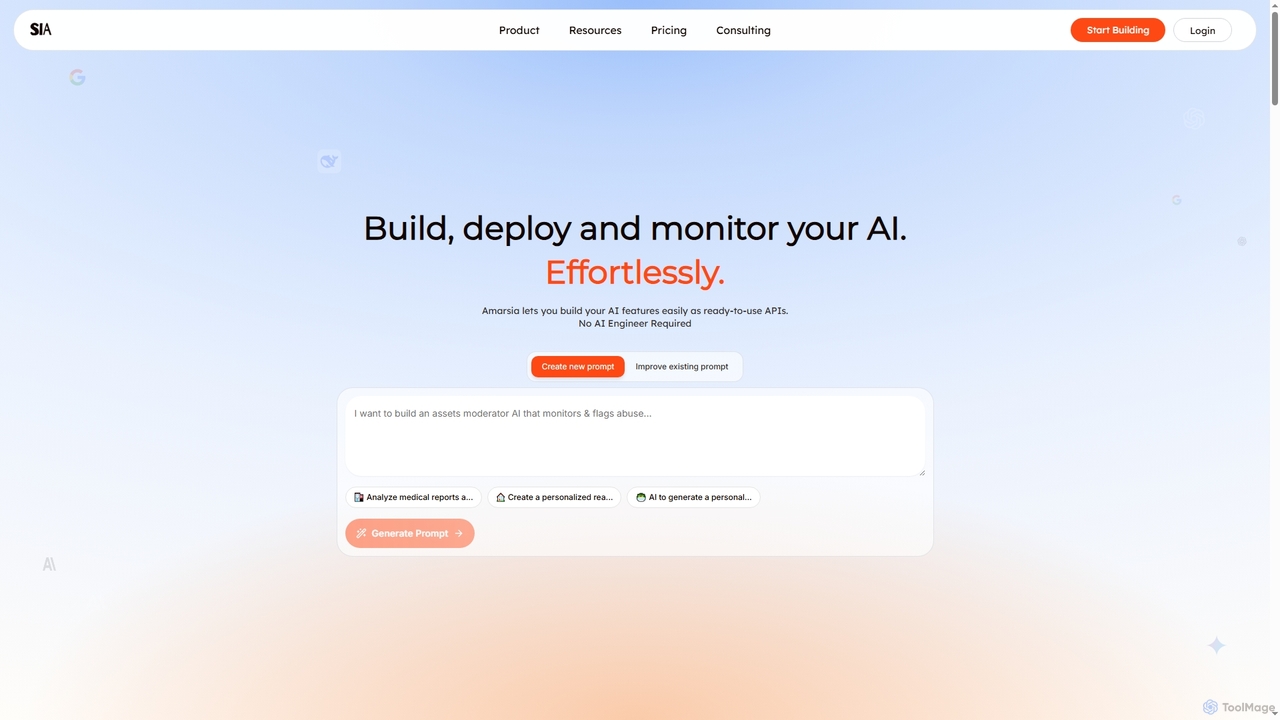
Amarsia is an intuitive platform designed to help teams effortlessly build, deploy, and monitor custom AI features as …
Amarsia is an intuitive platform designed to help teams effortlessly build, deploy, and monitor custom AI features as ready-to-use APIs. It eliminates the need for extensive coding or AI engineering expertise, enabling rapid development of intelligent workflows, knowledge bases, and multimodal AI solutions with built-in version control and performance monitoring.
Morph
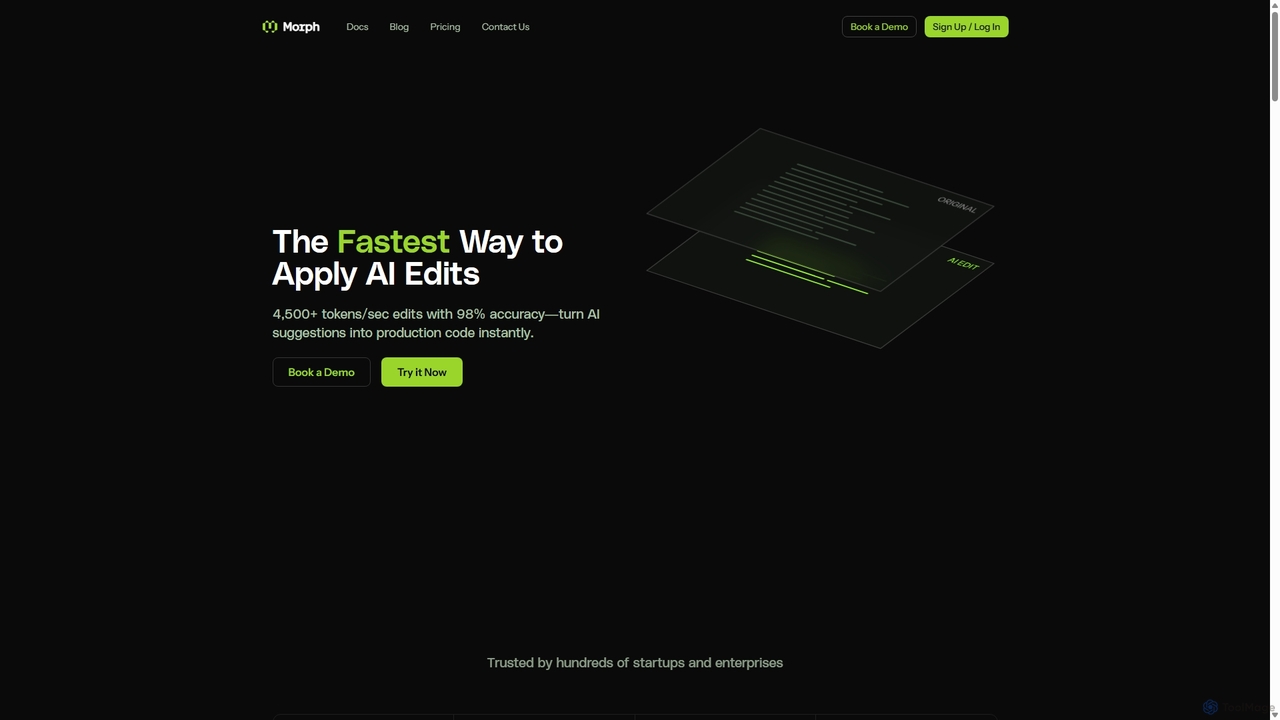
Morph is an API-first platform for developers, providing the fastest and most accurate way to apply AI-generated edits …
Morph is an API-first platform for developers, providing the fastest and most accurate way to apply AI-generated edits to code and files. With speeds of 4,500+ tokens/sec and 98% accuracy, it empowers AI agents to perform reliable, semantic modifications, bridging the gap between AI suggestions and production-ready implementation.
Deepdub
Deepdub is an AI-powered dubbing and localization platform that provides Hollywood-quality voice solutions for the media and entertainment …
Deepdub is an AI-powered dubbing and localization platform that provides Hollywood-quality voice solutions for the media and entertainment industry. It leverages proprietary eTTS™ and V2V technology to generate emotionally resonant and natural-sounding voices in over 130 languages, ensuring seamless global content adaptation with creative control and enterprise-grade security.
ManagePrompt
A developer platform to rapidly build, deploy, and manage AI-powered applications. ManagePrompt handles backend complexities like multi-model integration, …
A developer platform to rapidly build, deploy, and manage AI-powered applications. ManagePrompt handles backend complexities like multi-model integration, testing, security, and scaling, allowing you to launch in minutes, not months.
earth
earth by Atmo is an advanced AI-powered global weather forecasting model. It provides highly accurate, high-resolution forecasts for …
earth by Atmo is an advanced AI-powered global weather forecasting model. It provides highly accurate, high-resolution forecasts for temperature, rain, and wind, visualized on an interactive global map. Designed for both public use and professional integration via API, it offers a modern alternative to traditional weather prediction methods.
CustomJS
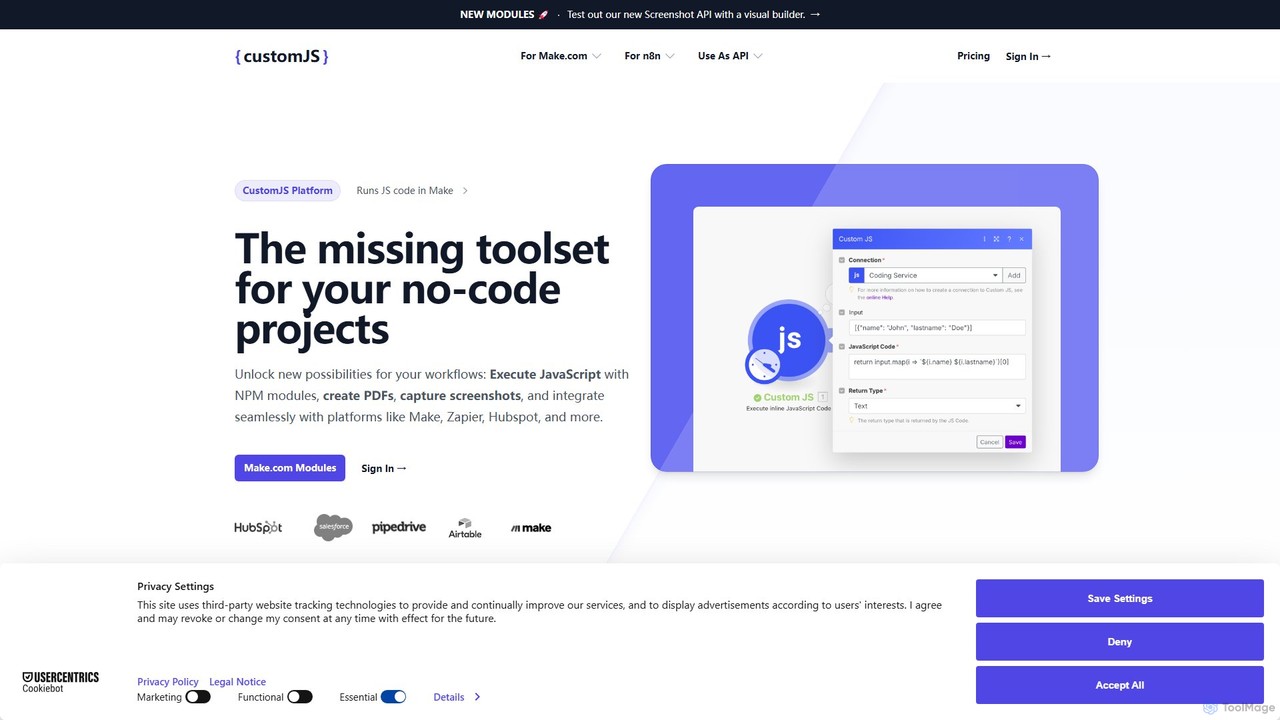
CustomJS is a powerful platform that bridges the gap between no-code and custom development. It allows you to …
CustomJS is a powerful platform that bridges the gap between no-code and custom development. It allows you to execute JavaScript, use NPM modules, and integrate custom logic into your favorite automation platforms like Make, Zapier, and Airtable. Unlock advanced functionalities like PDF generation, web scraping, and API creation without managing your own servers.
About Api
API (Application Programming Interface) in the context of AI tools refers to a set of defined rules and protocols that allow different software applications to communicate with each other, specifically enabling programmatic access to powerful AI models and services. These APIs act as a bridge, allowing developers to integrate advanced AI capabilities like natural language processing, computer vision, and generative AI directly into their own applications, websites, or workflows without needing to build complex AI models from scratch. By leveraging AI APIs, businesses and developers can rapidly innovate, enhance user experiences, and automate intelligent tasks, significantly accelerating the development cycle and reducing operational costs.
Core Features
- Model Access: Provides direct programmatic access to pre-trained or custom AI models for various tasks.
- Data Handling: Manages input and output data formats, often supporting various data types like text, images, or audio.
- Authentication & Security: Ensures secure access to AI services through API keys, tokens, and robust security protocols.
- Scalability: Designed to handle varying loads, allowing applications to scale their AI usage as demand grows.
- Documentation & SDKs: Offers comprehensive guides and software development kits to facilitate easy integration and usage.
Applicable Scenarios
AI APIs are widely adopted across various industries and roles. Developers integrate them into custom applications, product managers enhance existing software with intelligent features, and data scientists leverage them for advanced analytics. Typical scenarios include building intelligent chatbots, automating content creation, powering recommendation engines, and enabling real-time language translation in global platforms.
How to Choose
When selecting an AI API, consider the specific AI task (e.g., text generation, image analysis), the quality and accuracy of the underlying AI model, and the ease of integration through clear documentation and SDKs. Evaluate pricing models, latency, scalability, and the level of technical support offered. Compatibility with your existing tech stack and data privacy policies are also crucial factors for a successful implementation.

ApiUse Cases
Automating Customer Support with AI Chatbots
Customer service teams can integrate a natural language processing (NLP) API to power intelligent chatbots on their websites or messaging platforms. By sending customer queries to the API, the chatbot can understand intent, retrieve relevant information from knowledge bases, and provide instant, accurate responses, handling common inquiries 24/7 and freeing up human agents for complex issues. This significantly reduces response times and improves customer satisfaction.
Enhancing E-commerce with Visual Search
Online retailers can leverage a computer vision API to implement visual search capabilities. Users can upload an image of a product they like, and the API processes the image to identify similar items within the store's catalog. This allows customers to find products more intuitively, improving discovery, reducing bounce rates, and potentially increasing sales by offering a novel and convenient shopping experience.
Generating Personalized Marketing Content at Scale
Marketing teams can utilize a generative AI API (like a large language model API) to create personalized marketing copy, email subject lines, or social media posts. By providing prompts and audience specifics, the API can generate multiple content variations tailored to different segments, enabling marketers to produce high volumes of engaging content quickly and efficiently, optimizing campaign performance and reach.
Transcribing Meetings and Calls for Business Intelligence
Businesses can integrate a speech-to-text API into their meeting platforms or call centers. The API converts spoken audio from meetings, customer calls, or interviews into accurate text transcripts in real-time or post-event. These transcripts can then be analyzed for keywords, sentiment, or action items, providing valuable insights for improving product development, sales strategies, and customer service training.
Implementing Real-time Language Translation for Global Communication
Global companies or platforms can use a machine translation API to enable real-time communication across different languages. Whether it's translating customer support chats, user-generated content, or internal documents, the API provides instant and accurate translations. This breaks down language barriers, fosters better international collaboration, and expands market reach by making services accessible to a wider, multilingual audience.
Analyzing Customer Feedback for Product Improvement
Product development teams can integrate a sentiment analysis API to process large volumes of customer feedback from reviews, surveys, and social media. The API automatically identifies the emotional tone (positive, negative, neutral) and extracts key themes. This allows teams to quickly gauge public perception, prioritize feature requests, identify pain points, and make data-driven decisions to improve products and services.