Apex.AI
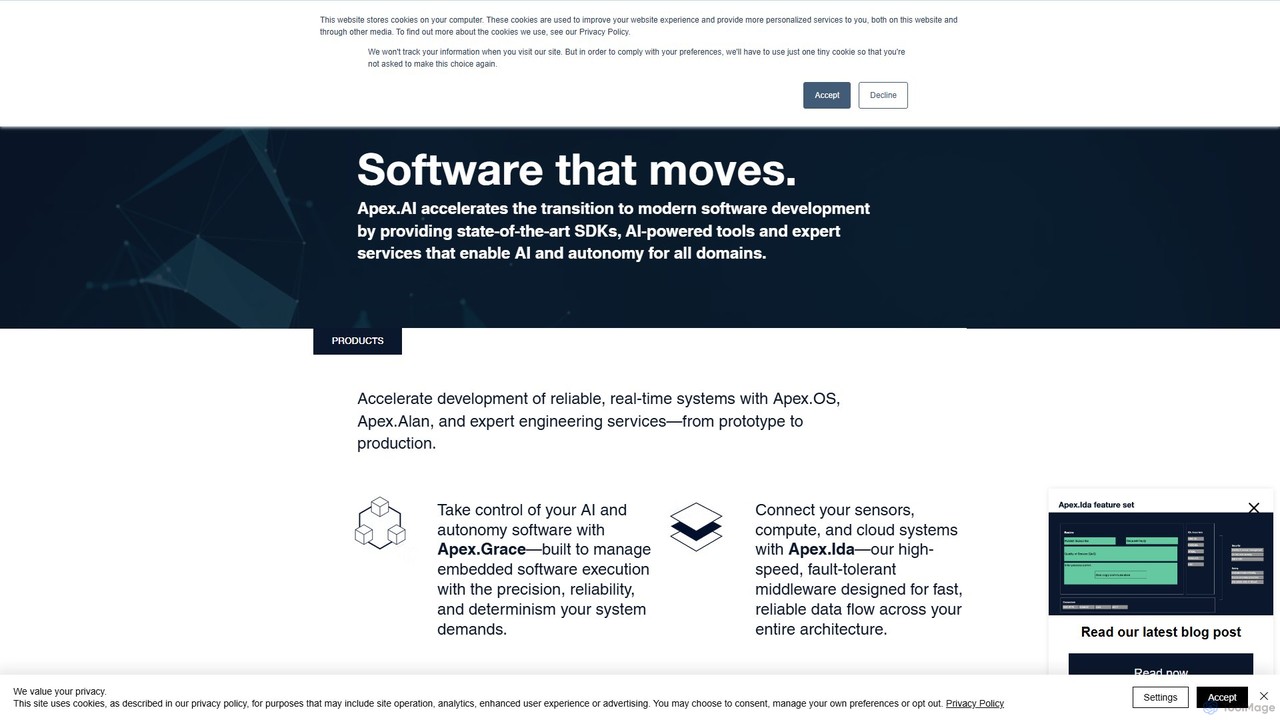
Apex.AI provides a comprehensive software development kit (SDK) and toolchain for building safe, certified, and reliable autonomous systems. …
Apex.AI provides a comprehensive software development kit (SDK) and toolchain for building safe, certified, and reliable autonomous systems. Designed for automotive, robotics, and industrial applications, it accelerates development from prototype to production with a real-time OS, middleware, and automated testing tools based on open standards like ROS 2.
About Adas
Adas (Advanced Driver-Assistance Systems) are AI-powered tools designed to enhance vehicle safety and improve the driving experience. These systems leverage a combination of sensors, cameras, radar, and AI algorithms to perceive the driving environment, make informed decisions, and assist the driver. Their primary value lies in reducing the likelihood of accidents, mitigating driver fatigue, and paving the way for future autonomous driving capabilities.
Core Features
- Perception Systems: Integrate data from cameras, radar, and lidar to accurately identify obstacles, lane markings, and traffic signs.
- Decision & Planning: AI algorithms process perceived data to plan optimal driving paths, speeds, and execute maneuvers like lane changes or braking.
- Execution & Control: Interface with the vehicle's steer-by-wire, brake-by-wire, and throttle systems for precise control actions.
- Human-Machine Interface (HMI): Provide timely warnings and clear information to the driver, ensuring safe intervention when necessary.
- Functional Safety & Redundancy: Implement robust designs and backup systems to ensure safe operation even in the event of component failures.
Applicable Scenarios
ADAS tools are widely adopted across various automotive applications. In passenger vehicles, they provide crucial safety enhancements like automatic emergency braking and adaptive cruise control, making daily commutes safer and more comfortable. For commercial fleet management, ADAS helps reduce driver fatigue-related accidents and optimize operational efficiency. Furthermore, these systems serve as foundational building blocks and testing platforms for the ongoing research and development of higher-level autonomous driving technologies (L3-L5).
How to Choose
When selecting ADAS tools or systems, consider the desired level of autonomy and the specific features offered, ranging from basic L1 assistance to more advanced L2+ capabilities like highway assist. Evaluate the sensor suite's configuration and its ability to fuse data from multiple sources (cameras, radar, lidar) for comprehensive environmental perception. Prioritize systems with high reliability, robust functional safety ratings, and proven performance in diverse weather conditions. Finally, assess the sophistication of the underlying AI algorithms and the potential for over-the-air (OTA) software updates to ensure future adaptability and performance improvements.

AdasUse Cases
Highway Driving Assist
For long-distance commuters or professional drivers, ADAS enables vehicles to automatically maintain speed, keep within the lane, and perform safe lane changes on highways. This significantly reduces driver fatigue and enhances safety during extended journeys, allowing for a more relaxed driving experience.
Urban Traffic Jam Assist
In stop-and-go city traffic, ADAS systems manage acceleration, braking, and steering to keep the vehicle at a safe distance from the car ahead. This feature alleviates the stress of constant pedal work in congested areas, providing a smoother and more comfortable urban driving experience.
Automated Parking Assistance
Drivers struggling with parallel or perpendicular parking can utilize ADAS for automated parking. The system identifies suitable parking spots and precisely maneuvers the vehicle into place, minimizing the risk of minor collisions and making parking effortless, especially in tight spaces.
Forward Collision Warning & Automatic Emergency Braking (AEB)
To prevent or mitigate frontal collisions, ADAS continuously monitors the road ahead. If a potential collision is detected and the driver doesn't react in time, the system issues warnings and can automatically apply the brakes, significantly enhancing occupant safety.
Lane Keeping Assist & Departure Warning
This ADAS function helps drivers stay centered in their lane and alerts them if the vehicle unintentionally drifts. It provides gentle steering corrections or haptic feedback, preventing accidents caused by momentary inattention or fatigue, particularly on monotonous roads.
Blind Spot Monitoring & Lane Change Assist
When changing lanes, ADAS uses sensors to detect vehicles in the driver's blind spots. It provides visual or audible warnings if a vehicle is present, and some advanced systems can even prevent a dangerous lane change, greatly improving safety during highway maneuvers.