
DeConsole
DeConsole is a distributed, persistent, and tamper-resistant database service designed for critical data, offering the simplicity of a …
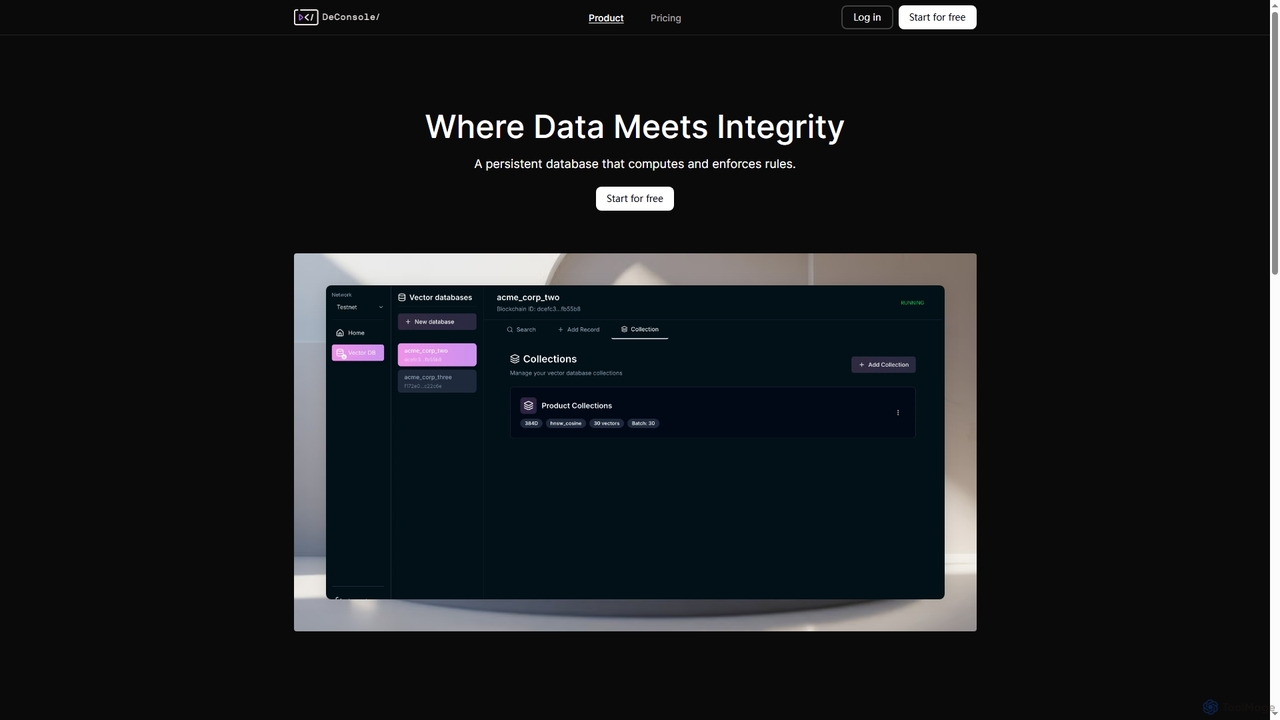
DeConsole is a distributed, persistent, and tamper-resistant database service designed for critical data, offering the simplicity of a cloud DBaaS without a single point of control. It computes and enforces rules, ensuring data integrity and providing a tamper-evident history for various applications, especially AI.
About Decentralized Data
Decentralized Data refers to information stored and managed across a distributed network, often leveraging blockchain technology, rather than on a single central server. This approach enhances data security, transparency, and user control by eliminating single points of failure and enabling verifiable, tamper-proof records. It forms a foundational layer for Web3 applications and digital economies, empowering users with greater data sovereignty.
Core Features
- Immutability: Once recorded, data cannot be altered or deleted, ensuring its long-term integrity and trustworthiness.
- Censorship Resistance: Data is not controlled by a single entity, making it resilient to arbitrary removal or blocking by authorities.
- Enhanced Security: Distributed storage and advanced cryptographic techniques protect data from breaches and unauthorized access.
- User Ownership & Control: Individuals retain greater sovereignty over their data, defining access permissions and usage rights.
- Transparency & Verifiability: Transactions and data changes are publicly auditable on the network, fostering trust and accountability.
Applicable Scenarios
Decentralized Data solutions are crucial for industries and applications where data integrity, transparency, and user control are paramount. This includes tracking goods in complex supply chains, managing digital identities, securing financial transactions in DeFi, and ensuring content ownership in Web3 media platforms.
How to Choose
When selecting Decentralized Data solutions, consider the underlying blockchain or distributed ledger technology's consensus mechanism for security and efficiency. Evaluate scalability and performance to meet data volume needs, assess data privacy features like encryption, and examine the ecosystem's developer support and integration capabilities for dApps.
Decentralized DataUse Cases
Securely Storing User Data for Decentralized Applications
Web3 application developers use decentralized data solutions to store sensitive user information, such as profile data or content, without relying on centralized servers. This ensures user privacy and data ownership, as data is encrypted and distributed across the network, making it resistant to single-point attacks or unauthorized access, thereby enhancing trust in the application.
Securing Supply Chain Traceability
Manufacturers use decentralized data solutions to record every step of a product's journey, from raw materials to delivery. This provides consumers with verifiable proof of authenticity and origin, while businesses gain immutable audit trails for compliance and quality control, reducing fraud and increasing trust across the entire supply chain ecosystem.
Creating and Managing Verifiable Digital Identities
Individuals and organizations leverage decentralized data to establish self-sovereign identities. Personal credentials (e.g., educational degrees, professional certifications) are stored as verifiable claims on decentralized networks, allowing users to control who accesses their data and prove their identity without revealing unnecessary personal information to third parties, streamlining verification processes.
Managing Self-Sovereign Digital Identities
Individuals leverage decentralized data to store and control their personal identity attributes (e.g., verifiable credentials, educational records) on a blockchain. They grant selective access to third parties without relying on central authorities, enhancing privacy, reducing the risk of identity theft, and empowering users with true ownership of their digital selves.
Archiving Critical Information with Censorship Resistance
Journalists, activists, and historical archives utilize decentralized storage networks to preserve important documents, media, and research data. By distributing content across numerous nodes globally, these solutions prevent data from being tampered with, deleted, or censored by any single entity, ensuring long-term availability and integrity of vital information for future generations.
Ensuring Immutable Archiving for Legal Documents
Law firms and government agencies utilize decentralized data storage to create tamper-proof archives of critical legal documents, contracts, and public records. This guarantees the long-term integrity and authenticity of information, simplifying audits, preventing disputes, and ensuring compliance with regulatory requirements for data retention and immutability.
Ensuring Data Integrity in Supply Chain Tracking
Businesses in supply chain management implement decentralized data to record and track product journeys from origin to consumer. Each step, from manufacturing to shipping, is logged immutably, providing a transparent and verifiable history of goods. This helps combat counterfeiting, improves traceability, and builds consumer trust by offering undeniable proof of product authenticity and ethical sourcing.
Enabling Decentralized Social Media & Content Platforms
Content creators and users on Web3 social platforms store their posts, interactions, and ownership metadata on decentralized networks. This prevents censorship, ensures content persistence, and allows creators to directly monetize their work without intermediaries, fostering true digital ownership and a more equitable creator economy.
Managing Governance Data for Decentralized Autonomous Organizations
DAOs rely on decentralized data to store critical governance information, including proposals, voting records, and treasury transactions. This ensures that all organizational decisions and financial movements are transparent, immutable, and accessible to all members. By preventing any single party from altering records, it upholds the principles of fairness and trustless operation essential for decentralized governance.
Facilitating Verifiable Research Data Sharing
Researchers employ decentralized data systems to share scientific data sets securely and transparently, ensuring data integrity and provenance. This allows for collaborative research, prevents data manipulation, and enables verifiable replication of experiments, accelerating scientific progress and fostering greater trust in research outcomes across institutions.
Facilitating Secure and Transparent Data Marketplaces
Data providers and consumers use decentralized data platforms to create secure marketplaces where data can be exchanged transparently and fairly. Data ownership is maintained, and transactions are recorded immutably, ensuring that data usage rights are respected and payments are processed securely. This fosters a new economy around data, empowering individuals and organizations to monetize their information ethically.
Powering Decentralized Autonomous Organizations (DAOs) Governance
DAOs store their governance proposals, voting records, and treasury management data on decentralized ledgers. This ensures transparency, immutability, and audibility of all organizational decisions, fostering trust and accountability among members, and enabling a truly democratic and resilient form of collective management without central intermediaries.